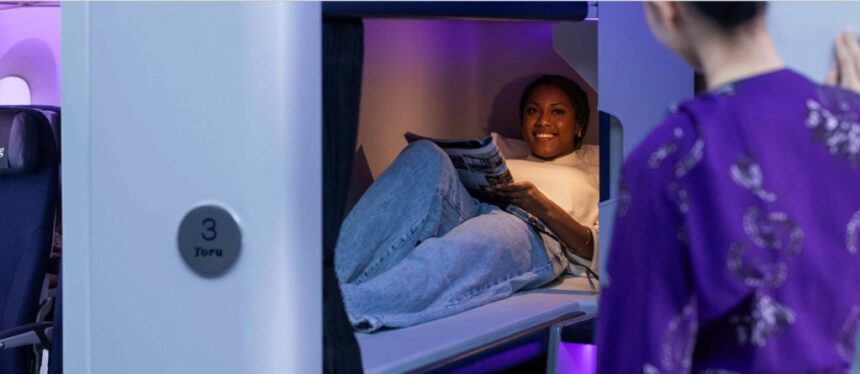
Sleeping on a plane may soon look very different. A new concept unveiled in the aviation industry is aiming to solve one of long-haul travel’s biggest problems—rest—by introducing actual bunk beds that passengers can book during a flight.
The idea marks a significant departure from traditional cabin design, where economy class has remained largely unchanged for decades. Instead of relying on upright seats, travelers could soon have the option to lie flat in dedicated sleep pods, even without upgrading to business class.
The concept was presented at the Aircraft Interiors Expo in Hamburg, one of the leading global showcases for aircraft cabin innovation. The project is being led by Air New Zealand, which has previously experimented with alternative seating concepts.
For the first time, economy passengers will have access to lie-flat sleeping options traditionally reserved for premium cabins.
How the In-Flight Bunk Beds Work
Unlike business class upgrades, the bunk beds will not replace standard seats. Instead, passengers will book access to sleeping pods for limited time slots, creating a hybrid model between seating and rest.
The setup includes six bunk beds arranged in two vertical stacks of three, located in a dedicated section of the aircraft cabin. Each pod is designed for rest rather than full-service luxury, with features such as:
- A mattress, pillow, and blanket
- Ambient lighting to support sleep cycles
- USB charging ports and reading lights
- Basic privacy curtains
Passengers will be able to reserve a bunk for approximately four hours per flight, after which the space is cleaned and made available to the next traveler.
As described by Andrew D’Amours, cofounder of Flytrippers:
“It’s not so much like upgrading your flight to a higher seat class, but more like booking time in a sleeping pod.”
Pricing and Availability

Access to the bunk beds is expected to cost around $495 USD for a four-hour session, on top of the regular ticket price. This pricing positions the product as a premium add-on rather than a budget-friendly solution.
The new feature will initially be introduced on long-haul routes operated by the airline’s Boeing 787-9 Dreamliner fleet, with the first flights planned between New York and Auckland starting in late 2026.
Bookings are expected to open in May, with demand likely driven by passengers seeking better rest on ultra-long-haul flights.
A Response to Changing Traveler Expectations
The introduction of bunk beds reflects a broader shift in passenger expectations, particularly on flights exceeding 12 hours. While premium cabins have long offered lie-flat seats, economy class has seen relatively little innovation in comparison.
By offering a paid sleep option, airlines are experimenting with modular comfort—allowing travelers to customize their experience without committing to a full upgrade.
However, industry observers note that the value proposition may be debated. Some travelers may prefer traditional upgrades using loyalty points or premium fares, while others may see the bunk beds as a practical way to rest without significantly increasing overall travel costs.
What This Means for the Future of Flying
The move signals a willingness among airlines to rethink cabin layouts and introduce new revenue streams, especially as long-haul travel demand continues to grow.
If successful, the concept could influence other carriers to adopt similar sleep-focused solutions in economy cabins.
For now, the idea of bunk beds at 35,000 feet remains a bold experiment—one that could either reshape economy travel or remain a niche offering for a specific segment of passengers seeking rest over luxury.