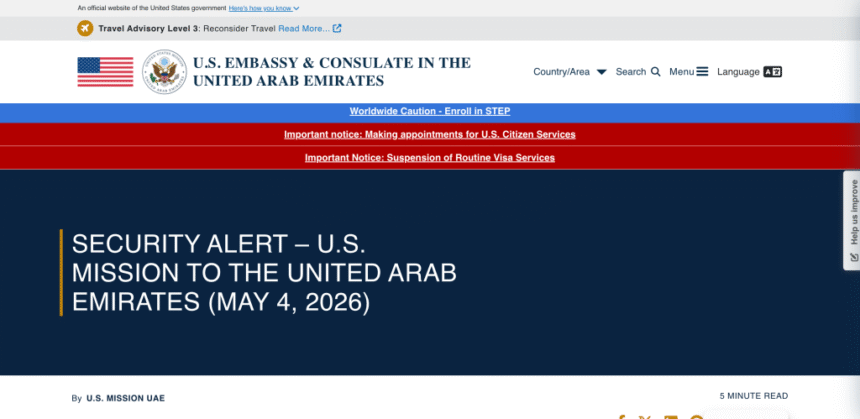
Americans in the United Arab Emirates woke this morning to one of the most serious travel alerts the US government has issued in the region in years. The US Embassy in Abu Dhabi published an official security alert on May 4, 2026, urging all American citizens in the UAE to prepare to take shelter and follow emergency instructions from local authorities immediately.
The alert was triggered by events on the night of May 4, when Iran fired missiles and drones at the major oil terminal of Fujairah — a strategically critical port on the UAE’s eastern coast that lies just beyond the mouth of the Strait of Hormuz. The UAE Ministry of Interior issued emergency push notifications directly to all mobile phones in the country warning of potential aerial threats, a measure reserved for imminent national security situations.
What the Embassy Said
The US Embassy confirmed in its official statement that it is now operating under ordered departure status — meaning non-emergency American government personnel and their family members have already been relocated outside the UAE. The Embassy and Consulate General remain physically open for urgent consular needs, but routine US visa services have been suspended indefinitely.
The travel advisory for the UAE currently stands at Level 3: Reconsider Travel — one level below the highest designation of Level 4: Do Not Travel.
“Our travel advisory for the UAE remains at Level 3: Reconsider Travel,” the Embassy stated. “The US Embassy and Consulate General remain open but on ordered departure status, meaning that non-emergency US government personnel have been relocated outside the UAE.”
Americans currently in the country are being advised to stay away from glass windows and doors, keep a supply of food, water and medications, maintain charged mobile phones programmed with the UAE emergency number 999, and register with the State Department’s Smart Traveler Enrollment Program at travel.state.gov to receive live security updates.
The Broader Context
The Fujairah attack represents a significant escalation in a conflict that has been reshaping global travel since late February, when US and Israeli strikes on Iran triggered the closure of the Strait of Hormuz. Fujairah is not located inside the Strait itself but serves as a critical bypass terminal — one of the primary points through which oil tankers reroute to avoid Hormuz entirely. Striking it signals a deliberate attempt to close off the alternative route as well.
Since President Trump launched “Project Freedom” — a US Navy operation to escort commercial shipping through the Strait — multiple vessels have been hit, including a South Korean cargo ship. US gas prices reached $4.46 per gallon on May 5, the highest level in nearly four years, and analysts warn that prices could reach $5 per gallon if the Strait remains closed through summer.
Impact on Travelers
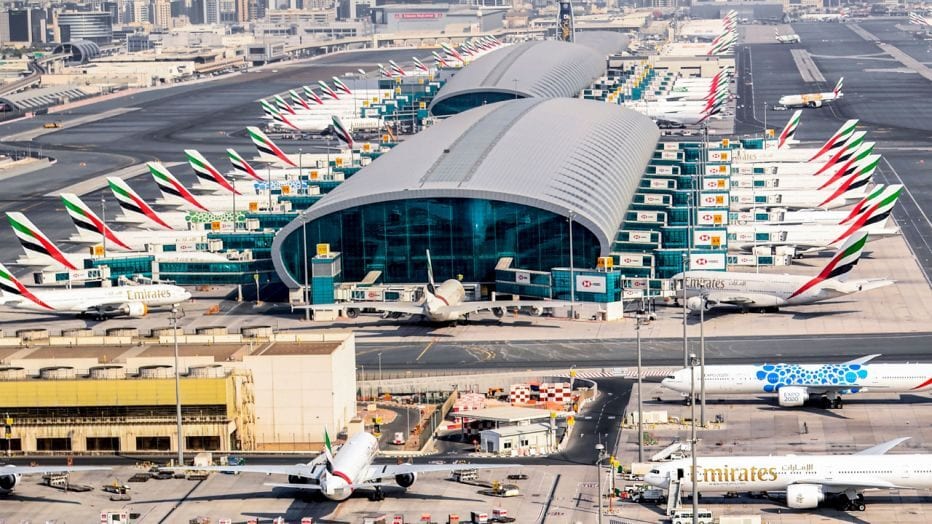
For the millions of travelers who use Dubai as a connecting hub between Europe, Asia and the Americas, the situation has already created severe disruption. Dubai International Airport — the world’s busiest international hub — has been operating at dramatically reduced capacity since April, with foreign airlines capped at one flight per day to Dubai under a UAE government emergency measure that runs until at least May 31.
British Airways, Lufthansa, KLM and Singapore Airlines have all suspended Dubai services until the end of May or beyond. For travelers with onward connections through Dubai, airlines are advising rebooking via alternative hubs including Doha, Singapore, Bangkok and Frankfurt.
Anyone with planned travel to the UAE in the coming weeks is strongly advised to contact their airline and travel insurer immediately, monitor State Department advisories at travel.state.gov, and avoid non-essential travel to the region until the security situation stabilizes.
Sources: US Embassy Abu Dhabi, Security Alert May 5, 2026 · CNN, “Day 66 of Middle East Conflict,” May 5, 2026