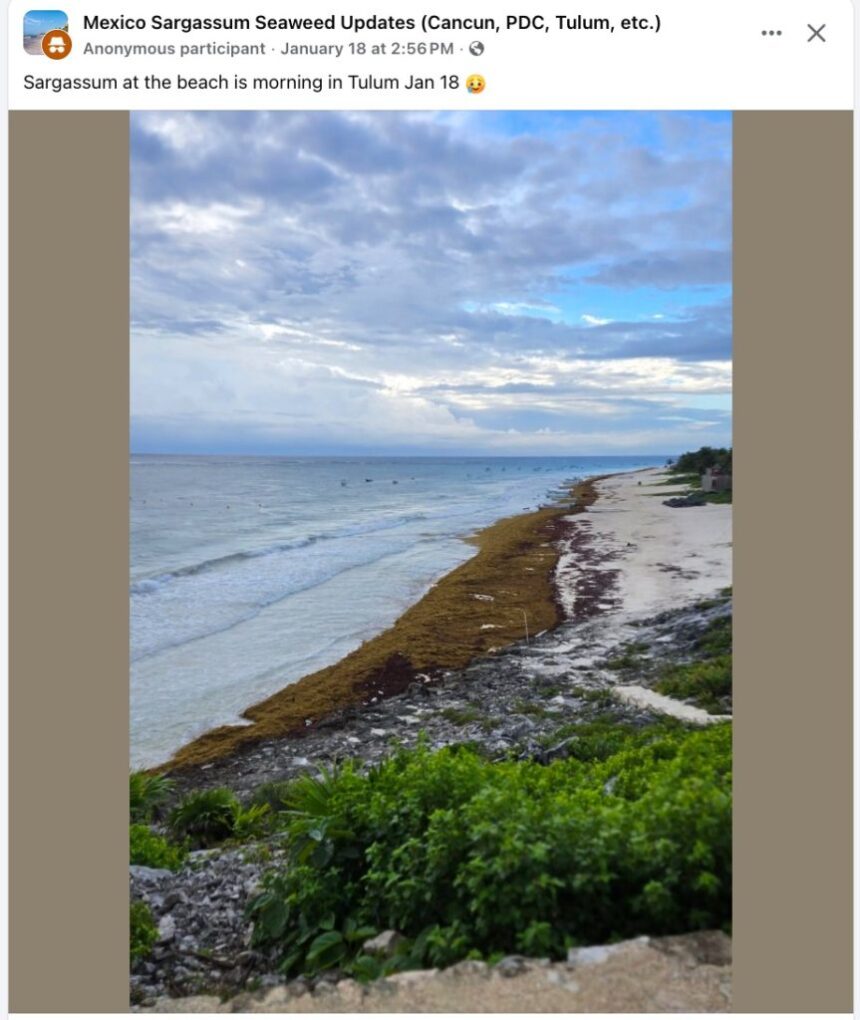
The Mexican Caribbean is once again bracing for a potentially severe invasion of sargassum.
As reported by Mexico News Daily, satellite imagery from the Optical Oceanography Laboratory of the University of Florida has detected around 7 million tons of seaweed currently drifting from the Atlantic toward the Gulf of Mexico and Caribbean.
The unusual early arrival and sheer volume of the floating macroalgae are raising concerns among environmental experts, tourism authorities, and local communities along the coast of Quintana Roo.
Early Arrival Raises Red Flags
In past years, sargassum has typically arrived on the shores of Mexico between April and May.
However, this year, FB photo reports show the yellowish-brown seaweed has made an early appearance on select beaches in Xcalak, Mahahual, Cozumel, Tulum, Puerto Morelos, and Playa del Carmen, prompting local authorities to prepare for what could be another intense year.

“This season is expected to be just as intense as 2025,” said Esteban Jesús Amaro Mauricio, head of the Sargassum Monitoring Network in Quintana Roo. “Although we are only seeing the first signs now, the scale of what is coming is unprecedented.”
Last year, over 73,000 tonnes of sargassum were collected from beaches in the region, severely impacting local tourism and coastal ecosystems.
7 Million Tons: Not a Solid Mass, But Still a Threat
While the figure of 7 million tons may sound alarming, scientists emphasize that it does not represent one massive patch. According to Amaro, the macroalgae are dispersed in large floating patches, which are difficult to detect due to heavy cloud cover caused by a recent cold front.
“Satellite images show extensive but scattered formations of sargassum,” Amaro explained. “These large patches pose serious environmental and economic challenges once they begin to make landfall.”
Key Beaches at Risk
The Gulf and Caribbean Oceanographic Institute of the Mexican Navy has identified Puerto Morelos and Playa del Carmen as likely hotspots for significant sargassum accumulation.
In a bulletin issued on January 10, the institute projected that the largest cluster currently weighs approximately 85 tonnes, which could severely affect these beaches within days.
Economic and Environmental Costs

Each year, hotels and local governments in the region spend an estimated US $150 million to combat the sargassum crisis, covering everything from manual beach cleanups to sea barriers and offshore containment.
Beyond the economic burden, the seaweed poses health risks. Once it washes ashore and begins to decompose, sargassum emits hydrogen sulfide, a gas with a strong odor similar to rotten eggs.
Prolonged exposure can irritate the eyes and respiratory system, particularly for vulnerable individuals such as children and the elderly.
A Broader Marine Challenge
Despite its problematic presence on land, sargassum plays an important ecological role in the ocean. Floating in the Atlantic, it serves as a nursery and habitat for marine life, including fish, turtles, and birds. However, its migration toward the coast disrupts these ecosystems and overwhelms coastal areas ill-equipped to manage the volume.
In response to the crisis, Mexican authorities in 2025 declared sargassum a national fishing resource, allowing specially equipped vessels to harvest the seaweed at sea before it reaches the coast. This decision marked a shift in strategy, moving beyond reactive cleanup to proactive management.
Ongoing Monitoring and Regional Cooperation
The Sargassum Monitoring Network and scientific institutions such as the University of South Florida’s Optical Oceanography Lab continue to track sargassum movements in real-time using satellite technology. Forecasts are updated weekly to assist authorities and beachside businesses in planning mitigation efforts.
Meanwhile, local residents, environmental groups, and business owners are calling for increased federal support, better waste management infrastructure, and sustainable tourism practices to reduce the long-term impact of sargassum on Mexico’s Caribbean coast.
As the 2026 sargassum season begins far earlier than expected, it is clear that the battle against this invasive seaweed will require greater coordination between scientists, the private sector, and government agencies—both local and international.