5 sheriff’s deputies in Colorado have been reprimanded over the usage of an encrypted group chat with state, native and federal workers that violated state legislation. A type of deputies can be being sued by the state lawyer common.
The results comply with the conclusion of an inside investigation into the involvement of the Mesa County Sheriff’s Workplace (MCSO) within the high-profile detainment of Caroline Dias-Goncalves, a 19-year-old school scholar, in June. It discovered that the members of the group chat, which was on an encrypted messaging app known as Sign, utilized it to collaborate on immigration-related arrests.
Immigration officers arrested and detained Dias-Goncalves after a sheriff’s deputy pulled her over throughout a short visitors cease in June. The deputy offered the members of the chat with an image of her driver’s license, an outline of her automobile and details about which course she was heading previous to immigration officers pulling her over and detaining her moments after.
A number of MCSO deputies had been within the group chat with federal workers — together with those that labored for Homeland Safety Investigations, Immigration and Customs Enforcement and the Drug Enforcement Company. The chat additionally included Colorado State Patrol and some different native legislation enforcement businesses.
The information comes because the Trump administration continues to implement its mass deportation and anti-immigration agenda, which has largely been met with resistance from group members, organizers, lawmakers and attorneys throughout the nation.
What occurred to Caroline Dias-Goncalves?
Caroline Dias-Goncalves is a 19-year-old scholar on the College of Utah. She was born in Brazil and dropped at the U.S. by her household when she was a baby on a visa that has since expired.
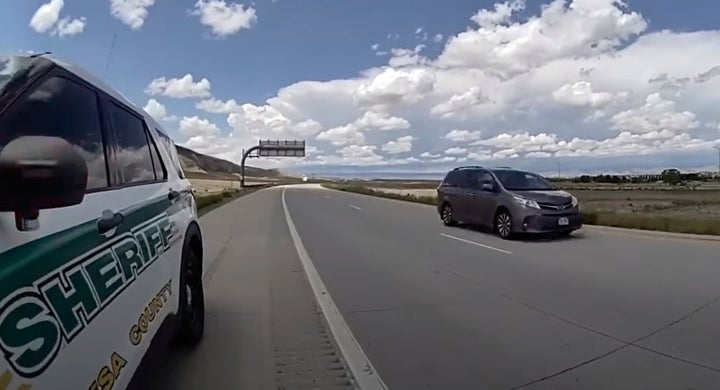
On June 5, MCSO Investigator Alexander Zwinck pulled her over whereas she was driving towards Denver on Interstate 70 outdoors of a Colorado city known as Loma.
Throughout a visitors cease that lasted below 20 minutes, Zwinck claimed she was driving too near a tractor-trailer.
Body camera footage of the interplay reveals that Zwinck requested Dias-Goncalves the place she was from as a result of she had a “little little bit of an accent.” She advised him she was from Utah, to which he responded by asking if she was “born and raised” there.
She then advised him she was born in Brazil.
“Oh, that’s cool,” Zwinck mentioned, earlier than letting her go.
When she exited the freeway, Immigration and Customs Enforcement brokers then pulled her over, arrested her and positioned her in ICE detention.
“She has no prison report and she or he was not proven a warrant,” her lawyer, Jon Hyman, advised NBC News on the time in an e mail.
Because it seems, when Zwinck pulled over Dias-Goncalves, he despatched an image of her driver’s license to the Sign chat searching for details about her, the investigation revealed. His message prompted the federal brokers to go to his location. Nonetheless, he had already let Dias-Goncalves go. Zwinck offered the chat with an outline of her automobile and the course she was heading, which helped the brokers find and arrest her.
The Investigation’s Findings
Zwinck’s actions seem to defy Colorado state legislation, particularly Senate Invoice 25-276 and 21-131.
Colorado Senate Bill 25-276, handed lower than two weeks earlier than Dias Goncalves’ detainment, prohibits coordination between state legislation enforcement, comparable to MCSO, and federal legislation enforcement, together with HSI and ICE. Additional, SB 21-131 restricts state businesses from sharing private figuring out info with immigration officers until there’s a court docket order or a requirement of federal or state legislation.
“The chat group was reportedly initially set as much as facilitate communication and cooperation” amongst drug interdiction officers within the space, wrote Artwork Smith, operations division chief, in a memo to Undersheriff Matt King. Nonetheless, the makes use of of the chat appear to have expanded past that, as evidenced by the just about instant arrest of Dias-Goncalves after her visitors cease.
There have been 18 members within the sign group chat, in keeping with a abstract of the investigation. Whereas a few of the names had been redacted, the group chat listed the next members: three MCSO deputies — together with Zwinck, Erik Olson and Joshua Ray — 5 Colorado State Patrol officers, six or seven folks with Homeland Safety Investigations, one particular person from the Eagle County Sheriff’s Workplace, one from the Vail Police Division and an individual with the Drug Enforcement Company.
It’s unclear to JS how usually this chat was used, in addition to what number of others might have been detained equally to Dias-Goncalves.
”Based mostly on our findings, the Mesa County Sheriff’s Workplace mustn’t have had any function within the chain of occasions resulting in Miss Dias-Goncalves’s detention, and I remorse that this occurred. I apologize to Miss Dias-Goncalves,” Sheriff Todd Rowell mentioned in a prolonged statement on Wednesday.
He additionally known as on HSI to launch all the messages within the Sign chat.
Colorado State Patrol Chief Matthew C. Packard additionally launched a press release on Wednesday, claiming that the patrol has stopped utilizing the chat “attributable to an obvious lack of shared goal.”
“This incident involving Caroline Dias-Goncalves, Mesa County Sheriff Deputy Alexander Zwinck, and Immigration and Customs Enforcement (ICE) prompted the Patrol to reevaluate its use of the Sign group chat attributable to an obvious lack of shared goal amongst all businesses on the platform,” Packard mentioned. “For the Patrol, our use was for operations concentrating on the fight of drug trafficking and arranged crime; different organizations might have totally different priorities and targets. As of June 18, 2025, the Patrol now not shares info on this chat.”
The Colorado State Patrol didn’t present additional remark.
Because of the investigation, Zwinck has been positioned on three weeks of unpaid depart, in keeping with Rowell.
4 others have additionally been disciplined because of the investigation: Deputy Erik Olson was positioned on two weeks of unpaid depart. He’s additionally being dismissed from the Western Colorado Drug Job Power (WCDTF) and reassigned to patrol.
Sgt. Joe LeMoine, the direct supervisor of Zwinck and Olson, will probably be suspended with out pay for 2 days on dates of his selecting. LeMoine’s punishment comes because of not being “moderately conscious” of his subordinates’ actions and for not adequately complying together with his supervisor’s directions.
Lt. David Holdren, LeMoine’s supervisor, was given a “letter of reprimand,” which is about to stay in his personnel file completely. The letter faults Holdren for Zwinck and Olson’s violations as a result of he was directed to make sure that people below him don’t coordinate with federal legislation enforcement on immigration issues, per the letter.
Lastly, Captain Curtis Brammer, Holdren’s supervisor, acquired verbal counseling, which was documented, over the problems.
Ray was not reprimanded, because the investigation discovered that he didn’t take part within the chat aside from a earlier, unrelated operation months prior. He then muted the chat and claimed to be unaware of its goal.
MCSO declined JS’s request for additional remark. JS additionally reached out to ICE, the DEA, the Division of Homeland Safety, the Eagle County Sheriff’s Workplace, and the Vail Police Division, however didn’t instantly hear again.
On prime of his unpaid depart, Zwinck is now being sued by the Colorado AG.
Colorado Legal professional Normal Phil Weiser filed a lawsuit towards Zwinck on July 22 for his function in Dias-Goncalves’ ICE detainment. He additionally accused Zwinck of taking related actions within the group chat earlier than her arrest.
“Colorado legislation clearly directs that our restricted state sources go to implementing Colorado prison legal guidelines and never be diverted to immigration enforcement,” Weiser mentioned at a Denver news conference concerning the matter. “The legislature specified that such actions can undermine public belief and in addition deter folks from accessing the companies supplied by state businesses and political subdivisions.”
“The deputy knowingly acted to help federal immigration officers in immigration enforcement after the deputy knew that the motive force wasn’t concerned in any prison exercise and had no excellent warrants,” Weiser mentioned. “After they took her into custody, the deputy recommended the immigration officers, saying, ‘Good work.’”

Hyoung Chang through Getty Photos
Sheriff Rowell argued that the case towards Zwinck ought to be dropped since he’s already being punished. In any other case, every of the people concerned within the chat ought to be sued, he reasoned.
“I ask that Legal professional Normal Weiser apply the legislation equally to all legislation enforcement and authorities officers as a substitute of creating Deputy Zwinck an instance. This would come with submitting lawsuits and internet hosting press conferences for every state and native legislation enforcement officer within the group chat and different authorities officers who’ve violated SB 21-131 and SB 25-276,” Rowell mentioned in his Wednesday assertion.
“Because it stands, the lawsuit filed by the Legal professional Normal’s Workplace sends a demoralizing message to legislation enforcement officers throughout Colorado — that the legislation could also be wielded selectively and publicly for optimum political impact slightly than utilized pretty and persistently,” Rowell continued.
A spokesperson for the Legal professional Normal’s Workplace doubled down on the lawsuit in a response to Rowell’s assertion.
“The lawyer common was introduced with details that confirmed blatant violations of state legislation. Because the lawyer common mentioned final week, different legislation enforcement businesses are below investigation for a sample or follow of civil rights violations,” the spokesperson advised JS. “The Mesa County sheriff has a job to do to research and self-discipline his workers. The lawyer common has an obligation to implement state legal guidelines and shield Coloradans and can proceed to take action.”
Dias-Goncalves’ detainment attracts consideration to weak ‘Dreamers’ and immigrants throughout the nation
Dias-Goncalves spent 15 days on the immigration middle often known as the Denver Contract Detention Facility earlier than being launched on bond. Greater than 1,000 others are detained on the facility, which has been accused of inmate mistreatment and wrongful dying in multiple lawsuits.
“The previous 15 days have been the toughest of my life,” Dias-Goncalves mentioned in her first statement after being launched.
She mentioned she goals to “concentrate on work, on college and on therapeutic.”
“However I gained’t overlook this,” she continued. “Immigrants like me — we’re not asking for something particular. Only a truthful probability to regulate our standing, to really feel protected, and to maintain constructing the lives we’ve labored so laborious for within the nation we name house.”
A relative of Dias-Goncalves advised the Salt Lake City Tribune that her household fled Brazil as a result of that they had skilled violence, together with being robbed and held hostage by gang members.
Dias-Goncalves will be described as one in all nearly 2.5 million “Dreamers” within the U.S. The time period refers back to the Improvement, Reduction, and Training for Alien Minors (DREAM) Act, which Congress by no means handed. It was meant to defend people who got here into the U.S. as youngsters from deportation.
Gaby Pacheco, president and CEO of TheDream.US, acknowledged the sheriff’s apology as a optimistic step ahead, however mentioned Dias-Goncalves’ detention calls consideration to deportations throughout the nation.
(Dias-Goncalves can be a scholar with TheDream.US. This system gives immigrants with funding to attend college.)
“We’re heartened by the official recognition that Caroline’s detention was illegal and we’re grateful that she is now house, recovering and getting ready to renew her school research this Fall. The Sheriff’s apology issues, it’s an essential step,” Pacheco advised JS in a press release. “However let’s not lose sight of the bigger problem: Caroline nonetheless faces the very actual risk of deportation. And he or she’s not alone. Throughout the nation, Dreamers are being focused, detained, and now inspired to self-deport from the one nation most of them have ever identified. That is unacceptable.”
Pacheco urged Congress to move the DREAM Act or related laws to guard weak Dreamers like Dias-Goncalves.
“Dreamers like Caroline belong right here. They’re college students, employees, caregivers, and future leaders. Detaining and threatening them doesn’t mirror American values, it betrays them,” Pacheco added.
Dias-Goncalves’ lawyer didn’t instantly reply to JS’s request for remark.