
At a glance
Expert’s Rating
Pros
- Voice control
- Uses floor detergent
- Knows its position
- Good carpet cleaning
Cons
- Doesn’t avoid smaller objects
- Schedules difficult to set
- Can become trapped
Our Verdict
Roborock’s Saros 20 robot vacuum delivers impressive cleaning that’ll definitely result in less manual vacuuming and mopping. Not only does it use detergent instead of water alone, it can detach and reattach its mop pads, reach into dirty corners, and even recognise larger obstacles. Plus, its climbing abilities mean thresholds and rugs aren’t an issue. However, over a sample fortnight, it only managed to complete a clean without issue a handful of times.
Price When Reviewed
This value will show the geolocated pricing text for product undefined
Best Pricing Today
Price When Reviewed
$1,599.99
Best Prices Today: Roborock Saros 20

$1,599.99
Roborock has been making decent robot vacuums cleaners for some time now, producing everything from the budget-friendly Q5 Pro, to the compact Qrevo Slim. All of which feels like it’s been building up to its new flagship model: the Roborock Saros 20 robot vacuum and mop.
Like the Qrevo Slim, this model features voice control, and its appearance isn’t wildly different either. However, it’s more capable of providing a high-quality clean, handling carpet and thresholds by raising itself up, and recognising objects, including wires, furniture and even cat litter boxes.
The mopping is more advanced too – not only does it use detergent, it can detach and reattach its mop pads for vacuuming only. This, plus an all-singing, all-dancing dock, makes it great for busy households looking for a better than basic clean.
Design & Build
- Can climb up to 8.8cm
- Dock only needs emptying every two months
- Cleans with hot water
Given the amount of tech in the Roborock Saros 20 robot vacuum and mop, you might expect it to be chunky, but far from it. Instead, it’s an average size at H7.98 x W35 x D35.3cm, although heavier than some at over 5kg. Its size means it can get underneath and around most furniture with ease. Underneath, it’s equipped for a thorough clean with a sweeping side brush, two rubber rollers to prevent hair tangles, and a pair of extending arms that help the robot to climb up to 8.8cm.
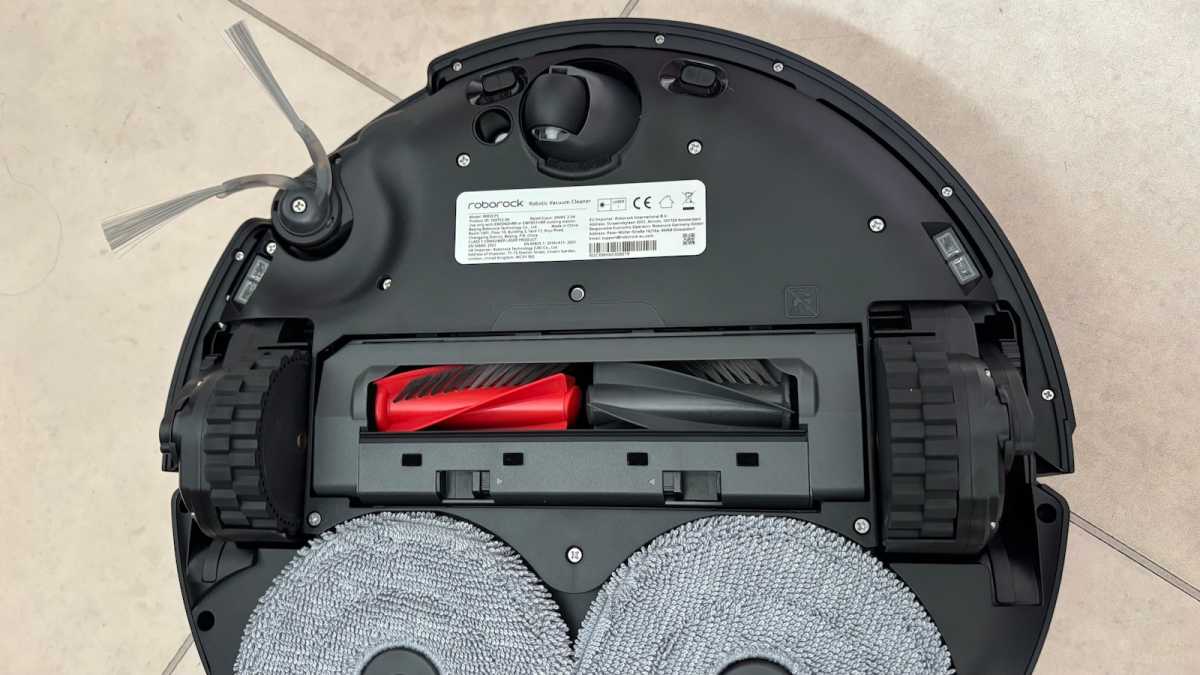
On top, two buttons handle the basics, such as sending it back to the dock or continuing cleaning if it’s been stopped. You can accomplish far more with voice control. Once it’s been set up in the app, saying ‘Hello Rocky’ allows you to instruct it do a variety of tasks without reaching for your device or even involving a smart speaker (although it is compatible with Alexa, Siri, and Google Home). There are so many possible commands that a card listing them is supplied.
The dock handles the business end of things: it’s here where the robot vac empties itself into a bag (which may only need changing every 65 days), refills with water and detergent for mopping, cleans (at 100°C) and dries its two mop pads (at 55°C), detaches and reattaches them, and charges.
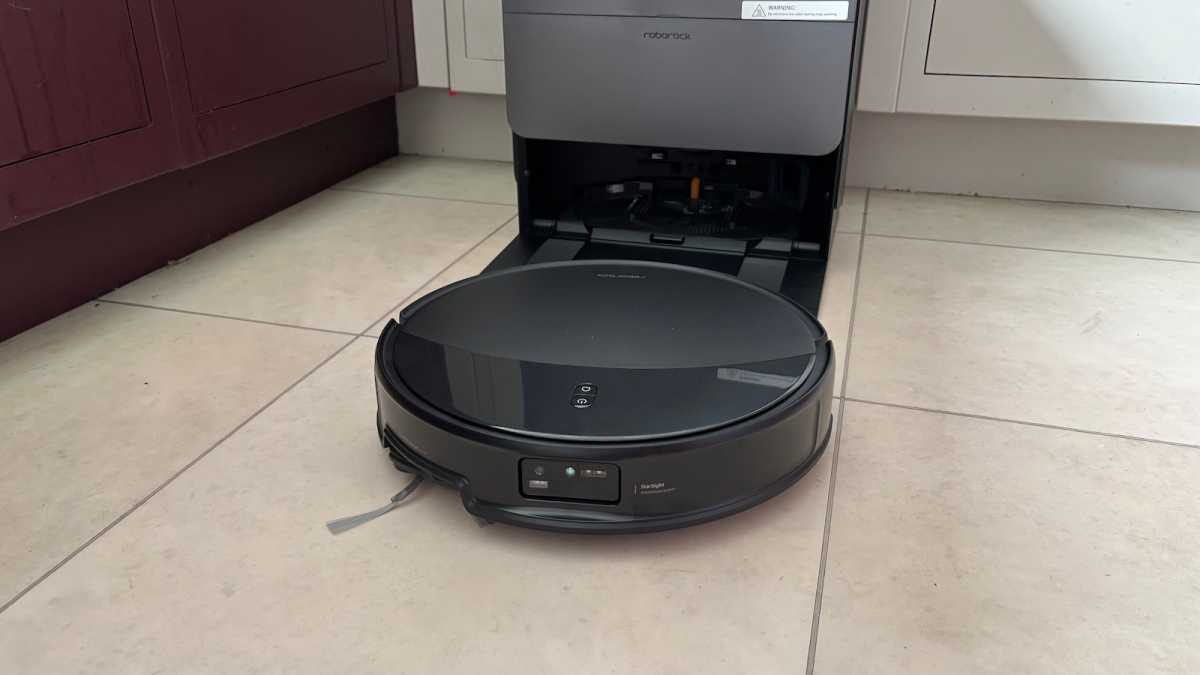
Rachel Ogden / Foundry
For all that, it’s also pretty compact: only H48.8 x W38.1cm, although a depth of 47.5cm, with additional clearance required in front may mean it’s in the way in smaller rooms. You’ll also need to keep both the top (for adding clean water and removing dirty) and front (for topping up detergent and changing vacuum bags) accessible.
Performance & Features
- Simple, advanced mapping
- Scheduling was more complicated
- Effective cleaning
Setting up a robot vacuum can be time-consuming but Roborock’s Saros 20 was one of the fastest we’ve encountered. It connected to Wi-Fi first time, mapped three spaces in less than two minutes (courtesy of a navigation system called Intelligent StarSight System 2.0), and once finished, it was easy to divide, merge and rename rooms via the app. The only real issue initially was where to put the dock – its power cable is 110cm, meaning that you’ll need a socket close by.
It’s simple to modify the map once you’re up and running by adding no-go areas and invisible walls – we liked that you can zoom into the floor map to do this, meaning that a small device screen is no barrier to personalising.
Other clever features include being able to change floor types if they’ve been incorrectly recognised (such as swapping tile for wood), tell it to ignore obstacles if they’re temporary (it’ll identify more than 300 different types, including a ball of paper or a pet), and the ability to photograph obstacles in colour – although for those concerned about privacy, this can be turned off. There’s a light too, for illuminating dirt in darker spaces, and the battery lasted well even during deeper cleaning cycles.

What’s less straightforward is choosing schedules for cleaning. Not only is this feature hidden under general settings, it’s not as user-friendly as the rest. There’s no guide to using it in the instructions, yet it gives a variety of options, from a mysterious smart mode to completely custom. I was able to set it to drag newly wetted, static mop pads across carpet while only vacuuming, which shouldn’t be possible.
Another issue was that the default for scheduled cleaning is once, which is odd given that schedules are usually intended to recur. Schedules that have run once then disappear, so forgetting to select daily means setting everything again. I felt this should be simpler for those who want to set and forget. The presets for ‘routines’ were more useful, and include actions such as ‘after meal’ cleaning for kitchen and dining areas.
Frustrations of the app aside, what the Saros 20 does brilliantly is clean both hard floors and carpet. Using flour to represent fine dust and oats as larger debris, pick-up was thorough on hard flooring. Only a little flour became trapped in the wheel treads, then dropped back onto the floor as it returned to the dock.
On a mid-pile carpet, all the oats were picked up. Some flour became embedded, with the most intensive suction unable to lift it, but we felt this was minor compared to other models. Again, some floury tread marks were left behind. But I especially liked the spot cleaning feature for going over dirtier areas again – it can be activated either by holding the home button or saying, “Clean here”.
On hard flooring, the mop performance was better than most rivals as the pads can pivot outwards to clean into corners and awkward spaces. However, we noted that the mopping was better for little-and-often cleaning rather than built-up dirt. Using dried-on sticky sauce, the first mop clean lifted some of it, while spreading the rest around. However, we were able to return the robot vac to the dock to clean the pads and have another go at it on the deepest clean setting. This time, all the visible mess was removed. However, once dried, some stickiness remained and had to be cleaned manually.
While obstacle recognition and ability to free itself when stuck is more advanced than many, the Saros 20 isn’t perfect. Cat toys were frequently sucked up and their strings wrapped around the rollers. We had to block off a fireplace hearth with a no-go area on the map as it would try to climb it and become stuck. It even knocked off a mop pad during one cycle. Loose trim threads were ripped off a curtain and wound around its rollers so it stopped mid-clean.
It would regularly climb a doormat, then drag it along behind. The robot also became stuck between a stool and a chair, a sofa and a scratching post, and sometimes on piano pedals. To its credit, though, it recognised and avoided pets, a scrunched-up ball of paper, cat tree, wires, larger furniture, an extension lead and litter tray.
Price & Availability
The Saros 20 is available to buy in the UK for £1,099, down from a launch price of £1,299. You can buy it from Amazon, or direct from Roborock. Its US launch price is $1,599.99 and that’s what you’ll pay if you buy from either the Roborock website or Amazon.
This pricing puts it in the top tier of robot vacuums, as you might expect given its flagship status. For the feature set it provides, it’s competitively priced but you’ll be able to get similar functionality for less if you buy an older model. We have more options in our round-up of the best robot vacuums we’ve tested.
Should you buy the Roborock Saros 20?
There’s no denying that the Roborock Saros 20 is a big step in the right direction for a mopping robot vacuum. It’s incredibly easy to set up, the technology for spotting objects and working out what they are is impressive (even if smaller items have a tendency to be missed), and voice control is a boon to those keen to minimise device usage.
However, all this technology is pricey, while basic scheduling has been made more complex than it needs to be. Those aspects aside, if you’re willing to put in time initially adjusting boundaries, drawing on multiple no-go areas, and keeping it away from chewable items, it can deliver a great clean with very little need for you to step in.