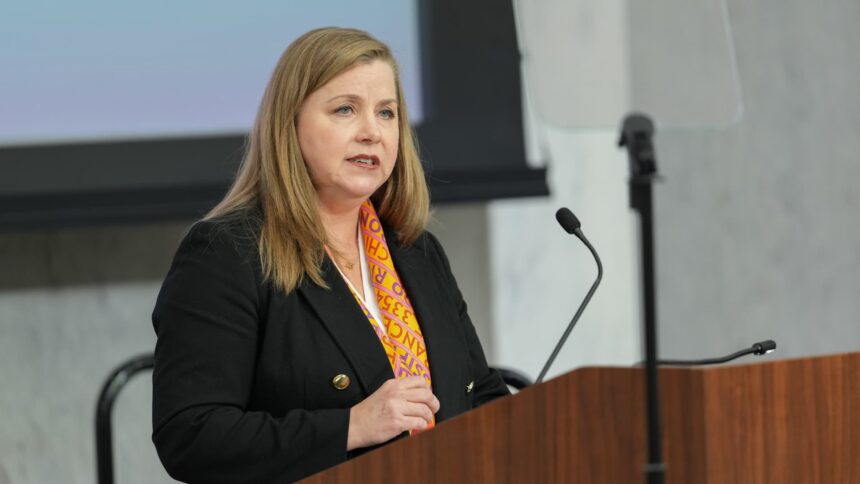
Michelle Bowman, vice chair for supervision on the US Federal Reserve, through the Federal Reserve Board Neighborhood Financial institution Convention in Washington, DC, US, on Thursday, Oct. 9, 2025.
Eric Lee | Bloomberg | Getty Photographs
Regulators are getting rid of controversial guidelines that required banks to plan for losses within the occasion of climate-related occasions, in accordance with an announcement Thursday.
A joint launch from the Federal Deposit Insurance coverage Company, the Workplace of the Comptroller of the Forex and the Federal Reserve mentioned they not consider the necessities are vital as they’re redundant with different provisions banks make to plan for emergencies and strange occasions.
“The businesses don’t consider ideas for managing climate-related monetary threat are vital as a result of the businesses’ current security and soundness requirements require all supervised establishments to have efficient threat administration commensurate with their measurement, complexity, and actions,” a joint launch from the three regulators mentioned.
Fed Governor Michael Barr, the previous vice chair for supervision, issued a press release disagreeing with the transfer.
“Rescinding the ideas is shortsighted and can make the monetary system riskier whilst climate-related monetary dangers develop,” Barr mentioned in a press release.
Mission creep
Trump administration officers have criticized the Fed for falling prey to mission creep, or exceeding the scope of its mandates for financial coverage and financial institution supervision. The local weather change provisions, established in October 2023, have been one level of criticism.
Chair Jerome Powell has repeatedly acknowledged that local weather isn’t a direct Fed concern. The principles required banks, as a part of routine testing, to listing potential losses they may undergo from climate-related points.
Governor Michelle Bowman, a Trump appointee who succeeded Barr because the Fed banking supervisor, praised the transfer rescinding the foundations as a part of an try at “refocusing the supervisory course of on materials monetary threat.”
“Rescission of the local weather ideas is a vital step on this course of,” Bowman mentioned. She criticized the local weather guidelines, saying “the impact of this steerage was to create confusion about supervisory expectations and improve compliance value and burden with out a commensurate enchancment to the protection and soundness of monetary establishments or to the monetary stability of the USA.”
Whereas acknowledging the dangers that local weather change poses, Bowman mentioned the Fed’s mission does “not lengthen to local weather policymaking.”