Nicaragua is a safe country to visit, but it’s important to follow protocols as in any other Latin American country.
Heading into 2026, the safety equation is increasingly situational: the country is workable for many travelers, yet the margin for error is narrower than in other Central American countries.
Two factors dominate current assessments. First, violent and opportunistic crime is concentrated in identifiable hotspots and transit-heavy settings, where robbery and theft can escalate quickly.
Second, the political-security environment has tightened, and visitors should anticipate less predictability in how laws are interpreted and enforced—including at border points and during routine encounters with authorities—especially where officials perceive political sensitivity.
The current advisory picture (as of late December 2025)
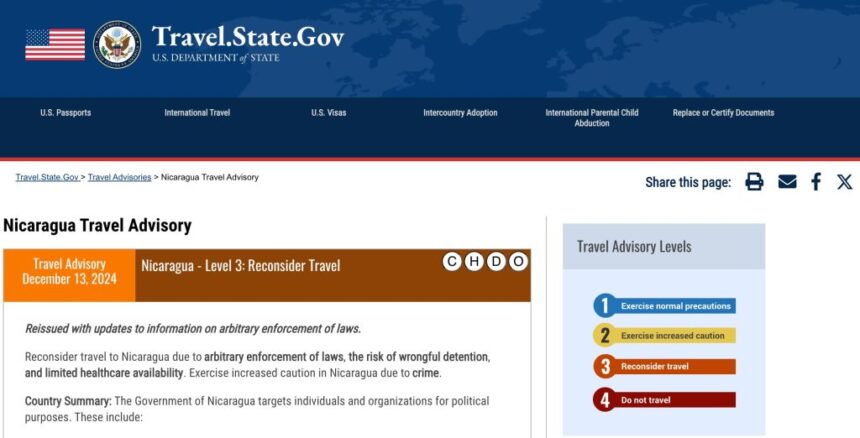
- United States (State Department): Level 3 — Reconsider Travel (last reissued December 13, 2024) due to arbitrary enforcement of laws, risk of wrongful detention, limited healthcare availability, and crime.
- Canada: Exercise a high degree of caution (last updated December 15, 2025) due to the political situation, potential civil unrest, and crime.
- United Kingdom (FCDO): Travel advice updated December 10, 2025; emphasizes legal risk for foreigners involved in political activity and highlights crime and transport-related risks.
- Australia (Smartraveller): Exercise a high degree of caution (updated December 4, 2025) with detailed crime hotspot guidance and safety measures.
What’s changed since early 2025
The broad themes are consistent (crime + political constraints), but several official advisories now describe more explicit “rule-of-law” and mobility risks—including arbitrary entry/exit bans and searches of devices/social media.
Separately, the UN human rights system has continued to document repression and cross-border pressure on Nicaraguans abroad, including measures such as entry bans, deprivation of nationality, and property confiscation.
Primary risks for travelers
1) Crime: where the risk concentrates
Official guidance consistently points to violent and opportunistic crime, with the highest rates flagged in:
- Managua
- Granada and San Juan del Sur
- Bonanza
- La Rosita / Siuna
- Corn Island
Australia also notes that gang violence can occur in major hotels, bus terminals, beaches, and markets in these higher-risk areas.
Canada adds that petty crime and property crime occur frequently in specific cities and regions and calls out especially high-risk neighborhoods in Managua (its advisory provides granular neighborhood detail).
2) Political and legal environment: “low visibility” is safer
Multiple governments warn that foreign participation in political activity is prohibited and can lead to arrest, detention, or deportation. The UK explicitly warns that even activity seen as acting against the government can trigger consequences, including the use of national colors/flag in a political context.
The U.S. and Canada further warn that authorities may:
- restrict entry/exit (including arbitrary bans),
- search phones/computers/social media for “anti-government content,”
- seize devices,
- and pursue politically motivated charges.
Practical implication: travelers should avoid political discussions (in person and online), demonstrations, political symbols, and any work/volunteering that could be interpreted as advocacy or organizing
3) Transport and “express kidnapping” risk in unofficial taxis
The UK and Australia both warn about elevated risk in unauthorized taxis, including “express kidnapping” scenarios where victims are forced to withdraw cash. Recommended mitigation: use radio-dispatched taxis or authorized taxis with red plates.
4) Natural hazards: hurricanes and volcanoes
Hurricane season typically runs June–November, and Nicaragua has active volcanoes; official guidance advises avoiding remote hikes without an experienced guide and having an evacuation plan where relevant.
Areas to avoid (or treat as “heightened caution” zones)
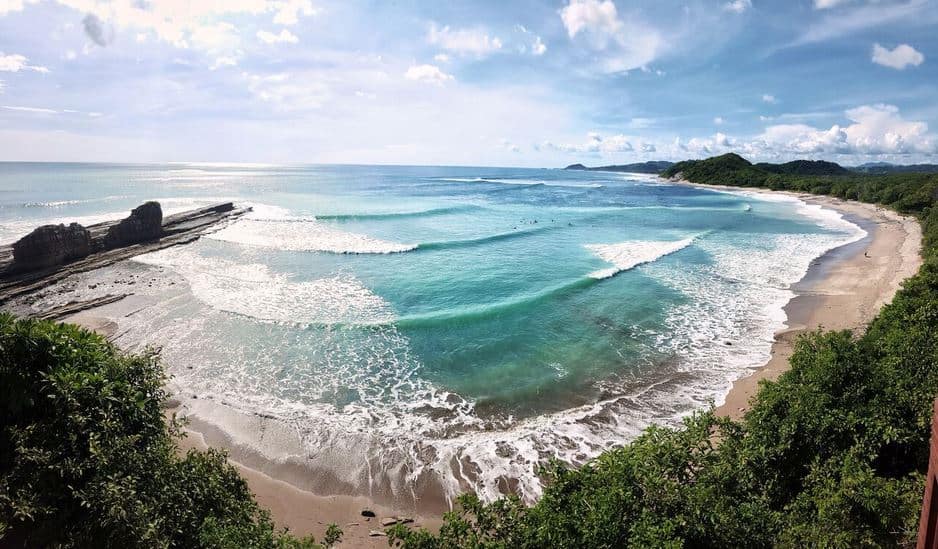
No advisory labels the entire country as off-limits, but official sources repeatedly flag the following as higher-risk or requiring stronger precautions:
- Managua (with specific neighborhoods called out in Canada’s advisory)
- Granada and San Juan del Sur
- Bonanza; La Rosita; Siuna; Corn Island
- Bus terminals, markets, major hotels, and busy beach areas in higher-risk cities (situational risk of robbery or gang-related violence)
Practical safety guidance (2026 playbook)
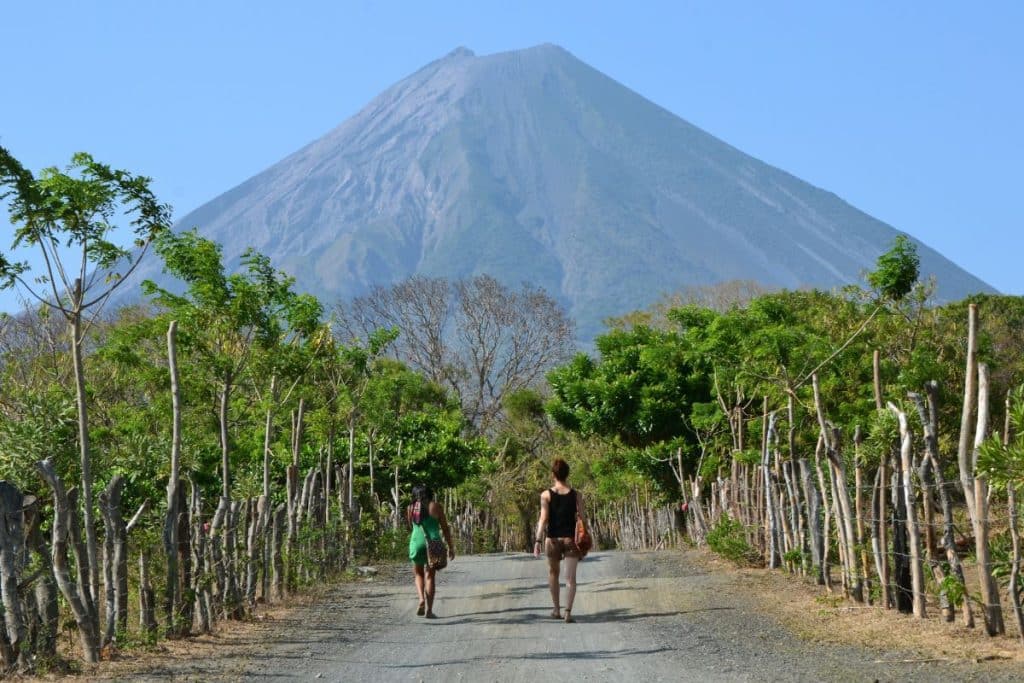
Before you go
Read the latest advisory pages the week of travel, not just at booking time.
Plan for limited consular reach and uneven infrastructure, especially outside major urban centers.
Minimize device risk: travel with a “clean” phone/laptop if possible; keep sensitive content off devices and logged out of accounts you do not need. (This is a direct response to official warnings about device searches.)
On the ground
Do not resist during a robbery. Several advisories emphasize that criminals may be armed.
Use authorized transport: avoid unofficial taxis and public transit at night; prefer hotel-arranged or radio-dispatched taxis.
Keep a low profile around politics: avoid protests, political talk, politically themed posts, and photographing sensitive government/security sites.
Know “special restrictions”: the UK warns of strict rules affecting travelers in specific areas (for example, its travel advice notes restrictions affecting drones).
Who should think twice (even if they are experienced travelers)
Based on the risk factors spelled out in official advisories, the “reconsider” category is especially relevant for:
- journalists, researchers, academics,
- NGO/civil society and religious/charity workers,
- activists (or anyone with a visible political profile),
- dual nationals with complex family or political histories,
- travelers who cannot tolerate uncertainty around entry/exit or legal process.