I previously reviewed the INIU Slimmest BI-B41 10K mAh INIU power bank and thought it was a decent budget power bank.
INIU has now sent me the Cougar P63, which has a capacity of 25,000mAh and a 100W maximum output from the first output port, and it manages to cram this into a relatively compact package weighing just 392.3g.
While it doesn’t have a smart display like many Ugreen or Anker models, the capacity, size and price make it an appealing power bank for anyone wanting something compact but with more capacity than small 10K models.
The Cougar range sits above INIU’s more basic slim power banks and is aimed squarely at people who want to charge a laptop, tablet or handheld games console on the move. The P63 is the middle option in the line-up, sitting between the 20,000mAh 65W P62 and the 25,000mAh 140W P64. On paper, it looks like the sweet spot for most people, offering enough output for the majority of ultrabooks and MacBooks without the extra cost of the P64.
Specification
| Specification | Details |
|---|---|
| Product Model | P63-E1 |
| Category | Power Bank |
| Dimensions | 110 x 70 x 36mm |
| Weight | 392.3g |
| Total Capacity | 25,000mAh (90Wh) |
| Supported Protocols | PPS, PD 3.0, PD 2.0, QC, AFC, FCP |
| OUT1 (USB-C) | 5V/3A, 9V/3A, 12V/3A, 15V/3A, 20V/5A; 100W max |
| OUT2 (USB-C) | 5V/3A, 9V/3A, 12V/3A, 15V/3A; 45W max |
| OUT3 (USB-A) | 5V/3A, 9V/2A, 12V/1.5A; 18W max |
| OUT1 + OUT2 | 110W max |
| OUT1 + OUT3 | 83W max |
| OUT2 + OUT3 | 15W max |
| OUT1 + OUT2 + OUT3 | 80W max total |
| Input | 5V/3A, 9V/3A, 12V/3A, 15V/3A, 20V/3.25A; 65W max |
| Display | Digital display |
| Cable | 100W detachable USB-C GoCord cable |
Design
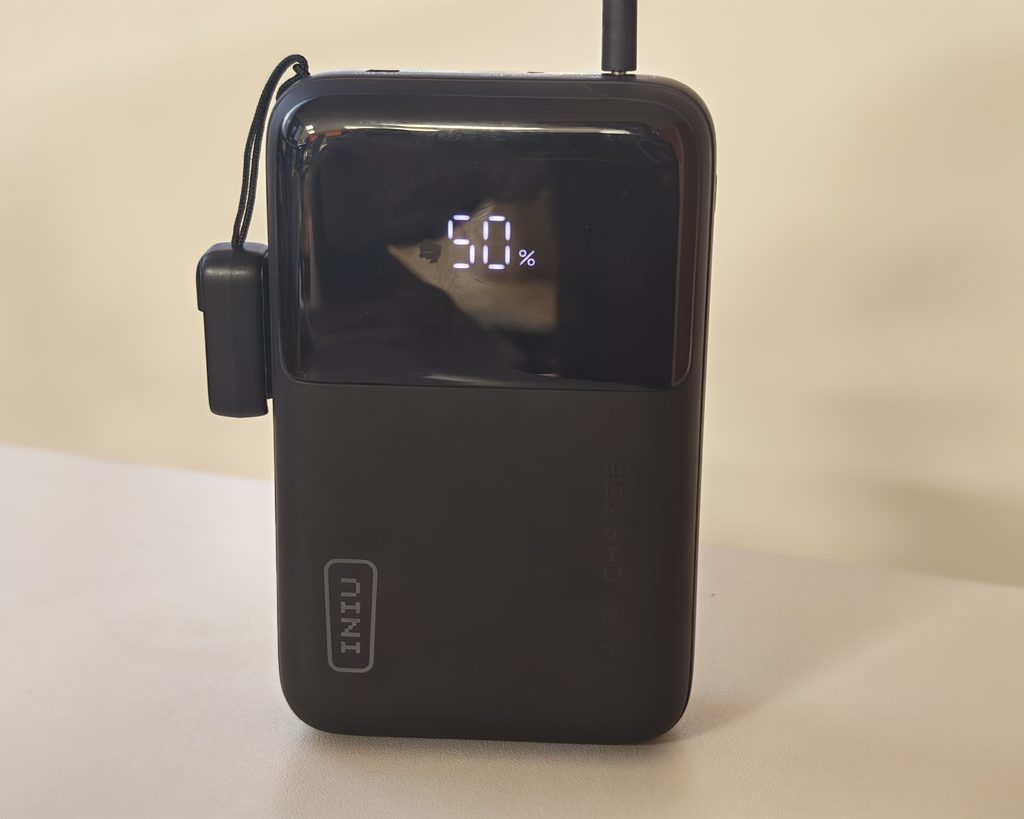
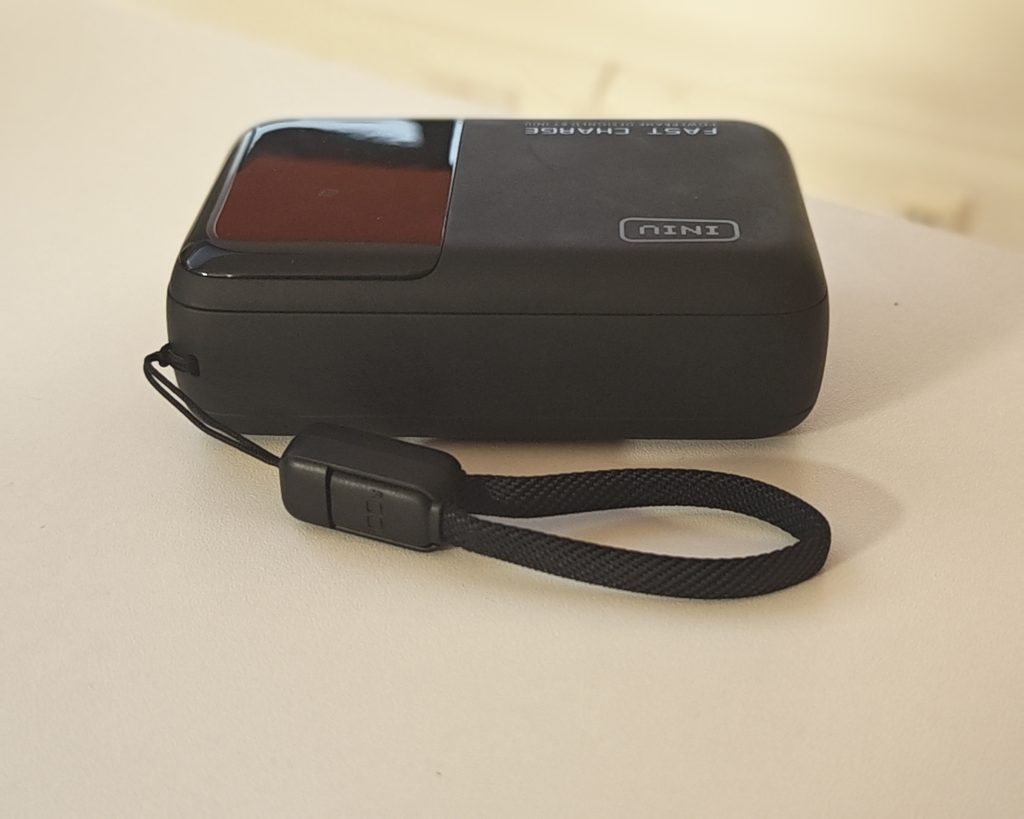
The P63 is a chunky little block rather than a slim power bank. At 110 x 70 x 36mm, it has a footprint not much larger than a deck of cards, but it is thick, so it is better suited to a bag or jacket pocket than a pair of jeans. The 392.3g weight is noticeable in the hand, but it is impressive for a 25,000mAh power bank, with many rivals of a similar capacity being considerably longer and often well over 500g.
Most of the casing has a soft-touch rubberised finish that offers good grip. The downside is that it picks up marks and scuffs fairly easily, and after a short period of use, mine was already showing some wear on the “Fast Charge” print. The top third of the front is a glossy panel that houses the display, and this is a fingerprint and reflection magnet.
The display itself only shows the remaining battery percentage. It is a clear improvement over the four LED dots used on many budget power banks, as you know exactly how much charge you have left, but it occupies only a small part of what is a relatively large glossy panel. There is no readout of input or output wattage, which is something I find useful on rival models from Ugreen and Anker, as it lets you confirm a device is charging at the speed it should be.
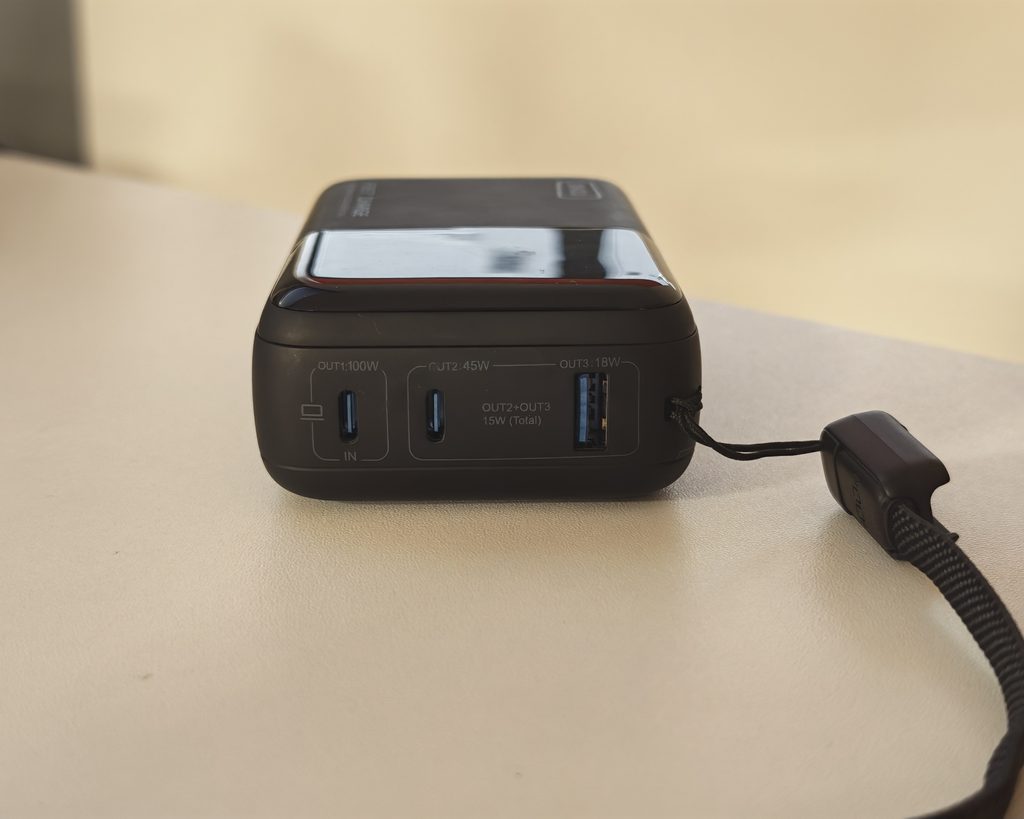
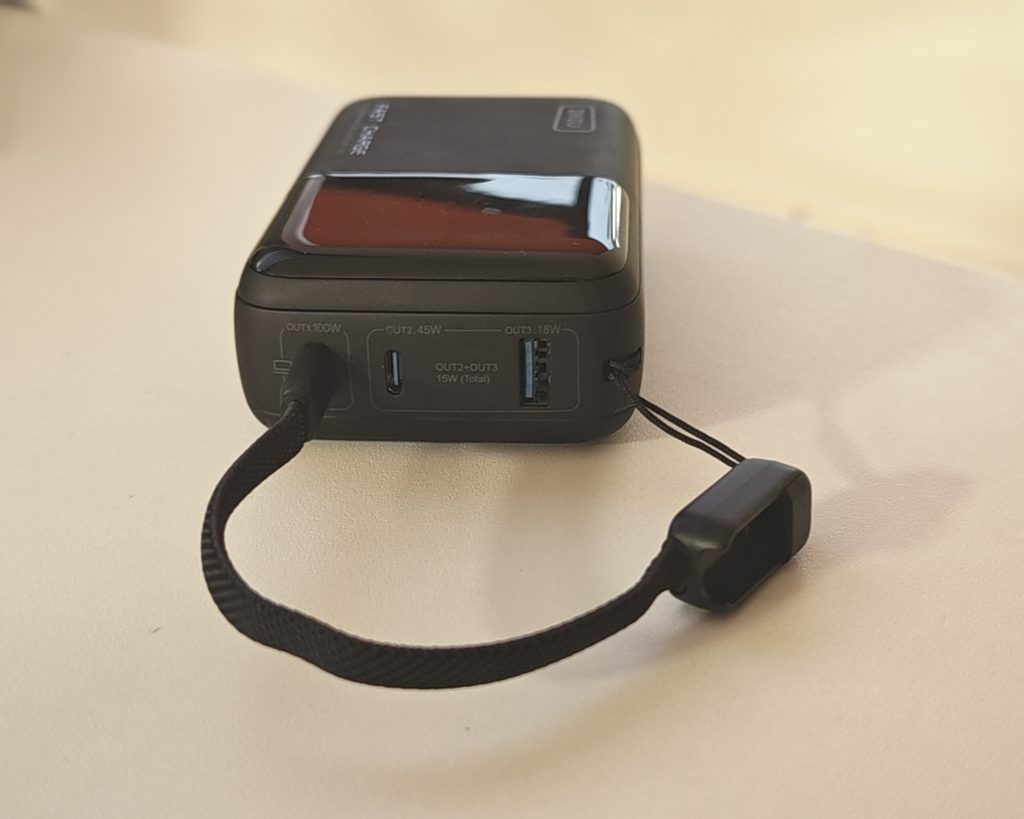
All three ports are on the top edge, and each is clearly labelled with its maximum output, including the somewhat unusual 15W combined limit for OUT2 and OUT3. A single power button sits on the side, which wakes the display and can be used to check the charge level.
The most distinctive feature is the GoCord cable. This is a short braided USB-C to USB-C cable rated at 100W that doubles as a wrist strap. One end loops through an anchor point on the corner of the power bank, and the two connectors clip together into a small holder when not in use. It is a clever solution, as you always have a cable with you, and it is detachable, so if it fails, you can replace it with any USB-C cable rather than being stuck with a broken built-in lead. The flipside is that it is quite short, which is fine for a phone or handheld console, but less convenient when charging a laptop on a desk.
INIU offers the P63 in several colours, including black, red, yellow and a selection of metallic finishes. INIU also provides a three-year warranty, which is longer than the 18 months or two years offered by some rivals.
Ports and Charging Speeds
The P63 has two USB-C ports and a single USB-A port, and how much power you get depends heavily on which combination you use.
OUT1 is the main USB-C port and supports up to 100W via 20V/5A. That is enough to charge most laptops at close to full speed, including the 13-inch and 15-inch MacBook Air, Dell XPS models, and most Windows ultrabooks. It will also charge a 14-inch MacBook Pro at a decent rate, although the most powerful 16-inch MacBook Pro models can draw 140W, so you would be better off with the P64 for those.
OUT2 is a second USB-C port capable of 45W, which is plenty for a Steam Deck, a tablet or a phone with fast charging. Samsung’s Super Fast Charging 2.0 at 45W is supported thanks to PPS, and most other phones will charge at their maximum wired speed. The USB-A port tops out at 18W, which is fine for older devices, earbuds and accessories.
Using the 100W and 45W USB-C ports together gives a combined 110W, which is respectable for a power bank of this size. Adding the USB-A port into the mix with all three ports in use drops the total to 80W.
The odd limitation is the combination of OUT2 and OUT3. If you use the 45W USB-C port and the USB-A port at the same time, without using OUT1, the total output is capped at just 15W. That is a significant drop, and it means you would be better off using OUT1 and OUT2 if you want to charge two devices at a reasonable speed. It is clearly labelled on the casing, so it shouldn’t catch you out, but it is a frustrating compromise.
A wide range of fast charging protocols are supported, including PD 3.0, PD 2.0, PPS, Qualcomm Quick Charge, Samsung AFC and Huawei FCP, so compatibility with older Android devices is good.
Capacity and Airline Compliance
The P63 has a rated capacity of 25,000mAh, which works out at 90Wh at the 3.6V nominal voltage of the cells. This keeps it under the 100Wh limit for carry-on luggage set by most airlines, including those operating in the UK and EU, so you can take it on a flight without needing permission from the airline.
As with all power banks, you won’t get the full 25,000mAh delivered to your devices. There are losses converting the cell voltage to the 5V to 20V required by your devices, along with heat losses during charging, and in my experience, most power banks deliver somewhere between 65% and 80% of their rated capacity. Charging at higher wattages, such as 100W to a laptop, typically leads to greater losses than charging a phone at 20W.
In practical terms, that means you should get around one full charge of a 13-inch MacBook Air, most of a charge on a 14-inch MacBook Pro with its 70Wh to 72.4Wh battery, roughly one and a quarter charges of a Steam Deck, and three or more full charges for most flagship phones.
Performance
INIU claims the P63 can charge a 14-inch MacBook Pro from 20% to 72% in 30 minutes, and that is broadly in line with what I would expect from a 100W output, as the MacBook Pro will happily draw close to that figure when its battery is low. As the battery fills, the charging rate drops off, which is normal behaviour for any laptop and not a limitation of the power bank.
For phones, INIU claims an iPhone 17 Pro Max can reach 77% in 30 minutes, while a Galaxy S26 Ultra reaches 91% in the same time. These figures are effectively identical to what you would get from a wall charger, as the phone, rather than the power bank, is the limiting factor.
The Steam Deck is one of the devices the P63 is marketed for, and with 45W available from either USB-C port, it can charge a Steam Deck while gaming without the battery level continuing to drop. Both USB-C ports can be used at the same time, so you could charge two handheld consoles at once, although each would then be competing for the 110W combined limit, which is still more than enough for two 45W devices.
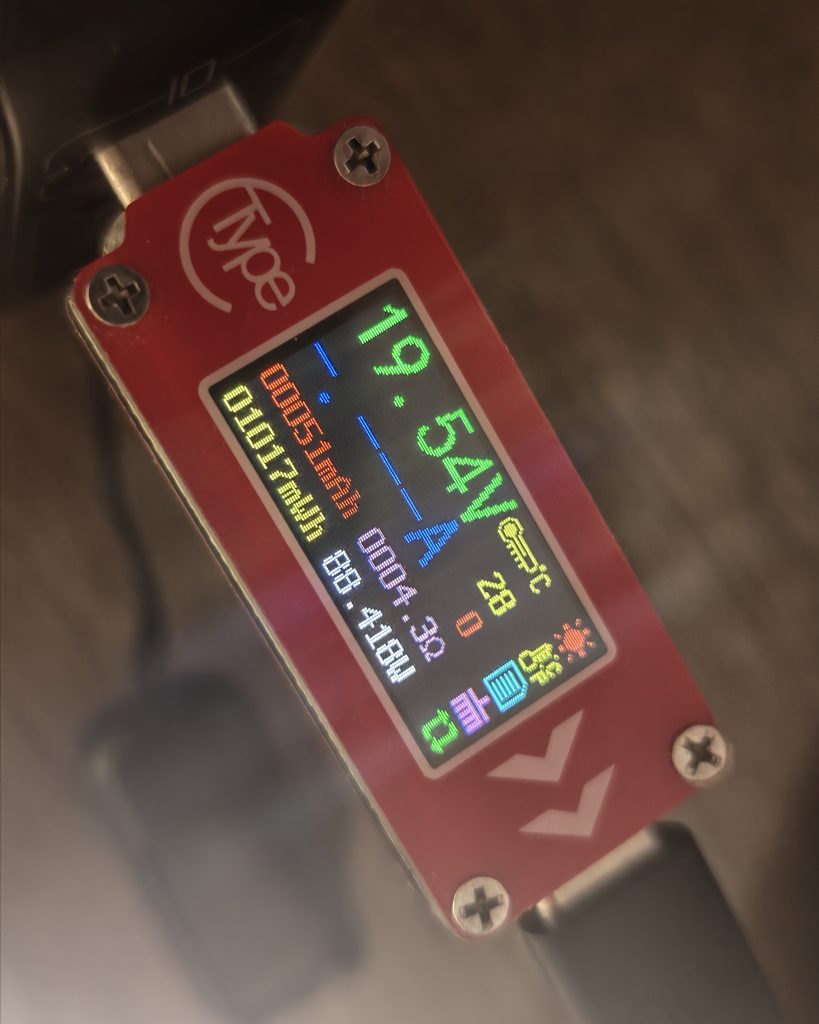
For a basic test, I used the ZHIYUN MOLUS X100 LED Lights, which take up to a 100W input. Dialling the brightness up to 100%. The USB power meter I used to test this showed an output of 88.5W.
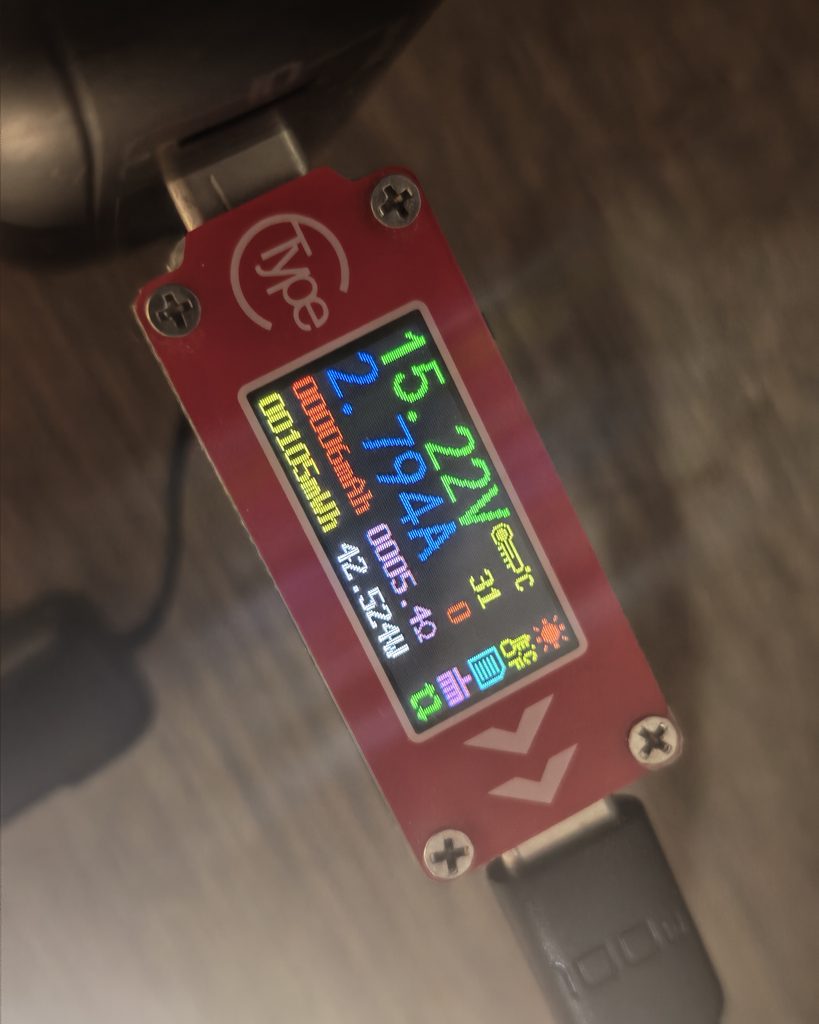
On the secondary port, the power meter confirmed the 45W output claim.
Recharging
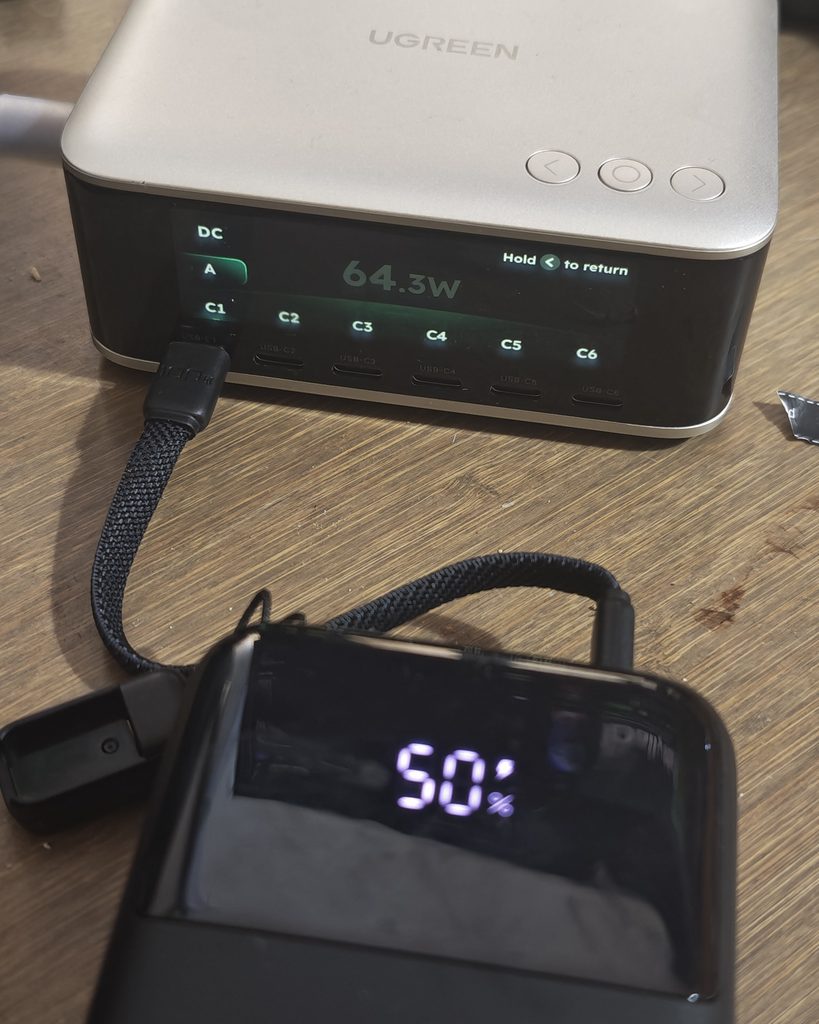
The P63 supports up to 65W input via USB-C, and INIU states it can be recharged in around 1.4 hours with a suitable charger. That is quick for a 25,000mAh power bank, and it makes a big difference when travelling, as you can top it up in a hotel room or airport lounge in the time it takes to have a coffee.
I tested the charging with the Ugreen Nexode Pro 300W Desktop Charger and confirmed it achieved a 65W charge.
Like most brands nowadays, INIU doesn’t include a charger in the box, and you will need one capable of at least 65W to hit those speeds. A typical 20W or 25W phone charger will work, but it will take four or five hours to fully recharge the power bank. If you already own a laptop charger rated at 65W or more, that will be ideal.
Price and Alternative Options
The INIU Cougar P63 has an RRP of £67; at the time of writing, it was available on Amazon UK for just £57.
There are plenty of other options at similar prices and capacities, but many seem to be physically larger power banks.
One example is the Ugreen Nexode 165W, which has a 20K capacity, up to 165W total output, and a nice smart display at just £50. However, it is physically larger and heavier.
If you want a power bank with built-in retractable cables and a more detailed display, the Anker Power Bank 25K 165W is one of the most popular options. It offers more total output and two built-in cables, but it is considerably larger and heavier, and it usually costs closer to £100, although it is frequently discounted.
Within INIU’s own range, the Cougar P62 offers 20,000mAh with 65W output for a little less money, and it is smaller still. This would be the better option if you only need to charge a phone, tablet or an ultrabook with lower power requirements. At the other end, the Cougar P64 has the same 25,000mAh capacity with a 140W output, which makes it the better choice if you own a 16-inch MacBook Pro or a gaming laptop, but it is more expensive and the extra output will be overkill for most people.
There is also the INIU P781, a 10,000mAh Qi2.2 magnetic power bank that is better suited to iPhone users who want wireless charging and something slim to carry around. However, its 25W output is no use for a laptop, so it serves a different purpose to the P63.
Overall
The INIU Cougar P63 is a well-judged power bank that balances capacity, output, size and price better than most of the competition. Getting 25,000mAh and 100W output into something that weighs under 400g is impressive, and it means you can carry enough power to charge a laptop without needing a large, heavy brick in your bag.
The GoCord cable is a practical touch that I would like to see more manufacturers adopt. Having a 100W cable permanently attached as a wrist strap means you are never caught without a lead, and because it is detachable, you aren’t left with a useless power bank if the cable fails.
There are some compromises. The display only shows the battery percentage, with no wattage readout, and the large glossy panel looks smart out of the box but quickly collects fingerprints. The 15W limit when using OUT2 and OUT3 together is an odd decision, and the lack of a charger in the box means you will need to supply your own 65W adapter to take advantage of the fast recharge times. The thickness also makes it less pocketable than the footprint suggests.
None of these issues are deal breakers, though, and at £57, the P63 is good value for a power bank with this combination of capacity, output and size. If you want a laptop power bank that can comfortably go in a small bag or be taken on a flight without a second thought, it is easy to recommend.
INIU Cougar P63 Laptop Power Bank Review
80%
Summary
The INIU Cougar P63 packs 25,000mAh and 100W output into one of the smallest and lightest power banks of its class. The detachable GoCord cable is useful, recharging is quick with a suitable charger, and the price is competitive. The basic display and odd multi-port limits stop it from being perfect, but it is a sensible choice for anyone wanting to charge a laptop on the move.
Pros
- 25,000mAh and 100W output in a compact 392g package
- Detachable 100W GoCord cable doubles as a wrist strap
- Fast 65W recharging
- Under 100Wh, so flight-safe
- Three-year warranty
- Competitive price
Cons
- Display only shows battery percentage, no wattage readout
- OUT2 and OUT3 together are limited to 15W
- No charger included
- Glossy panel attracts fingerprints and the soft-touch finish scuffs
- Thick for its footprint

I am James, a UK-based tech enthusiast and the Editor and Owner of Mighty Gadget, which I’ve proudly run since 2007. Passionate about all things technology, my expertise spans from computers and networking to mobile, wearables, and smart home devices.
As a fitness fanatic who loves running and cycling, I also have a keen interest in fitness-related technology, and I take every opportunity to cover this niche on my blog. My diverse interests allow me to bring a unique perspective to tech blogging, merging lifestyle, fitness, and the latest tech trends.
In my academic pursuits, I earned a BSc in Information Systems Design from UCLAN, before advancing my learning with a Master’s Degree in Computing.
I’m proud to share that Vuelio has consistently ranked Mighty Gadget as one of the top technology blogs in the UK. With my dedication to technology and drive to share my insights, I aim to continue providing my readers with engaging and informative content.
I work directly with the companies he reviews products for or their chosen PR agency.
For Social Media, you can find me on: