GasBuddy flags worrisome gas price trend, sends message on what’s next
Share
8 Min Read
SHARE
The Israel-U.S. war with Iran is proving to be frustrating.
Not just for the combatants or the politicians.
Just ask any motorist who has to fill a gas tank regularly.
GasBuddy’s daily report on gas prices shows U.S. prices jumped from $2.972 per gallon on Feb. 28, as the first Israel-U.S. attacks on Iran began, to an average $4.167 on April 8, a gain of nearly 40% and, at the time, an 83% jump for the year.
Then, there was a lull as peace talks were held; then, talk of a deal. Or President Trump was talking about a deal. And GasBuddy’s U.S. average fell 4.6% to $3.977 on April 19.
Alas, the lull was short-lived.
The price is now about $4.07 per 42-gallon barrel because light sweet crude, the U.S. benchmark, rose 14% in the past week as worries grew the war and the blockades in the Strait of Hormuz were nowhere nearing an end.
Brent crude, the global benchmark, was up 17% to $105.33 a gallon.
Related: Exxon Mobil’s future rests on massive play (it isn’t Venezuela)
To underscore the point on frustration, a negotiation meeting in Islamabad, Pakistan, between Iran and the United States was cancelled after President Donald Trump told his envoys the travel time was too great. Besides, the Iranians delegation had already left.
And Trump conceded in a social media post that he didn’t know who was really in charge in Iran.
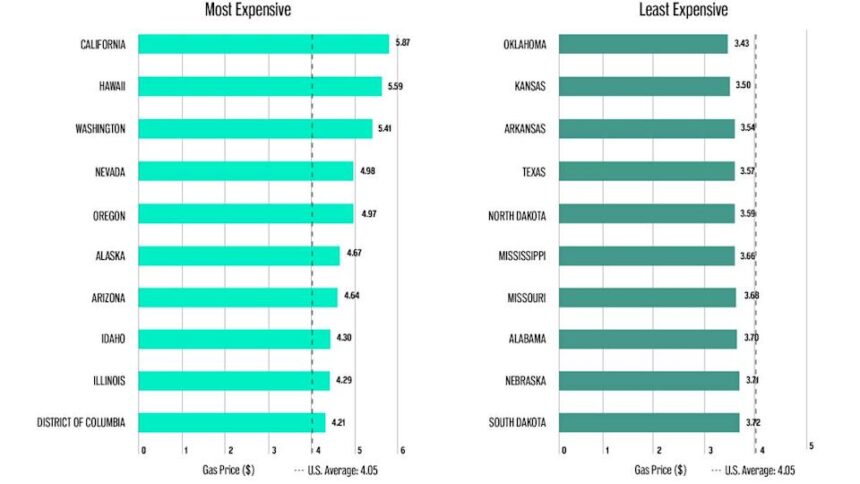
The uncertainty has meant that gas prices in California, the highest-priced state, are nearing $6 on average and rising. Averages in two rural counties — Mono and Lassen — already are above $6.40 and prices counties near San Francisco are at or near $6.
The cheapest gas in the United States is still in Oklahoma, with a statewide average of $3.47, GasBuddy says.
Patrick DeHaan, GasBuddy’s head of petroleum analysis, told me at TheStreet.com that he doesn’t see any big price breaks soon. The will to talk just doesn’t seem to be there.
Rising prices across the United States couldn’t come at a worse time.
Prices typically rise in the spring and early summer anyway as U.S. refiners build supply and change their recipes to make gasoline more environmentally friendly.
So, you see the average price in San Jose nearly $5.90 a gallon. In Portland, Ore., and Las Vegas, prices have now topped $5. The closer you get to the Gulf Coast the lower the price, however. New Orleans was averaging $3.64 on Friday; Nashville was at $3.73.
The big problem consumers and businesses now face is that the crude oil increasingly isn’t there, however, or not enough of it, GasBuddy’s DeHaan said. Shortages are growing in gasoline, jet fuel and related products.
(That’s bad for consumers, though great for energy stocks, still the year’s best-performing S&P 500 sector. The Energy Select Sector SPDR built to mirror the sector. APA Corp., Texas Pacific Land and Baker Hughes are its current top stocks. )
The Strait of Hormuz is blocked off by Iranian and U.S. blockades. Before the war, some 20% of the world’s oil moved from countries in the Persian Gulf region through the strait into the global market, particularly Asia.
That supply has mostly been lost and has set off bidding wars for the oil that is available.
About 9.1 million barrels of oil per day was blocked into the Gulf in March after the war broke out, according to JP Morgan estimates. In April, the shortages grew to 13.7 million barrels a day. Goldman Sachs thinks the shortages are now closer to 14.5 million barrels a day.
How might that affect gas prices?
They’ll be higher, DeHaan conceded, for the foreseeable future.
But hold on, didn’t Treasury Secretary Scott Bessent suggest prices could fall to near $3 a gallon this summer?
In fairness, his statement came before the stalemate became apparent to all.
And many others watching the situation agree.
More Oil and Gas:
Some countries, including the United States, have drawn down strategic reserves to try to make up some of the difference. Soaring prices has reduced gasoline and other purchases. Airlines have had to cancel flights because they can’t get the jet fuel. Diesel fuel supplies, used by trucks, train locomotives and many manufacturing facilities are also shrinking, Bloomberg News reported.
So far, the result has been to make up shortfalls of some 8 million barrels a day. But the global problem is that the global market is still some 2 million barrel short. OilPrice.com reported.
So, prices will probably continue to rise to force that demand off the market, analyst Natasha Kaneva wrote in the JPMorgan report.
Tanker at anchor near Los Angeles in March. Patrick T. Fallon / AFP / Getty Images
To be sure, the United States overall probably won’t suffer actual shortages. Those will be concentrated in countries that must import nearly all their oil, such as the Philippines, China, Japan and Thailand.
The U.S., as a whole, is pretty much self-sufficient and is, in fact, exporting crude oil and liquid natural gas through ports along the Texas Gulf Coast.
Primary destinations are Europe and Asia, especially the Netherlands and South Korea.
California is the one big exception to the idea of U.S. self-sufficiency. The state imports 77% of its oil: 16% from Alaska and the balance from outside the United States, according to the California Energy Commission.
But while the United States is a net exporter, shortages will show up because of refinery shortages, DeHaan noted. Most U.S. gasoline is refined in and along the Gulf Coast and piped to the Midwest and East. The Northeast is especially vulnerable.
Any breakage in those networks could cause serious issues and make summer of 2026 very long for all.
Related: Scott Bessent has an urgent message for all Americans