The city skyline and cityscape in Shanghai China.
Lu Shaoji | Second | Getty Photographs
BEIJING — From espresso to automobiles to actual property, there is a recurring sample in China: firms rush into an business, then resort to reductions to remain afloat. That has economists anxious.
Natixis’ examine of two,500 listed Chinese language firms reinforce how quantity is rising whereas worth is being damage by deflationary strain, Alicia Garcia Herrero, the agency’s chief economist for Asia-Pacific, stated on a webinar Friday. “You’ll be able to see it sector by sector, firm by firm.”
“On the floor you are dominating, however deep inside you are paying a excessive value to dominate,” she stated. “You aren’t getting the income wanted to proceed.”
A mirrored image of the breadth of influence, consumer prices fell by 0.1% within the first six months of the 12 months from a 12 months in the past, whereas factory-gate producer costs dropped by 2.8%, official information exhibits. In that point, solely seven of 48 producer value sub-categories rose, versus about half of the 37 client value parts.
That fierce and sometimes unproductive competitors is described as “involution” in China. The federal government has picked up on the time period in current coverage paperwork, calling for efforts to deal with the development.
Whereas the development has made tech and merchandise extra reasonably priced for the mass market, it has additionally underscored worries of a vicious cycle that forces companies to chop extra jobs.
“With involution, the Chinese language economic system feels a lot colder than the headline progress suggests,” Larry Hu, chief China economist at Macquarie, stated in a report Thursday. He identified that mainland China-listed “A share” firms expanded their workforces by simply 1% in 2024, the slowest on file.

“From a extra elementary perspective, involution is each a function and a bug of the ‘China mannequin,'” he stated. “Large funding results in value wars and poor returns for shareholders. However for policymakers, intense competitors may assist obtain industrial upgrading and self-reliance.”
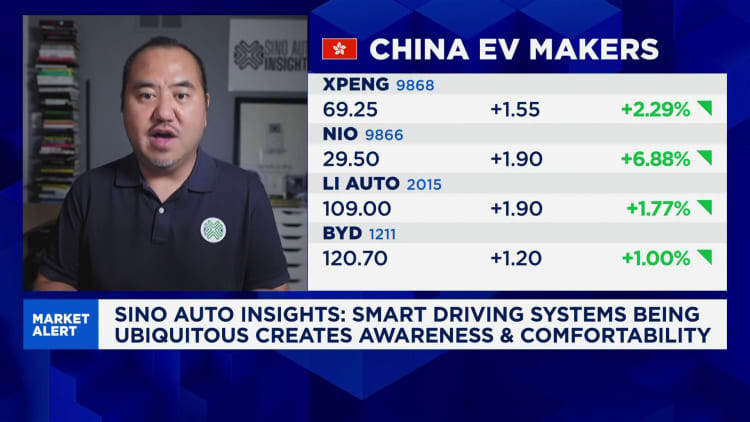
China’s push into electrical automobiles has been essentially the most obvious instance, with business large BYD providing some reductions of almost 30% or extra this 12 months and smartphone firm Xiaomi pricing its newest SUV beneath that of Tesla’s Mannequin Y.
U.S. espresso large Starbucks has struggled in China with falling gross sales because it maintains costs of round 30 yuan per cup ($4.20) — whereas a bunch of rivals from Luckin Espresso to boutiques promote lattes for as little as 9.9 yuan.
Even in industrial actual property, property house owners who’ve tried to lift costs in Beijing ended up dealing with larger vacancies, Rayman Zhang, managing director for North China, at property supervisor JLL, advised reporters Thursday. He famous that there is nonetheless inadequate demand — with little expectation for a turnaround within the close to future.
China is anticipated Tuesday to report second-quarter gross home product progress of 5.2% from a 12 months in the past, in accordance with a Reuters ballot. That might be slower than the 5.4% enhance within the first quarter, however consistent with the nationwide goal of round 5% progress for the 12 months.
However the second half of the 12 months will seemingly reveal a much more aggravating image, warned Jianwei Xu, senior economist for Larger China at Natixis. He was additionally talking at Friday’s webinar.
“We’re seeing the earnings particularly for manufacturing firms, are nonetheless reducing,” he stated. “There may very well be extra households below stress in [the second half of the year] as a result of it is going to be tougher to discover a job.”
A special problem
This is not the primary time China has handled overcapacity, analysts identified, referencing extreme capability within the state-dominated commodities sector a couple of decade in the past. However this time, fewer state-owned firms are concerned, making it tougher for policymakers to behave.
“The dominance of personal corporations in industries with overcapacity tends to complicate the coordination of mergers, even with authorities steerage,” Robin Xing, chief China economist at Morgan Stanley, and a staff stated in a report Thursday.
“The economic system can also be ranging from a weaker level, which necessitates extra demand-side stimulus to counter the influence of provide discount,” the report stated. “Nevertheless, the federal government’s debt degree is already excessive (~100% of GDP), which can constrain its willingness and skill to undertake aggressive fiscal growth.”
China’s prime leaders are anticipated to take care of the present fiscal stimulus at a high-level Politburo assembly late this month. Beijing in March raised the nation’s fiscal deficit for the 12 months to 4% — up from 3% final 12 months.

Subscribe now
Notably, Chinese language President Xi Jinping on July 1 led a high-level monetary and financial fee assembly that referred to as for more governance of “low price, disorderly competition,” in accordance with a CNBC translation of Chinese language state media.
The ruling Chinese language Communist Occasion’s official Qiushi journal on July 1 even outlined a number of measures that promote standardized authorities conduct to deal with involution-style competitors, warning of great financial injury. The article cited high-level authorities conferences from the final a number of months.
“To attain the expansion goal, Beijing may have no alternative however to launch a serious demand stimulus,” Hu stated. “Afterwards, the improved home demand would ease the value competitors amongst materials producers and web giants. However for producers, it is going to be an extended and painful course of to soak up the prevailing capability.”
International spillover
Exacerbating issues with resolving China’s home overcapacity is the commerce conflict with the U.S., Goldman Sachs analysts identified in a July 1 report.
The U.S. and European Union turned extra vital of China’s persistent overcapacity points final 12 months. Each have raised tariffs on Chinese language electrical automobiles particularly in an try to guard home automakers. The U.S. in April additionally focused China with larger duties throughout the board.
The escalation of tariffs has made Chinese language producers extra decided to construct factories abroad, “probably producing redundant provide within the coming years,” the Goldman report stated. The analysts estimated a 0.5% to 14% enhance in capability by the top of 2028, up from the 0.4% to 10% growth projected a 12 months in the past.
And amongst seven sectors — air conditioners, photo voltaic modules, lithium batteries, electrical autos, energy semiconductors, metal and development equipment — 5 have extra capability than the whole international demand, the Goldman analysts stated. Solely ACs, and EVs — simply barely — get pleasure from some market potential.
— CNBC’s Victoria Yeo contributed to this report.