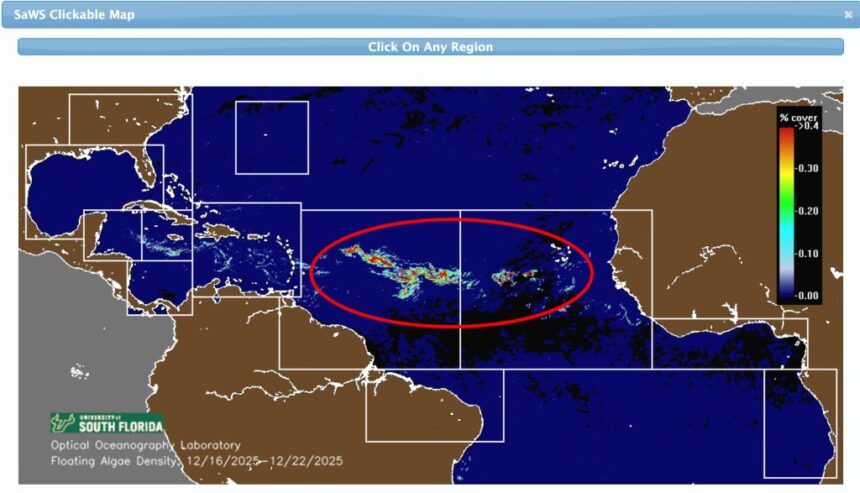
Massive mats of sargassum seaweed are once again drifting toward the Caribbean, with early signs already appearing along key coastlines in early January—weeks ahead of typical seasonal trends.
The first 2026 forecasts released by the University of South Florida’s Optical Oceanography Lab warn of a potentially significant bloom year, with preliminary satellite data showing above-average sargassum concentrations in the central Atlantic, a known precursor for large influxes in the Caribbean Sea.
“We’re observing early accumulations, particularly along the eastern shores of Barbados, Dominica, and parts of the French Antilles,” said Dr. Mengqiu Wang, an oceanographer with the USF team tracking the bloom via satellite imagery. “The transport patterns from the central Atlantic suggest elevated arrivals through the first quarter of 2026.”
Reports from Tulum and other parts of the Mexican Caribbean
Visitors in Tulum have already been posting photos of high sargassum arrivals in our Traveling Lifestyle FB Group: Mexico Sargassum Seaweed Updates (Cancun, PDC, Tulum, etc.)


Another traveler posted a photo from the early sargasum arrival in the Dominican Republic on January 8 at Bavaro beach.

2026 Could Mirror Record-Breaking Years
Although it is still early in the season, ocean scientists caution that current trends bear resemblance to heavy sargassum bloom years like 2018 and 2022, when tons of the brown macroalgae inundated beaches from Mexico to Martinique.
According to the latest bulletin by the Caribbean Coastal Ocean Observing System (CARICOOS), sea surface temperatures remain warmer than usual, providing ideal conditions for sargassum growth and drift. These warm waters, combined with nutrient inputs from West African upwelling and river runoff, are contributing to the explosive algae development across the tropical Atlantic.
Tourism and Fisheries on Alert
Local authorities and tourism stakeholders are already on alert. In Barbados, clean-up crews have been deployed ahead of the typical March peak season to handle new sargassum arrivals. Meanwhile, in Saint Lucia, fishermen are reporting difficulty navigating through the mats near traditional fishing grounds.
“We’ve had to cut through the sargassum just to get to our traps,” said Levi Joseph, a fisherman from Vieux Fort. “It’s not thick yet, but it’s worrying this early in the year.”
In 2022, cleanup costs across the region soared into the millions, and marine habitats suffered due to oxygen depletion caused by decomposing sargassum. A United Nations Environment Programme (UNEP) report highlighted how persistent sargassum blooms have disrupted ecosystems, economies, and human health.
Experts fear similar patterns may emerge if the 2026 season continues on its current trajectory.
Outlook Remains Cautious
While scientists stress that the full scope of the 2026 bloom remains uncertain, early indicators suggest Caribbean nations may need to prepare for a longer-than-average sargassum season. Mitigation strategies, including mechanical removal, sea barriers, and offshore harvesting initiatives, are being re-evaluated across the region.
Monitoring agencies, including NOAA, are expected to release updated forecasts in February, which will give a clearer picture of expected landings through spring and summer.
“This is a regional challenge that requires ongoing collaboration and adaptive management,” said Dr. Wang. “But early warnings like these are crucial for giving communities time to prepare.”