
At a glance
Expert’s Rating
Pros
- Beautifully engineered design
- Matt inner screen keeps crease minimal
- Software adapts brilliantly
- Surprisingly good battery life
Cons
- Touch ID instead of Face ID
- Cameras trail the iPhone 18 Pro
- No Action Button
- Very expensive and long wait time
Our Verdict
The iPhone Duo shows how much Apple has learned from watching its competitors develop folding phones over the past few years. The titanium design is gorgeous, the nano-textured matt inner display is a novelty in this category, and the software experience makes switching between the inner and outer displays feel effortless. Losing Face ID and the Action Button are two compromises I’d rather not have made, and the cameras don’t justify the price. But if you’ll use the larger screen regularly, it’s one of the best foldables around.
Price When Reviewed
This value will show the geolocated pricing text for product undefined
Best Pricing Today
Price When Reviewed
$1999
Best Prices Today: Apple iPhone Duo

If you’ve been holding out for a folding iPhone, the wait is finally over. The iPhone Duo is Apple’s answer to the Samsung Galaxy Z Fold 8 and the Google Pixel 11 Pro Fold, arriving around seven years after Samsung first unveiled a phone that could unfold into something closer to a tablet.
At £1,999/$1,999, it also has the highest starting price of any iPhone, sitting above the iPhone 18 Pro, iPhone 18 Pro Max and iPhone Air in Apple’s line-up. On the outside, there’s a 5.4-inch screen for everyday tasks. Open it up, and there’s a 7.6-inch display, powered by the same A20 Pro chip as the Pro models and a version of iOS 27 tailored to its dual-screen design.
Arriving late to the folding-phone party has given Apple years to study what its rivals got right and wrong, and in many areas, that shows. In others, the Duo makes compromises that existing iPhone owners may find hard to swallow, from the switch to Touch ID to a camera system that can’t keep pace with the cheaper 18 Pro.
I’ve been using the Duo instead of my iPhone 18 Pro Max for more than a week to find out who it’s really for and whether it justifies the hefty price.
Design & Build
- Titanium frame and IP68 rating
- Touch ID in place of Face ID
- Night Sky and Star White finishes
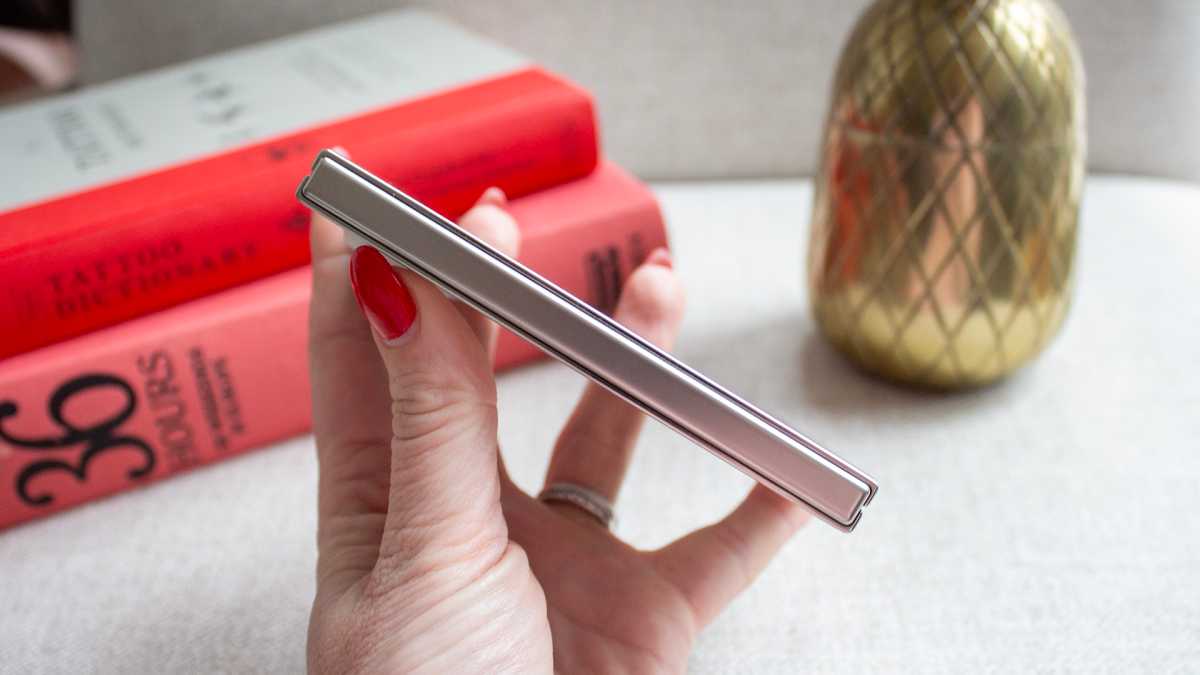
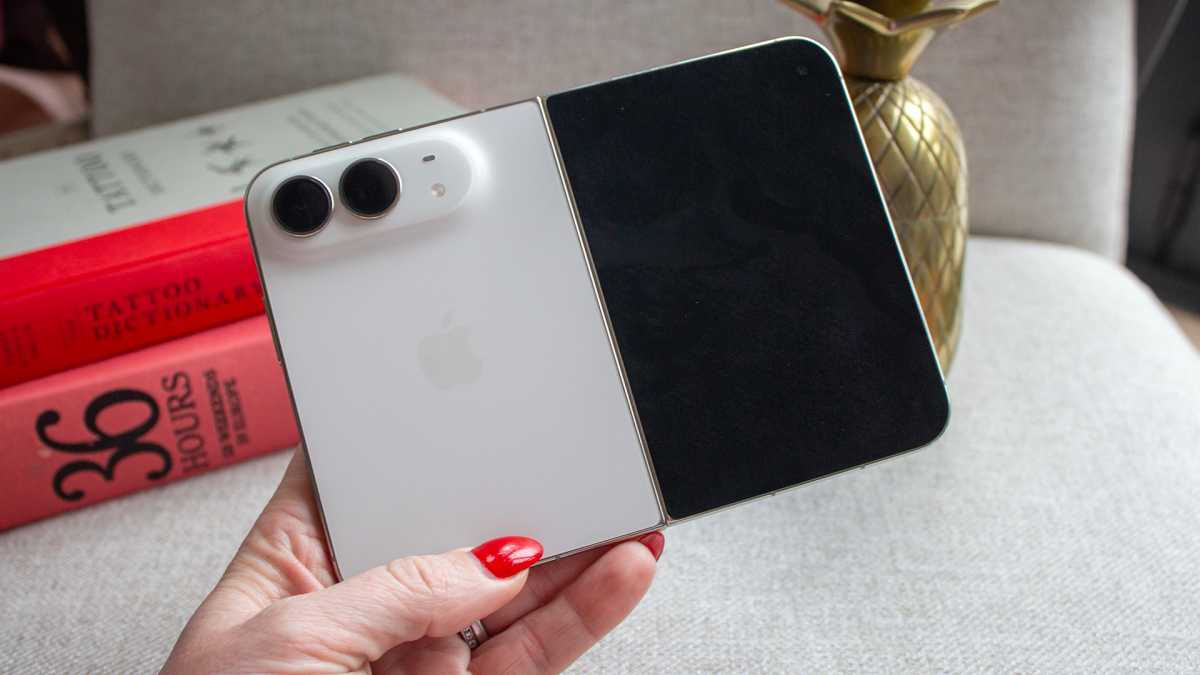
Apple is no stranger to delivering premium, well-built products, but the iPhone Duo might be its best example yet. It’s a gorgeous device that oozes quality in every respect, from the hinge to frame. That frame is slim (5.2mm) when open, crafted from titanium with a polished finish, while the hinge cover has a contrasting textured finish, and they complement each other well.
There are two colour options: Night Sky, which is a dark navy, and Star White (pictured), which is a pearly white. Both are lovely in the flesh, though Star White is more distinctive.
The hinge itself deserves particular mention for its consistent resistance from fully closed to fully open. This means the Duo stays put whether you have it slightly ajar, bent into an L-shape on a desk, or folded into a tent on the bedside table, and there are no signs of flex or flimsiness. Magnets pull the two halves of the Duo together with a pleasing click when you shut it, too, which is more satisfying than you’d expect.
Britta O’Boyle
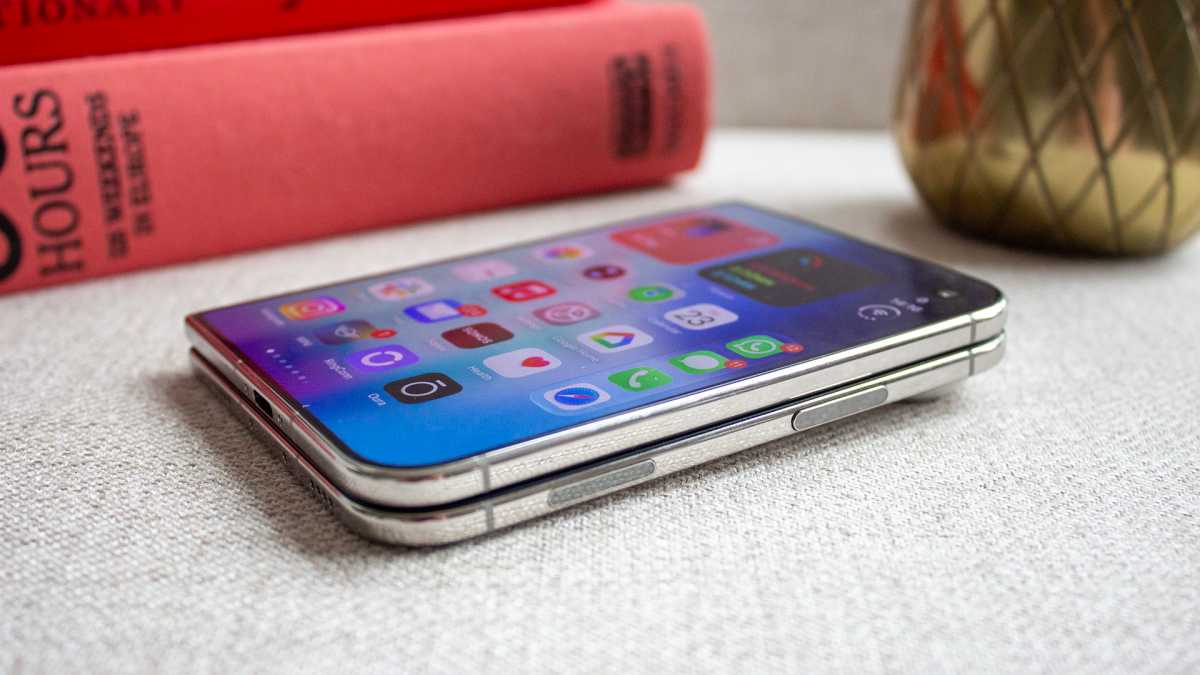
Closed, the Duo is short and wide rather than tall and narrow, with a format similar to Samsung’s Galaxy Z Fold 8 and a footprint not much different from a British passport. Unlike the Galaxy Z Fold 8, however, one side of the Duo has rounded corners, while the other has square ones, giving it an asymmetric look that took me a few days to warm to.
It makes more sense once you open it, with the rounded corners framing the inner display to resemble a small iPad mini. When closed, the curved corners rest against your palm, making one-handed use more comfortable. The Duo weighs 254g, so it’s far from light, but I found it well balanced open or closed, and the weight adds to its premium feel.
The Action Button hasn’t made the cut either, which I’ve found hard to accept
Apple’s Ceramic Shield 2 glass protects the outer screen, while the rear panel gets standard Ceramic Shield, and a hardened polymer layer covers the inner folding display. So far, I’ve picked up no scratches or scuffs, though it will be interesting to see how the surfaces hold up in a few months.
The Duo is IP68-rated for dust and water, which is still rare for a foldable. Google’s Pixel 11 Pro Fold is the only other one I can think of with the same rating, with others like Samsung’s Galaxy Z Fold 8 rated at IP48.
Britta O’Boyle
The biggest design change on the Duo compared with other iPhones (except the folding element, of course), is the lack of Face ID. Apple has put Touch ID in the power button on the Duo, as it does on its iPad and iPad Air, and while it’s accurate and works whichever screen you’re using, it just isn’t as seamless an experience as Face ID.
It’s worth setting up several fingers, as your grip changes depending on whether the Duo is open or shut, but you’ll need to go back to remembering to press the button, whereas Face ID just happens. An Apple Watch can handle unlocking for you, which helps reduce some of the irritation, but you’ll still need your fingerprint for Apple Pay and saved passwords.
The Action Button hasn’t made the cut either, which I’ve found hard to accept since I used it hundreds of times a day on my iPhone 18 Pro. The volume keys have also moved to the top edge, and more than a week in, they still don’t feel natural there. It’s also worth noting that the Duo is eSIM-only, so there’s no SIM tray. Aside from the lack of Face ID, however, these are minor flaws in an otherwise excellent design.
Screen & Speakers
- 7.6-inch inner and 5.4-inch outer OLED displays
- 120Hz ProMotion and up to 3,000 nits outdoors
- Nano-texture matt finish on the inner screen
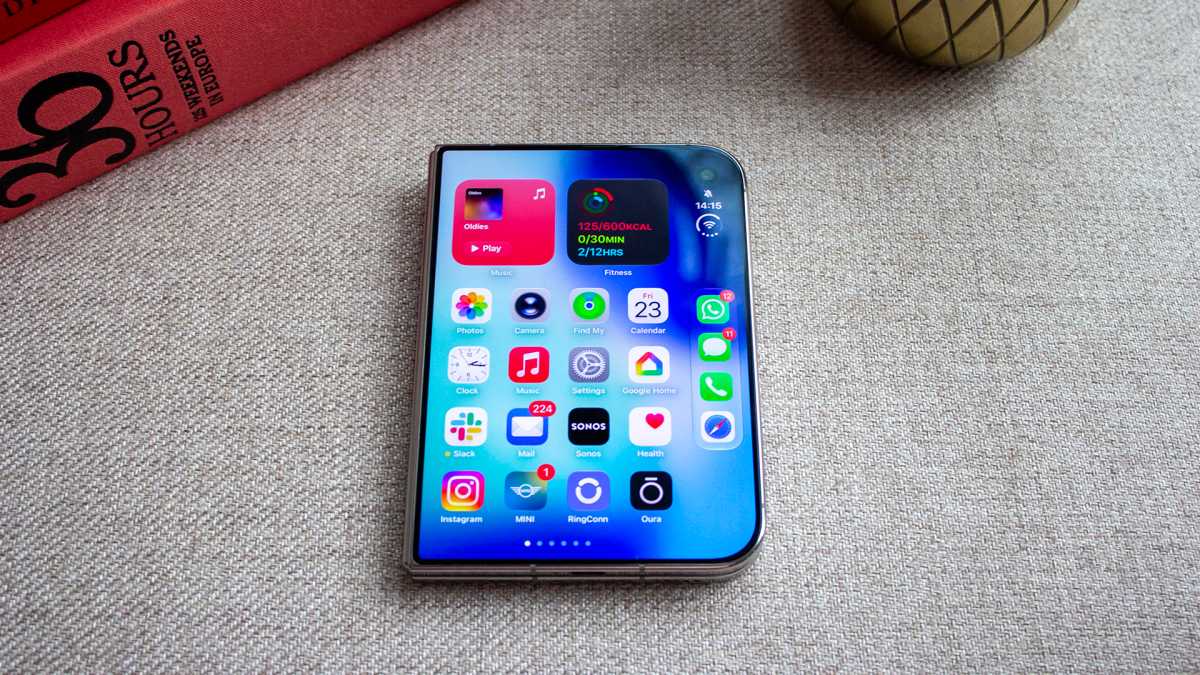
Both the external and internal panels on the iPhone Duo are 120Hz OLEDs with ProMotion, so scrolling is silky smooth, and both support Always-On. Colours are vibrant, and with a peak outdoor brightness of 3,000 nits, I had no trouble reading either screen in bright conditions. They do both attract fingerprints, though, so do make sure you have a cloth to hand.
The Duo’s 5.4-inch outer screen is small by current standards, but I never found it cramped. I should note that the iPhone 13 mini was one of my favourite iPhones, so I have never been opposed to smaller, more compact devices.
The crease all but disappears in normal use
Still, Apple says it offers 90 per cent of the iPhone 18 Pro’s screen area, so you don’t miss out on much. It also shares the same aspect ratio as the inner display, so apps look and behave consistently on both, creating a seamless experience.
Britta O’Boyle
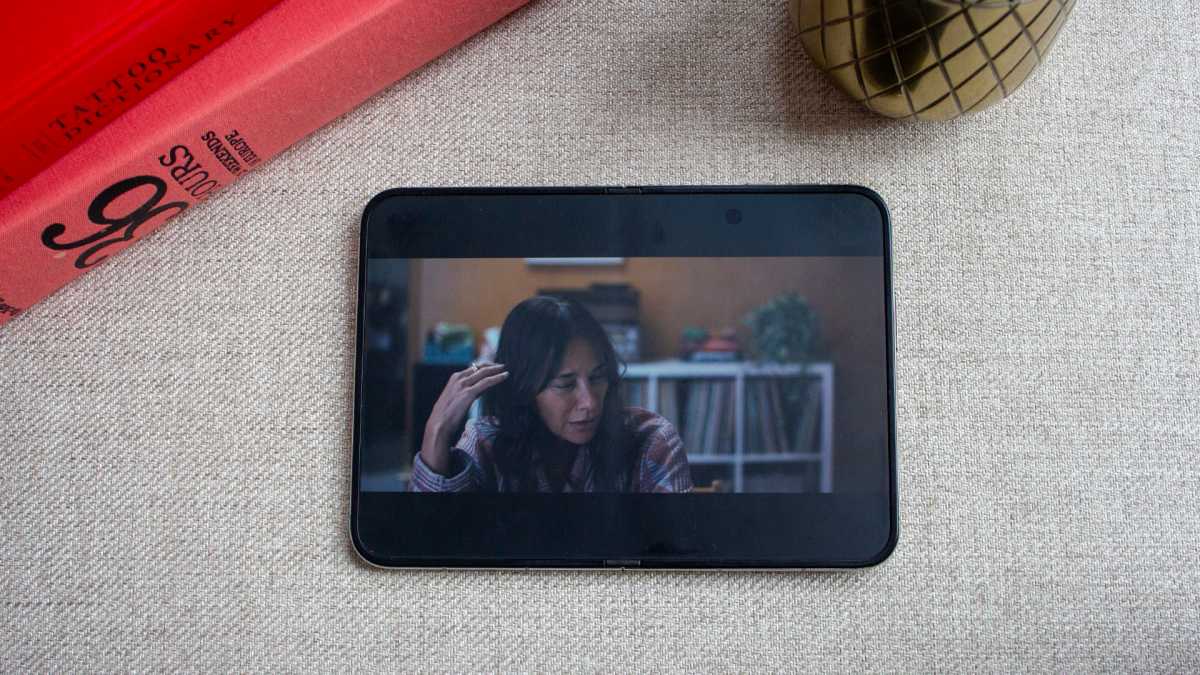
Unfold the Duo, and you’ll find a 7.6-inch display, said to be 50 per cent larger than the iPhone 18 Pro Max’s screen. This matches the Samsung Galaxy Z Fold 8, but the Duo’s inner display has a nano-textured matt finish. Every other foldable I’ve used, including Samsung’s, has a glossy inner screen that reflects light, feels plasticky, and makes the crease obvious from certain angles.
The Duo’s matt coating tackles many of those problems. Reflections are heavily diffused, the matt finish feels smoother and more pleasant under your finger, and the crease all but disappears in normal use. Drag a finger over the centre and there’s a faint groove, but it’s rarely visually distracting. The paper-like texture makes long reading sessions a pleasure, too.
Britta O’Boyle
There are downsides. The coating takes some of the punch out of dark content, so night-time scenes in films lack the inky depth of a glossy OLED, and some things can look washed out. Content also doesn’t look as good on the matt display as on a glossy one when you’re next to a window – something matt TVs suffer from, too – but it’s great outside.
The Duo’s squarer shape means widescreen content leaves black bars above and below when watching video, as on the Galaxy Z Fold 8, but you can zoom in if you want to. Anyone buying a foldable mainly to stream video may be just as well served, for less, by a large conventional phone, though so do consider what else you will do with that larger space.
As for audio, Apple has positioned the speakers to deliver stereo sound and Spatial Audio, no matter how you hold or prop up the Duo. As with any phone, you’ll get far better results with a pair of headphones, but the Duo delivers decent enough sound quality if you just want to watch a quick clip, take a video call or play a little music.
Specs & Performance
- Apple A20 Pro
- 12GB RAM
- 256GB, 512GB, 1TB and 2TB storage options
The Duo shares its A20 Pro chip with the iPhone 18 Pro and Pro Max, and performance is excellent. It’s Apple’s first processor built on a 2nm process, and in the Duo, it’s paired with a vapour chamber and a flexible graphite layer that dissipates heat across both halves of the phone.
In day-to-day use, it delivers a slick, speedy experience
In day-to-day use, it delivers a slick, speedy experience. Apps open instantly, transitions between the two screens are seamless, and running two apps side by side causes no slowdown at all. I played several games from Battlefleet Duo to NYT games, as well as the Toastie app (which I kept returning to far more than a sandwich game deserves) without any stutters.
Under sustained load, the Duo warms up more than the iPhone 18 Pro does, but that was nothing I didn’t expect from a device with such a slim frame. It’s also worth noting that, while it was sometimes warm, it never became hot or uncomfortable to hold.
Britta O’Boyle
Siri AI, Apple Intelligence tools such as image editing, and third-party apps such as Claude all ran smoothly. Elsewhere, Apple’s C2 modem handled cellular connections without issue during my testing. The N1 chip brings Wi-Fi 7, Bluetooth 6 and Thread support to Duo, and I had no connectivity issues there either. Satellite messaging, Emergency SOS and Roadside Assistance via satellite are all on board, as is Crash Detection, though thankfully I didn’t need to use any of them during my review period.
My review unit was the 512GB model, though the iPhone Duo also comes in 256GB, 1TB and 2TB options. I have over 70,000 photos and videos, along with hundreds of apps, and I use under 256GB, so that should give you some context if you’re mulling over storage options.
iPhone Duo benchmarks
- Geekbench 6 single-core: 4697
- Geekbench 6 multi-core: 12315
- 3DMark Wild Life Extreme Frame Rate: 37fps
- 3DMark Wild Life Extreme Stress Test: 63.3%
Cameras
- 48Mp main camera with 2x optical-quality crop
- 48Mp ultrawide
- 12Mp Centre Stage front camera and under-display FaceTime camera
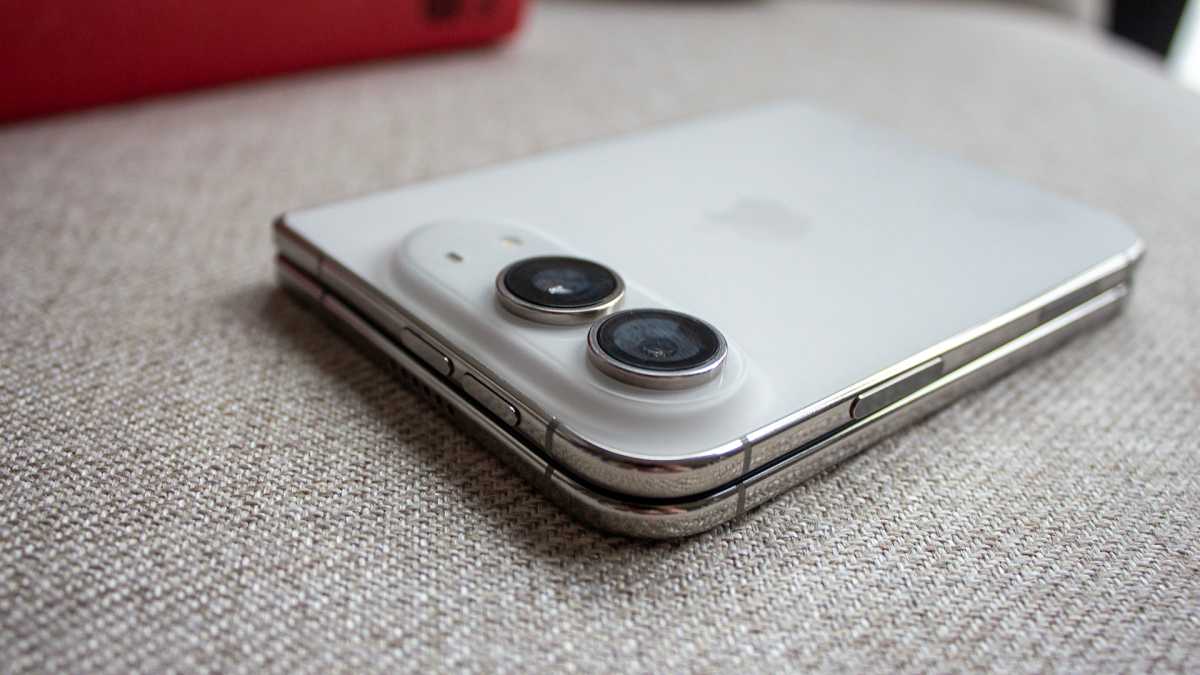
Squeezing a camera system into something as slim as the iPhone Duo, with a hinge and two screens to accommodate, inevitably involves trade-offs, and photography is where the Duo gives the most ground. On the back, you get two 48Mp sensors: a main camera and the same ultrawide used on the iPhone 18 Pro. There’s no dedicated telephoto lens, so the 2x zoom is achieved by cropping the main sensor.
If photography is high on your priority list, the Pro models remain the better choice
Two of the iPhone 18 Pro’s headline photography upgrades, the adjustable aperture and the manual shooting controls in the Camera app, are also missing. For a phone that costs £800/$800 more than the 18 Pro, that’s not an easy pill to swallow. If photography is high on your priority list, the Pro models remain the better choice.
Britta O’Boyle
That said, the photos from the Duo are still very good. In daylight, images are sharp, with natural colours and pleasing contrast, and the ultrawide matches the main camera’s tone well. After dark, results remain impressive, though each shot has a slight delay before it’s ready, something I didn’t notice on the 18 Pro. The lack of a telephoto becomes obvious when you try to capture anything far away. The 2x crop holds up well, but push beyond that and detail drops off quickly.
On the outer display, there’s a 12Mp Centre Stage front camera with a square sensor, so a tap is all it takes to switch a selfie from portrait to landscape. However, the eagle-eyed among you will notice a drop in resolution compared with the iPhone 17 and iPhone 18 Pro, despite having the same smarts. There’s also a camera tucked under the inner display on the Duo, which leaves the big screen free of cut-outs. It’s fine for FaceTime, but the detail is mushy enough that I wouldn’t use it for anything else.














Like other folding phones, the Duo uses its second screen for party tricks. Turn on Duo Preview, and whoever is in front of the lens gets a live view of the shot on the outer display, so they can adjust their pose. Flip it around, and you can frame selfies using the far superior rear cameras.
Smart Take, meanwhile, lets you prop the phone up and step into a group photo, leaving the Duo to decide when to fire the shutter, while Kid Cue plays a Snoopy animation on the outer screen to get little ones looking at the lens. My kids (and I) love Snoopy, so this was a huge hit in my house.
Video is strong, too, with 4K at 120fps, Cinematic mode effects that can be added after recording, and 4K time-lapses in Dolby Vision HDR. Since the Duo doubles as its own tripod when half-folded, too, setting up a time-lapse or a hands-free recording doesn’t require any extra kit.
Battery Life & Charging
- Two batteries, one in each half
- 50 per cent in around 20 minutes with a 60W adapter
- Up to 25W MagSafe wireless charging
Inside the Duo are two batteries, one tucked into each half, and Apple’s power management balances the load between them. The company claims up to 24 hours of typical use, up to 31 hours of video playback on the inner screen, and up to 44 hours on the outer screen.
In my experience, that’s better than both the iPhone 18 Pro and the Galaxy Z Fold 8
I’ll admit, I was sceptical and ready for the battery life to be another compromise, but the Duo comfortably got me through every day of testing. On heavy days, with plenty of writing on the inner display, streaming, gaming, camera testing and a steady flow of messages and emails, I’d go to bed with roughly 25 per cent still in the tank.
Meanwhile, on slower days, I’d finish with around 40 per cent remaining. In my experience, that’s better than both the iPhone 18 Pro and the Galaxy Z Fold 8, though, unsurprisingly, it doesn’t quite match the iPhone 18 Pro Max.
Britta O’Boyle
Charging is quick, too. With a 60W adapter, the Duo will go from flat to 50 per cent in around 20 minutes. MagSafe and wireless charging both top out at 25W, but if you’re charging overnight, that doesn’t really matter. Don’t expect a power brick in the box, though: Apple only includes a USB-C cable, so you’ll need to factor that in if you don’t already have one.
Software & Apps
- iOS 27, optimised for two screens
- Split View multitasking
- Siri AI
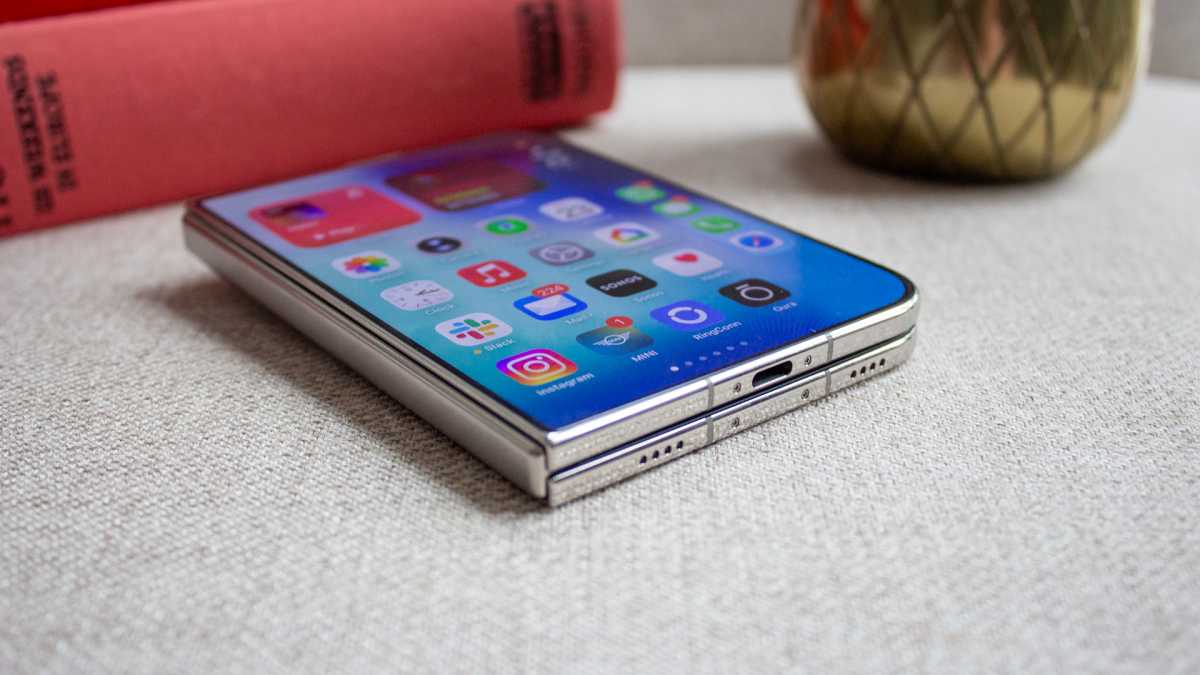
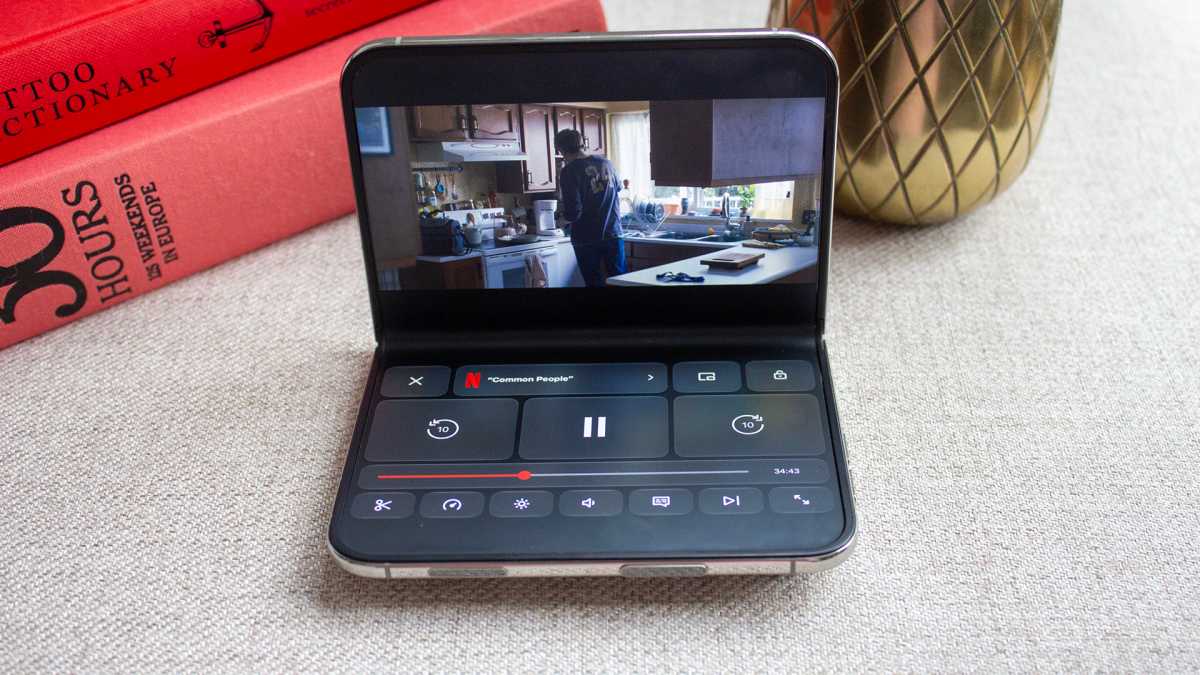
Hardware aside, the software makes the Duo experience great. The transitions between the two screens are among the slickest I’ve seen on any foldable. Unfold the phone mid-task and apps seamlessly fill the larger canvas without missing a beat. Close it and everything scales back down. Bend it to a right angle and optimised video apps such as Netflix move their playback buttons to the bottom half, leaving the top for the picture.
When everything clicks, the Duo is a superb productivity tool
The layout does take some getting used to. To make the most of vertical space, the Dock and app controls sit along the right edge of the screen rather than at the bottom, and there’s currently no option to move them to the left. Years of muscle memory are hard to undo, and more than a week later, I am still tapping for controls that have moved.
Britta O’Boyle
App support is the other caveat. Apple’s own apps, from Mail and Messages to Photos and Apple TV, have been redesigned to use the extra space, and a growing list of third-party apps have followed, with Netflix, Slack, Sonos, Oura and Instagram all adding Duo support while I was testing.
Those still waiting for an update are boxed in by a dark band on the outer screen and sit marooned in the centre of the inner one, spoiling the experience. That said, even as I was writing this review, more and more apps were being optimised, so I expect this to continue to improve over the coming weeks as developers catch up.
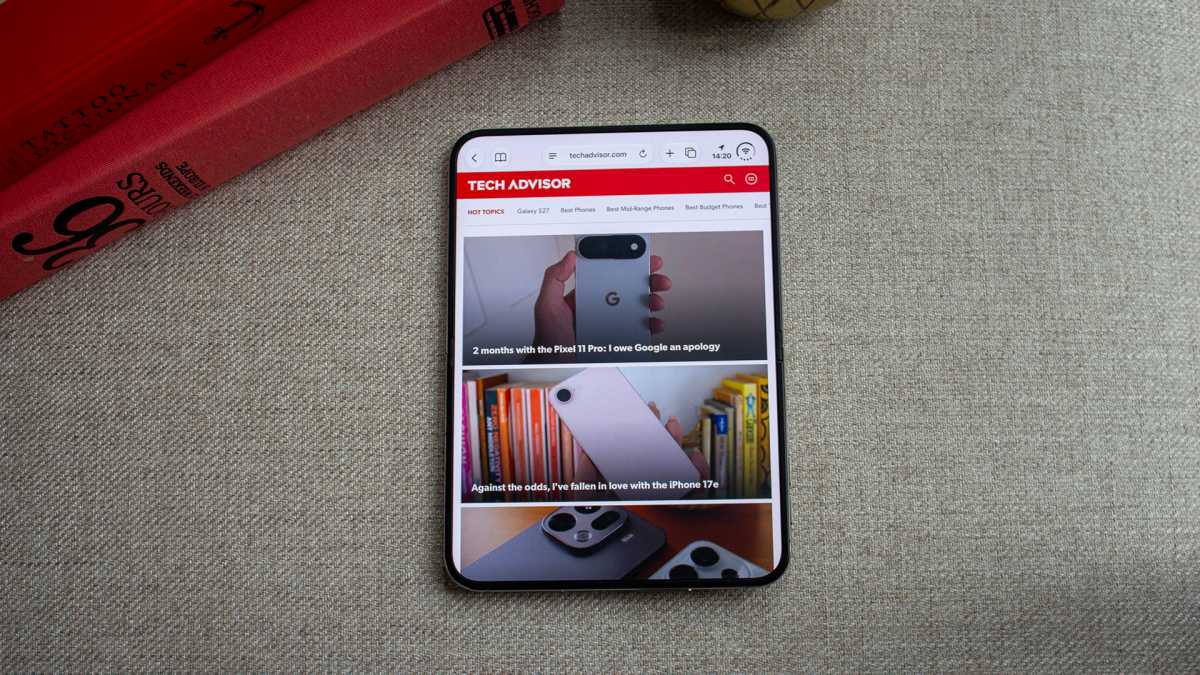
When everything clicks, the Duo is a superb productivity tool. Split View lets you run two apps side by side, or two windows of the same app, and I used it constantly for Mail with Calendar, Messages with Photos, and Slack with Pages. Some apps are superb in full screen on the Duo’s inner display, too, and as I’ve used the Duo, I’ve found more and more use cases.
I’ve written an entire article in Pages, cross-referenced a Trello board and invoicing software, and really enjoyed catching up on the news while holding the Duo vertically. The keyboard adapts well, too, filling the screen when open, splitting in two when the Duo is half-folded, and leaving plenty of room to see what you’re replying to when using it on the outer display.
Britta O’Boyle
Elsewhere on the software front, StandBy has also been reworked for the Duo and no longer requires the phone to be charging. Stand the Duo up like a book or fold it into a tent, and it becomes a bedside clock, photo frame or calendar. Siri AI is on board as well, and having used it for several months, I’ve found it far more capable than the old Siri. It’s done everything from finding a restaurant I visited in Barcelona a couple of years ago to surfacing a marinade recipe my mum sent me in 2023.
One last point is that Apple Pencil compatibility is on the Duo roadmap too, with support for both screens arriving in an update due by the end of 2026.
As ever, Apple doesn’t commit to a set number of years of updates, but iPhones typically receive around seven years of support.
Price & Availability
The iPhone Duo starts at £1,999/$1,999 for the 256GB model. Prices rise to £2,199/$2,199 for the 512GB model, £2,599/$2,599 for the 1TB model and £3,199/$3,199 for the 2TB model. Pre-orders opened on 16 October, and it went on sale on 23 October. However, demand quickly outstripped supply, and orders placed now aren’t expected to arrive until January 2027.
It’s available from Apple, as well as from retailers including Amazon and Currys, and from networks including Vodafone, EE and O2. In the US, you can buy it from Apple and other retailers, including Best Buy, as well as from AT&T and Verizon.
Should you buy the iPhone Duo?
Apple’s first foldable sets a high bar. Its titanium build and hinge are exceptional; the matt inner display solves the crease and reflection problems that have dogged folding phones for years; and intuitive software makes moving between the two screens feel completely natural.
But it isn’t flawless. Swapping Face ID for a fingerprint sensor feels like a step back; the absence of the Action Button is a compromise I’d rather not have had to make; and the camera hardware doesn’t match the price tag. Not every app is ready for the new layout yet, either, though even as I write this review, that situation is improving.
Whether it’s right for you depends on how much you’ll use the inner display. Photography fans, and anyone who simply wants more room for Netflix, will get more for less from the iPhone 18 Pro Max. But if that 7.6-inch screen would become your go-to for long reads, emails and working across two apps at once, the Duo is a remarkable first attempt, and one that continues to win me over the longer I use it.
Specs
- iOS 27 with Apple Intelligence
- 7.6-inch, 120Hz ProMotion OLED inner display with nano-texture finish
- 5.4-inch, 120Hz ProMotion OLED outer display
- Up to 3,000 nits peak outdoor brightness
- Apple A20 Pro
- 12GB RAM
- 256GB/512GB/1TB/2TB storage
- 48Mp main camera with 2x optical-quality zoom
- 48Mp ultrawide camera
- 12Mp Centre Stage front camera
- Under-display FaceTime camera
- Up to 24 hours typical use battery
- 60W wired charging
- 25W MagSafe wireless charging
- Touch ID
- IP68 water and dust resistance
- Grade 5 titanium frame
- Ceramic Shield 2 outer display, Ceramic Shield back
- 5G, Wi-Fi 7, Bluetooth 6
- eSIM only
- 164.6 x 117.8 x 5.2mm (open); 117.8 x 84.1 x 11.3mm (closed)
- 254g
- Night Sky, Star White