INGLEWOOD, Calif. – Iran’s World Cup opener was played in the shadow of war, even amid discussions of a ceasefire deal, a signal that FIFA had not delivered on its promise of an issue-free tournament before the team’s 2-2 draw with New Zealand on Monday at SoFi Stadium.
FIFA president Gianni Infantino said in the months building up to the World Cup that things would go as planned for Iran and though their group stage schedule remains unchanged from December’s draw, Iran complained of several issues that impacted their preparation for Monday’s match. Chief among them is the location of their base camp in Tijuana, Mexico. They were originally slated to reside in Tucson, Arizona, for the World Cup, but the change was made weeks before the tournament began because of travel restrictions imposed by the U.S. government. They have now been limited to spending as little time in the U.S. as possible, despite the fact that they will play all of their group stage games in the country and presumably many of their knockout matches should they advance.
Iran spent little more than a day in the Los Angeles area, arriving Sunday afternoon and departing Monday right after the match. Their trip from Tijuana to Los Angeles, usually a 45-minute flight, took five hours, with Mehdi Taremi alluding to the fact that they were held up by customs and border patrol authorities. The travel limitations have also disrupted their pre- and post-match routines, crucial both to performance and player fitness.
“We must come here two days before the game,” Mohammad Mohebi, one of the goalscorers on Monday, said. “Yesterday’s trip [started] in the morning and we arrive at afternoon and we direct[ly] go to the training. We get tired, you know. I think it’s supposed to be [that] we came here two days before the game. This kind of thing, I think, it’s not a little bit fair, no? We need to get fair [competition], no?”
The players also rushed through their post-match media responsibilities, insisting they had a flight to catch.
“I think FIFA told us you have to go,” Taremi said. “Our preparation, it’s supposed to be, as I said, tomorrow morning recovery, then we fly to Tijuana, then we return to L.A. again, but now, right now, we have to go back. … Everything is a disaster, actually, for us. It’s not the right thing for us, but we don’t follow the excuse. We’re just looking forward. We’re having hope for the next two games and we will do our best for our people and bring the joy for our supporters.”
Infantino also paid a visit to Iran’s locker room after the match, doing so after he attended Belgium’s 1-1 draw with Egypt at Seattle’s Lumen Field in a game that kicked off six hours before Iran’s tie with New Zealand did. Taremi said Infantino promised to help and that he believed him.
“He just wants to help us,” Taremi said. “He said it’s the beginning of the World Cup now and he will help us. … Why not [believe Infantino]? We believe everything. We are here for peace, for the joy to our supporters, as we said always. We are not looking around the things of football. We are just looking for the football.”
The disruptions to Iran’s cadence have impacted the team for several months now, dating back to the joint military strikes by the U.S. and Israel in February that led to the start of the Iran war. The interruptions included two quickly arranged closed-door friendlies in March in Turkiye, though their participation in those matches was unclear because of travel restrictions in the Middle East forced by the war. Their fitness levels seemed to dim faster than New Zealand’s, who enjoyed a much more straightforward road to the World Cup than their counterparts.
“It’s a bad situation and you just tired of this situation because from two months ago, last month, we’re having a lot of problems, no?” Mohebi said. “It’s so bad, and it’s affect[ing] our team, and we just want peace.”
A passionate but tense fanbase fills the stadium
The crowd that filled SoFi Stadium on Monday was largely there to support the Iranian side, which was not exactly a surprise – Los Angeles is home to the largest population of Iranian people outside of the country itself, the supporters living up to the promise of a World Cup in North America where immigrant communities have found a home in large numbers.
“I want to mention the supporters in Los Angeles because it was an incredible atmosphere during the game for 90 minutes, and we are much appreciat[ive] about that, and it was like home for us.” Taremi said. “I hope they [are] doing the next two games the same [way], but Tijuana, we are so comfort[able] there. Everyone likes us [from] what I saw, and we are appreciat[ive] of them, too, and looking forward [to] the next two games, and I hope they support us the same.”
The crowd, though, was of a unique makeup. Several fans clad in Iran merchandise carried the Lion and Sun flag or wore shirts branded with the signage of the flag, a popular image associated with Iranian opposition movements. Though FIFA had signs throughout the venue saying they would confiscate political signage as they see fit, as well as accompanying announcements over the loudspeakers, it was unclear if tournament organizers ultimately took away those flags in large numbers. Imagery associated with the Lion and Sun flag was visible throughout SoFi Stadium over the course of the game, even if it appeared that the world feed was careful not to catch those sights for the international broadcast.
There was some noticeable tension amongst the fans, some of whom booed and whistled during Iran’s national anthem before the game. Ramin Rezaeian, who scored Iran’s opening goal on Monday, refused to answer a question on the topic in one of the team’s futile attempts to focus on soccer rather than politics.
“Actually, we are here to answer football questions,” Rezaeian said, “My people in Iran, they are so great, they are so good [about] everything. Everyone in the world now knows about my people. If there is any problem between us, this is our business. It’s none of your business, so I just respect you, but this is something between us. We’re going to solve it. Don’t worry.”
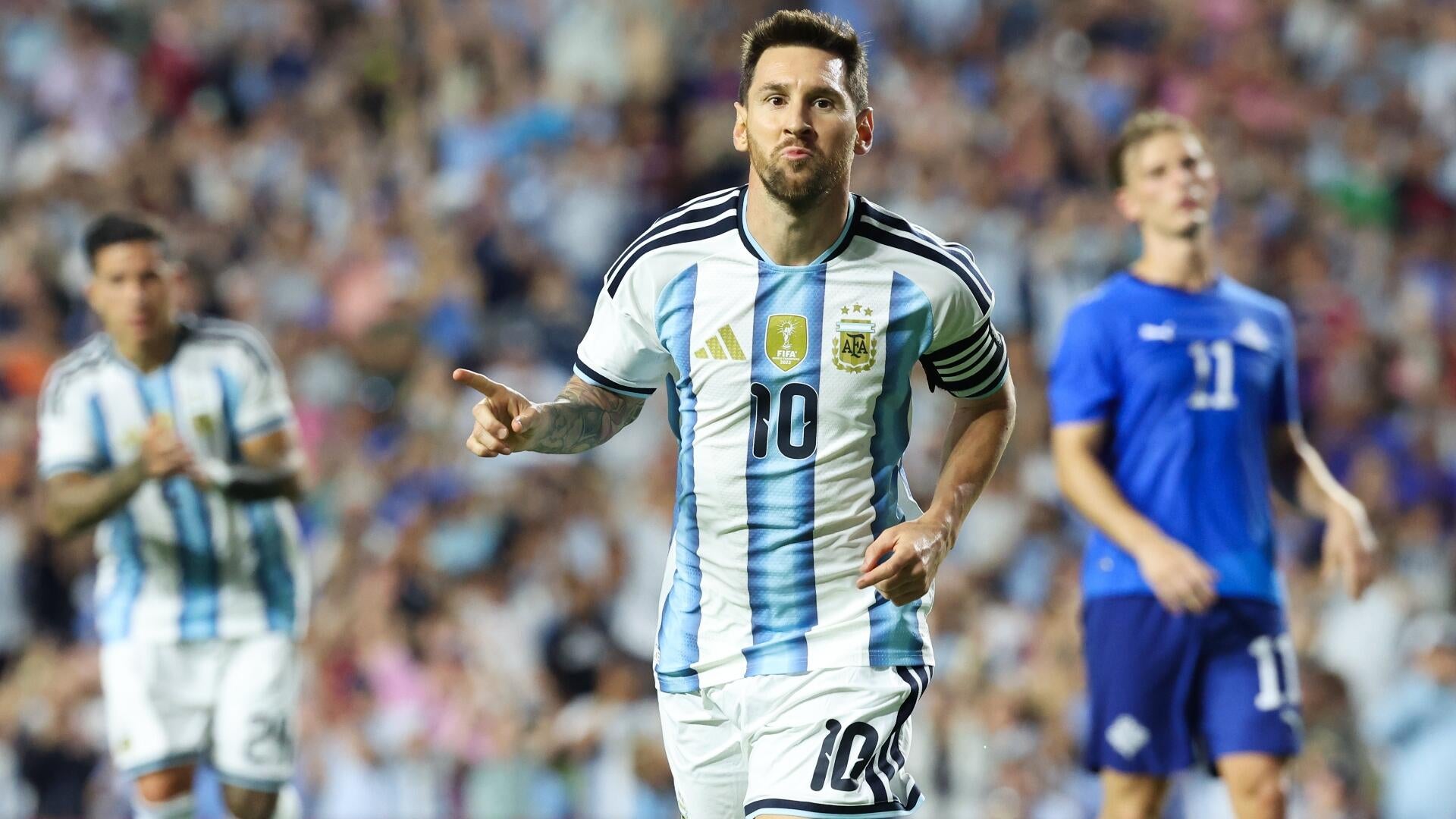
Though Iranian fans outnumbered New Zealand’s support, it was clear that a large portion of the crowd were there first and foremost without a natural rooting interst, clad in jerseys of their liking, regardless of who was playing. It was easy to pick out fans wearing the U.S. men’s national team’s red and white striped kit and the same went for the iconic light blue-and-white strip of Argentina.
Fans clad in Mexico gear were almost easier to spot than the rest, in part because the Los Angeles area houses many of them and Monday’s game was ultimately geographically accessible to them. Many of them appeared to cheer for Iran, much as they did for Iraq during their intercontinental playoff match against Bolivia in March in the Monterrey area. Iran’s players also commended the people of Tijuana for their hospitality, especially during a World Cup that has been far from smooth.
“I have to thank the people in Mexico because they were so nice,” Rezaeian said. “They have a great behavior [towards] us, but actually it’s so difficult. We train in Mexico and we play in L.A.”
Iran continue their group stage run against Belgium on Sunday at SoFi Stadium before concluding Group G play against Egypt on June 26 at Seattle’s Lumen Field.