Scientists sound the alarm as biomass surges 31%!
South Florida’s coastline is facing what researchers are calling an unprecedented environmental and economic crisis. Scientists warn that 2026 is on track to become the worst sargassum season ever recorded, with projections suggesting seaweed levels may surpass even the historic highs of 2025.
In January, NASA satellites detected a volume of sargassum greater than any previously recorded in January in history. By March, the biomass within the Great Atlantic Sargassum Belt had reached 19.6 million metric tons — a 31% increase compared to the same period in 2025, when the annual total across the tropical Atlantic reached 50 million tons, according to data from the University of South Florida’s Optical Oceanography Lab.
Dr. Chuanmin Hu, professor of oceanography at the University of South Florida and a pioneer in satellite monitoring of the phenomenon, offered a stark assessment. “As a scientist, it is unsettling to witness how in the past two or three years, we have been setting more and more historical records,” he told CBS Miami. He was equally direct about the limits of intervention: “No one can stop the enormous amount of sargassum in the ocean. All we can do is prepare.”
Tourism Dollars at Risk as Shorelines Turn Brown
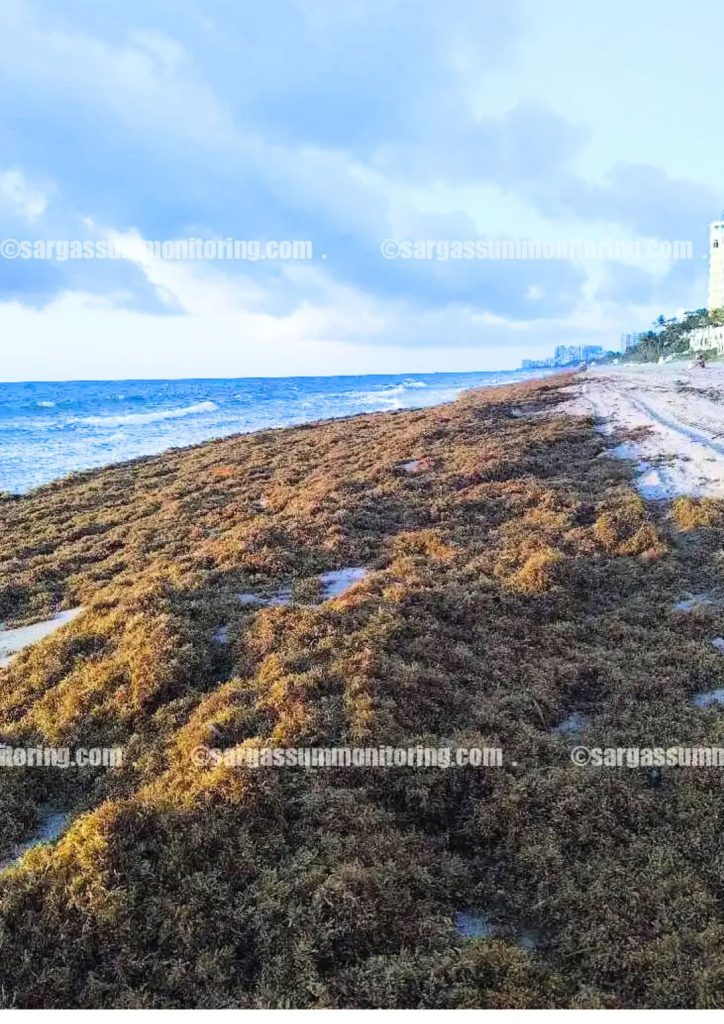
The effects are already visible along Miami’s iconic shoreline. Last week, three tractors spent over an hour raking the beach at South Pointe Park in Miami Beach, while beachgoers navigated through dense piles of seaweed that turned nearshore waters a murky brown. At Crandon Park Beach, a commercial film crew was forced to reposition cameras to remove sargassum heaps from their shots.
Miami-Dade County taxpayers spend nearly four million dollars annually to remove algae from approximately 27 kilometres of public beaches — a cost that has grown steadily since systematic cleaning operations began in 2019. The deeper economic toll, however, is far greater. Di Jin, a scientist at the Woods Hole Oceanographic Institution’s Ocean Discovery Center, estimates that Florida’s tourism and fishing sectors absorb approximately $2.7 billion in losses, with total projected economic damage statewide potentially reaching $10 billion in 2026.

The reputational damage is compounding the financial strain. Brena Watson, a traveller from St. Louis who had been considering a Miami beach holiday, told reporters she was now weighing Las Vegas or New York instead. “We don’t need that in our lives. A beach vacation should be clean, beautiful, and enjoyable,” she said.
A Health Hazard Beyond the Smell
The crisis extends beyond aesthetics and economics. When sargassum decomposes on shore in tropical heat, it releases hydrogen sulfide (H₂S) — a colourless, toxic gas recognisable by its rotten-egg odour. Research published in Harmful Algae in early 2026 found that cleanup workers in the Mexican Caribbean were exposed to H₂S concentrations peaking at 50.8 parts per million during the 2025 season, with nearly half of all readings exceeding Mexico’s occupational safety standard of 1 ppm.
The U.S. Environmental Protection Agency has documented thousands of acute exposure cases across the Caribbean region and flags elevated risk for people with asthma, the elderly, pregnant women, and infants. The seaweed also bioaccumulates heavy metals including arsenic, raising further concerns for coastal food chains.
Climate Change and Nutrient Runoff Drive the Bloom
Experts attribute the accelerating crisis to a convergence of factors: nutrient runoff from the Amazon River, shifting ocean currents, and warming sea surface temperatures linked to climate change — all of which create increasingly favourable conditions for sargassum growth. The NOAA classifies pelagic sargassum as critical habitat for sea turtles and other marine species, meaning the seaweed cannot legally be removed until it has already washed ashore, limiting the window for preventive action.
The phenomenon is not confined to Florida. In 2025, eastern Cuba issued a maximum public health alert as sargassum overwhelmed its beaches. This year, the entire Caribbean basin is monitoring the same trajectory — with South Florida, once again, directly in its path.