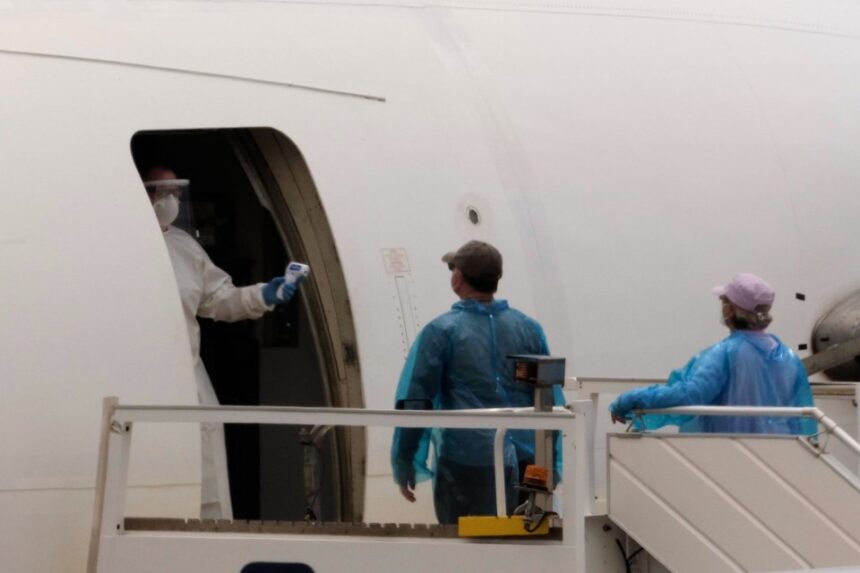
Eighteen American passengers evacuated from the MV Hondius — the Dutch cruise ship at the center of a deadly international hantavirus outbreak — are now under medical monitoring at specialized biocontainment facilities in the United States.
One passenger has tested positive for the virus, a second is experiencing symptoms, and the remaining 16 are asymptomatic but under close observation. Federal health officials emphasize that the risk to the general public remains extremely low.
How the Americans Arrived Home
The passengers disembarked the MV Hondius in Tenerife, Spain’s Canary Islands, on May 10 and were repatriated via a U.S. State Department medical flight, landing at Offutt Air Force Base in Omaha, Nebraska early Monday morning. Sixteen of the 18 — including 15 American citizens and one dual U.S.-British national — were transported directly to the National Quarantine Unit at the University of Nebraska Medical Center, the nation’s premier federal quarantine facility. The remaining two passengers, a couple with one showing symptoms, were transferred to the Emory University Hospital biocontainment unit in Atlanta.
Dr. Angela Hewlett, medical director of the Nebraska Biocontainment Unit, told CNN that the facility is being used for patients who are well but need to be monitored, describing it as “more like a hotel than a patient care space.” She added that the unit — equipped like an intensive care unit — can care for patients ranging from well and stable to critically ill, and that she “highly” encourages all passengers to remain for the full monitoring period.
The Virus: What Makes This Outbreak Unusual

The pathogen responsible is the Andes hantavirus, a strain found primarily in South America and, critically, the only known hantavirus capable of human-to-human transmission. All other hantavirus strains spread exclusively through contact with infected rodents or their droppings. The European Centre for Disease Prevention and Control confirmed on Tuesday that as of May 12, 11 cases have been reported globally — nine confirmed and two probable — with three deaths recorded.
The WHO’s working hypothesis is that the index case, the first passenger to fall ill, most probably acquired the infection prior to boarding through environmental exposure during activities in Argentina. Current evidence points to subsequent human-to-human transmission onboard, given documented epidemiological links of some subsequent cases with the index case during his illness.
The fatality rate of hantavirus pulmonary syndrome is 30 to 40 percent, and there is no specific treatment or cure beyond supportive care, according to infectious disease specialist Dr. Krista Debbink. Symptoms — which include fever, muscle pain, chills, gastrointestinal distress, and rapidly progressing respiratory failure — can take anywhere from four to 42 days to appear following exposure, a window that makes monitoring all 150 passengers and crew from 23 countries a global public health undertaking.
The Outbreak’s Timeline
The MV Hondius departed Ushuaia, Argentina, on April 1 on a 33-day expedition voyage. The first passenger died on April 11. His body was taken ashore at Saint Helena on April 24, where his wife disembarked before dying two days later in a hospital in Johannesburg. A third passenger also died on board. Hantavirus was not confirmed as the cause until May 2, when testing on a critically ill patient evacuated to South Africa returned positive results. By that point, 30 passengers had already disembarked at Saint Helena — all of whom are now being contact-traced by the UK Health Security Agency.
The CDC classified the outbreak a Level 3 emergency response, its highest activation tier, and deployed infectious disease experts to coordinate with international partners on monitoring guidance distributed to state and local health departments across the country.
What Officials Are Saying
WHO Director-General Dr. Tedros Adhanom Ghebreyesus said at a press conference on Sunday: “Based on scientific assessment and based on evidence, the risk to the public is low.” However, he cautioned that “given the long incubation period of the virus, it’s possible we might see more cases in the coming week.”
Nebraska Governor Jim Pillen addressed residents directly, saying at a Monday press conference: “We’re glad that you’re here. We’re going to ensure that you have the best world-class care possible,” while adding: “No one poses a risk to public health, just walking out the front door of the streets of Omaha.”
What Travelers Should Know
The CDC states that routine travel can continue as normal and that the outbreak poses no meaningful risk to the American public. Hantavirus is not airborne in the conventional sense and is not transmitted through casual contact. The Andes strain requires close, sustained exposure to an infected individual.
Passengers or travelers who were aboard the MV Hondius since April 5 and develop symptoms — particularly fever, muscle aches, fatigue, or difficulty breathing — should contact their local health department immediately and disclose their travel history before seeking in-person care.