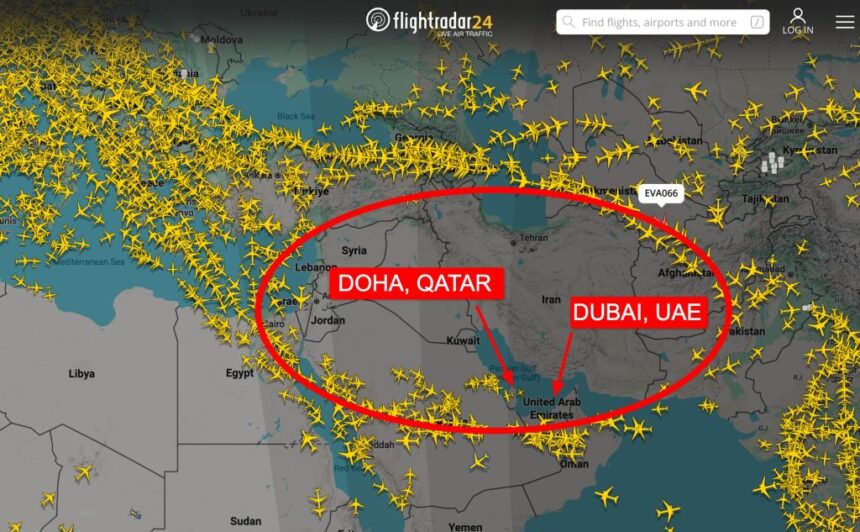
Widespread airspace restrictions across parts of the Middle East have triggered thousands of flight cancellations and diversions, creating the most significant disruption to global aviation corridors since the pandemic.
According to reporting by The Guardian, airlines suspended routes and rerouted aircraft after escalating regional tensions led to temporary airspace closures. “Flights have been cancelled across multiple carriers as airspace restrictions tighten,” the publication reported, describing scenes of stranded passengers and rapidly shifting flight schedules.
The disruption affects not only direct flights to the region but also long-haul routes connecting Europe and Asia, many of which rely on Middle Eastern airspace corridors for efficient transit.
Which Routes Are Impacted
Major hubs such as Dubai and Doha play a central role in intercontinental connectivity. When regional airspace narrows, airlines are forced to reroute via longer paths over Central Asia, the Mediterranean, or the Arabian Sea, increasing flight times and fuel costs.
Carriers including Lufthansa and Emirates have adjusted schedules, with some suspending specific city pairs while maintaining limited operations through alternative corridors.
The ripple effect extends beyond the Middle East. Flights between Europe and South Asia, Southeast Asia, and Australia may experience delays or aircraft swaps as airlines reposition fleets.
How Airlines Are Rebooking Passengers

Airlines are offering rebooking options, including alternate routings, travel vouchers, or refunds, depending on fare class and local regulations. European Union carriers remain bound by EU261 compensation rules in certain cancellation scenarios, though extraordinary circumstances—such as airspace closures tied to security concerns—may limit automatic compensation.
Passengers are advised to monitor airline apps and official notifications closely rather than relying solely on airport departure boards. Travel experts recommend avoiding voluntary cancellations, as doing so may forfeit rebooking protections.
Flexible tickets and travel insurance policies covering trip interruption are proving valuable in the current climate. Industry analysts note that while airlines have improved operational resilience since COVID-19, geopolitical disruptions remain inherently unpredictable.
For now, operational stability depends on how long airspace restrictions remain in place. If closures persist, schedule reductions could extend into additional markets, affecting peak spring travel flows between Europe and Asia.
Travelers with imminent departures through the region are urged to confirm flight status before heading to the airport and prepare for potential delays as airlines recalibrate global networks in real time.