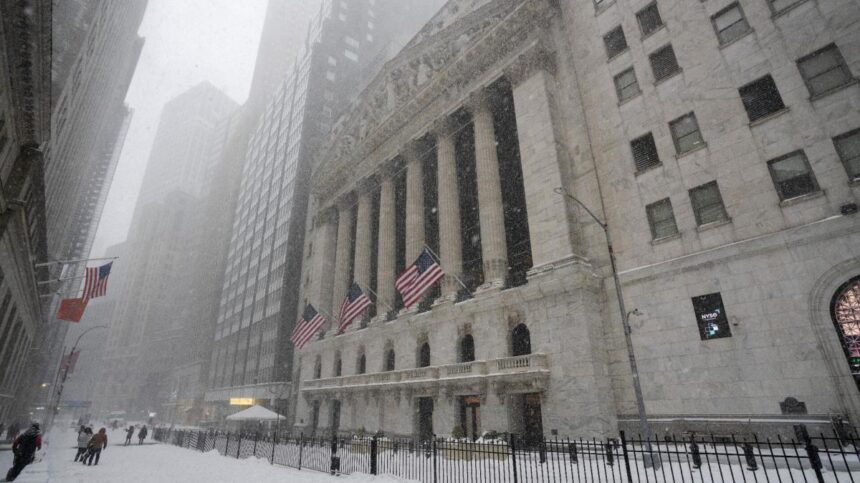
Massive blizzard Hernando could slam Wall Street Monday
Share
10 Min Read
SHARE
The New York Stock Exchange has survived global wars and financial collapses, but its Achilles’ heel remains a classic Nor’easter.
As a 30-year Wall Street veteran, I’ve seen the floor survive plenty of “snow days,” but Monday’s forecast is a different animal. With a blizzard warning officially in effect for Manhattan and 60 mph gusts targeting the Five Boroughs, the question isn’t just about the accumulation — it’s about the infrastructure.
Historically, the NYSE stays open unless the city’s veins stop pumping. But with the MTA already slashing Metro-North and LIRR service, we are hitting the “staffing trigger” where getting essential market makers to 11 Wall Street becomes a physical impossibility.
While electronic trading has made the market more resilient since the days of the Great Blizzard of 1888, a total shutdown isn’t off the table when the safety of personnel is at risk.
Here is what the record books — and the current MTA service alerts — tell us about the likelihood of a trading halt this Monday.
The decision to shut down the world’s most famous trading floor doesn’t happen because of a few snowflakes on a bronze bull. It’s governed by a specific regulatory framework — NYSE Rule 7.1 — and a very practical reality: If the specialists and Market Makers can’t get to the building, the floor can’t function in a “fair and orderly” manner.
Under Rule 7.1, the CEO of the Exchange (currently Lynn Martin) has the broad authority to halt, suspend, or close trading due to “extraordinary circumstances.” The rule specifically lists “severe climatic conditions” as a valid reason to pull the plug.
The Great Blizzard of 1888 (March 12-13): The gold standard for snow days. The storm was so brutal that the NYSE closed for two full days. It took 124 years for another weather event (Hurricane Sandy) to match that duration.
The “Lindsay Storm” (Feb. 10, 1969): Named after Mayor John Lindsay, this storm dumped 15 inches of snow and shuttered the exchange for a day and a half.
Hurricane Belle (Aug. 9, 1976): A rare summer disruption that forced the market to close early as the storm moved up the coast.
The 1977 Blackout (July 14, 1977): While technically a power failure, it was triggered by lightning strikes that paralyzed the city. The NYSE remained closed for the day.
Hurricane Gloria (Sept. 27, 1985): This was a big one. It was the first time in history a hurricane caused a full-day closure of the NYSE.
The Blizzard of 1996 (Jan. 8, 1996): One of the last major snow-related disruptions of the “floor era,” leading to an early close as the city was buried.
Hurricane Sandy (Oct. 29-30, 2012): The most recent and significant weather event. The combination of flooding in Lower Manhattan and mass transit failure led to a two-day total shutdown, the first multi-day weather closure since 1888.
While closures are rare, blizzards have caused the NYSE to change its hours.
Between 1967 and 1996, the NYSE actually saw eight different blizzards severe enough to cause either a late opening, an early close, or a full shutdown. Back then, if the floor traders couldn’t get to the post, the volume just wasn’t there to support a fair market.
But here is the nuanced part: Closing the floor doesn’t necessarily mean closing the market.
While the brass bells of 11 Wall Street get the glory, the market’s true engine is a 400,000-square-foot fortress in Mahwah, New Jersey.
The NYSE’s “matching engine,” located in New Jersey, can support continued stock-market operations during an extreme weather event.VIEW press / Getty Images. ·VIEW press / Getty Images.
Known as the U.S. Liquidity Center, this high-security data hub houses the matching engines that process billions of shares daily. Its primary role is to provide a “level playing field” where electronic trades are executed in microseconds, far from the physical chaos of Manhattan.
We saw this “digital floor” prove its worth during the 2020 pandemic; when Covid forced the physical trading floor to close for two months, the Mahwah facility seamlessly took over, running the NYSE as a 100% electronic exchange for the first time in its 228-year history.
Related: Treasury Secretary Bessent delivers blunt forecast on the economy
Opened in 2010 to replace an aging patchwork of smaller sites, the 400,000-square-foot U.S. Liquidity Center acts as the primary “matching engine” for the NYSE’s entire universe of equities and options.
It is built for survival, featuring a physical moat, bomb-sniffing dogs, and enough emergency generator fuel to stay online for 48 hours without a power grid.
To honor its roots, the NYSE even planted six buttonwood trees — the same species under which the exchange was founded in 1792 — on the Mahwah campus, signaling that while the physical floor in Manhattan may be sidelined by a blizzard, the “digital floor” in Jersey is designed to be indestructible.
A bomb cyclone is essentially a “winter hurricane” that earns its name through bombogenesis, a process where a storm’s central pressure drops so rapidly — at least 24 millibars in 24 hours — that it “explodes” in intensity. Essentially, this means a massive clash between Arctic air and warm Atlantic moisture, producing extreme winds and whiteout blizzard conditions.
Technically, the NYSE could run entirely on its Pillar electronic systems, as it did during the 2020 pandemic. However, the NYSE’s “secret sauce” is its hybrid model. The physical presence of Designated Market Makers (DMMs) is what distinguishes the Big Board from rivals like the Nasdaq.
The Exchange argues that human judgment reduces volatility during opening and closing auctions. If the blizzard is bad enough to keep DMMs away, it’s often deemed better to pause the game entirely rather than run a “sub-optimal” electronic session that lacks the usual human oversight.
Historically, the NYSE follows the lead of New York City’s public transit. With Governor Kathy Hochul declaring a State of Emergency and the MTA already grounding articulated buses and putting commuter rails on weekend schedules, the “Staffing Trigger” is being squeezed.
If the mayor or governor issues a total travel ban on Monday morning, Feb. 23, expect the NYSE to make a call by 7:30 a.m. EST.
When the market reopens after a rare weather-related shutdown, the initial reaction is often a burst of volatility as pent-up orders flood the system. However, the historical data suggests these pauses are usually “blips” rather than trend-killers.
Historically, the market’s response to reopening after a storm is mixed but generally resilient.
Hurricane Sandy (2012): Despite a two-day shutdown and massive regional damage, the Dow opened slightly higher and finished the first day back down only 0.08% (essentially flat).
The 1977 Blackout: After closing on July 14 due to the lightning-triggered power failure, the S&P 500climbed 2.1% over the next three days.
Hurricane Gloria (1985): This storm actually marked a bottom. After the one-day closure on September 27, the market turned higher and kicked off a 16.5% rally through the end of the year.
The Blizzard of 1996: While the market dipped about 3% in the 48 hours following the early closure on January 8, it quickly recovered to gain over 10% by mid-February.
For traders, the danger isn’t the snow; it’s the “Gap Risk.” When the market is closed, investors can’t react to global news. If a major economic data point or geopolitical event happens while 11 Wall Street is buried in snow, the “opening print” on Tuesday morning, Feb. 24, could see massive price jumps as the market tries to catch up to 48 hours of missed news.
Related: DJIA Master List: What companies make up the Dow Jones Industrial Index in 2026?