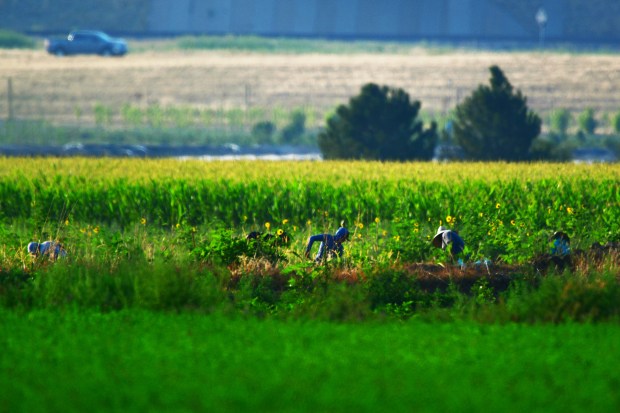
Dave Petrocco Sr. sees the writing on the wall.
His business, Petrocco Farms in Brighton, has been growing vegetables on the Front Range since 1916 — but Petrocco said he wonders how long that will continue.
Over the past few years, profits have decreased. Labor costs have accelerated.
Now, five years after establishing overtime rules for Colorado’s farmworkers, Democratic legislators are weighing dueling bills to either ease or tighten those standards.
In considering diametrically opposed policies, lawmakers will have to balance existential fears from an industry that’s weathered pain from tariffs, falling profits and declining commodity prices, against advocates and labor groups clamoring for more support for workers harvesting Colorado’s crops while facing unique vulnerabilities to immigration enforcement and employer abuse.
“Our ag producers are in a tenuous situation,” Amanda Laban, the markets division director for the Colorado Department of Agriculture, told state lawmakers in an oversight hearing last month. She said net farm income was expected to drop to $1.8 billion in 2026, $400 million lower than last year. “Markets are in flux, and prices are low on our commodity crops. The cost of doing business is high.”
Only one of the overtime bills — to make it easier for farmworkers to get more pay — has been introduced, but supporters and opponents have been readying for the debate for weeks. The measures will move through a Democrat-controlled legislature that sparred last year over a similar policy — cutting some restaurant workers’ wages to bolster that industry — and has for years argued over the proper balance between business interests, cost-of-living measures and worker protections.
Farmers are backing a bill to increase the threshold, which would require workers to clock 60 hours before they earn any overtime (farmworkers used to be exempt from overtime laws, but that changed with the passage of a 2021 bill). That measure has not been introduced in the legislature but will be run by the Senate’s Democratic majority leader, Sen. Robert Rodriguez of Denver.
“If the ceiling for overtime decreases, 2026 will be our last season,” Petrocco said. “We’ll be running into the minus and no longer in business.”
Workers’ advocates and Latino community leaders, meanwhile, say agricultural laborers are like any other worker and should be entitled to overtime after 40 hours, rather than the current level that varies between 48 and 56 hours. They’re supporting another Democratic bill — backed by Rodriguez’s colleague, Sen. Jessie Danielson — to drop the threshold to that level.
Farmworkers “are the people providing food on our tables. They should have access to earn more money as well,” said Betty Velasquez, of Project Protect Food Systems Workers, which advocates for farmworkers. Velasquez works in southeast Colorado. “They certainly earn it — they do back-breaking work, and they should be entitled to that.”
‘Farmworker Bill of Rights’
To understand the fight this legislative session, you have to go back to 2021.
In June of that year, Gov. Jared Polis signed Senate Bill 87 into law. The bill, dubbed the “Farmworker Bill of Rights,” enshrined minimum wage, overtime and safety protections for agricultural workers, who had historically been exempt from standard labor laws.
Most private employees in Colorado are covered by overtime laws, though certain professions — such as drivers, health care workers, ski industry professionals and in-residence laborers — are exempt or have modified rules.
Discussion surrounding the legislation grew increasingly fierce, with farmowners blasting the new provisions as an attack on their businesses, while advocates hailed the changes as long-overdue protections for a vulnerable and marginalized workforce.
Under the new law, the state phased in overtime requirements for employers, beginning at 60 hours. Regulators then set up a bifurcated system under which workers harvesting outside of peak season would generally be paid overtime after 48 hours. During the busier months, the threshold was bumped to 56 hours.
Farmowners, as a result of the 2021 changes, said they simply hired more workers to avoid paying the extra money.
“We will go into OT when we’re in the middle of harvest, and we have to get it off the tree,” said Bruce Talbott, a longtime grower in Palisade. “Anytime throughout the year, when we’re able to structure work on pruning and thinning, we’re not paying OT. It’s too big a penalty.”
He calculated that the overtime law has cost his workers $5,000 per employee, per year.
“The guys do not want overtime,” Talbott said. “They’re here to work; they want to work.”
There’s research to suggest laws such as Colorado’s do impact worker wages.
A 2023 study by researchers at the University of California found farmworkers there worked fewer hours and earned less in wages after a 2016 law mandated employers pay 1.5 times an employee’s regular pay rate for any hours worked beyond 40 hours per week.
That study examined California’s rules, which set farmworkers’ overtime threshold at 40 hours, below Colorado’s current level. It found the share of laborers working 56 to 60 hours per week decreased by roughly half, while the share of the workforce with higher weekly earnings decreased by roughly one-third.
“These changes in hours and pay are consistent with employers behaving as they claimed they would — by cutting hours to avoid paying overtime rates,” the authors noted.
Harrison Topp, who grows produce in Paonia and Hotchkiss, said he doesn’t want to go back to the days when agriculture was entirely exempt from overtime laws. Some framework, he said, is good for the industry.
During good harvests, like the past two years, Topp has been able to afford the extra overtime costs. But he worries about what will happen to his books during down years.
“It ends up being thousands and thousands of dollars for us,” he said.
Topp said he supports a 60-hour overtime threshold, calling the 40-hour floor “too extreme.”
“There is not enough money in this business to just pay overtime on anything over 40 hours,” he said.
Velasquez, the advocate in southeast Colorado, said workers are educated about the law and know when they’re entitled to overtime. Some workers have earned the extra pay, she said, while others have had their hours cut by their employers.
But she and other advocates doubted whether the wage provisions were “cost-prohibitive” or whether they had led farmers to bring in additional labor. Farmers have to provide housing and transportation for foreign workers here on visas, she said, and she questioned whether it was really cheaper to bring in more workers.
Zoila Gomez, also of Project Protect Food Systems Workers, said that before the 2021 law, she knew laborers who spent more than 100 hours in the fields. She would only see some workers when she visited their job sites in the San Luis Valley.
But after the bill passed, she said, she saw them at grocery stores and in the community.
They worked fewer hours, Gomez said, which was a shock to what she described as the culture of “work, work, work and earn as much money as you can.”
“Then people started seeing the benefit of it: ‘I get to spend more time with my kids, I get to go to a gathering, a family gathering, and I’m not as tired,’ “ Gomez said.
Jenifer Rodriguez, managing attorney of the Migrant Farm Worker Division at Colorado Legal Services, said she’s spoken extensively with farmworkers around the state, who say they’re able to spend more time with their families while still making a fair wage.
Farmers have not been able to provide the data to back their position that the overtime rules are negatively impacting worker wages and hours, she said. Gomez said she didn’t know of anyone who’d left the valley to seek more hours elsewhere.
“Farmworkers are pleased to receive overtime, especially in a time when finding work is difficult,” Rodriguez said. “Workers are very satisfied and in need of these protections right now; they’re benefitting tremendously.”
Rodriguez brought a lawsuit in 2022 on behalf of a former farmworker, alleging the current overtime rules for agricultural workers violate state law and the Colorado Constitution through the discrimination of an overwhelmingly Latinx workforce. A district court judge upheld the state’s rules.
Rodriguez and her team appealed the decision, and the case remains pending before the Colorado Court of Appeals.

Dueling bills
For Democrats in the Capitol, the bill mirrors a similar debate last year, when lawmakers argued over a proposal to lower some restaurant workers’ wages to help the dining industry.
Sen. Rodriguez, the Senate majority leader bringing the bill to raise the overtime threshold, said he’d planned to bring his measure last year. But at the request of labor groups, he held off, he said, because of the restaurant wage debate.
He said he wanted to bring the bill to help farmers and workers, who he said were going elsewhere to earn more. He said he became aware of the issue during discussions with business interests over a separate — and ongoing — fight to remove an anti-union provision from state law.
“It’s just hurting farms, it’s not the one single fix,” Rodriguez said of the state’s current overtime thresholds. “It’s death by 1,000 cuts, with water shortages, crops and rates and tariffs and Trump getting meat from Argentina. It’s all dumping on the ag industry, which is a big staple of our economy in Colorado.”
But Danielson, his Senate colleague, argued that the state should be increasing its protections for ag workers. She’s sponsoring the bill to lower the overtime threshold to 40 hours. That measure was introduced in early February; Rodriguez said his bill is expected later this month.
Danielson said that farmworkers should be treated like every other employee who is entitled to more pay after a standard 40-hour workweek. She laid the blame for the industry’s struggles on other pressures, like tariffs and water shortages.
“These are already vulnerable workers,” Danielson, a Wheat Ridge Democrat, said. “But in the face of this Trump administration, they are even more vulnerable. So I believe the state should be doing more to protect these essential workers in an industry that we depend on, and this is part of that.”
Last year’s fight over restaurant wages split the House Democratic caucus and ended with a watered-down bill limping to Gov. Jared Polis’ desk. Neither Rodriguez nor Danielson indicated that they were negotiating toward some sort of settlement on their competing proposals.
Danielson said she hadn’t seen Rodriguez’s bill yet, but that she was “really hopeful that my colleagues or whoever is considering doing something like this might reconsider.” Rodriguez said he was open to negotiating on changing the threshold, even if it wasn’t at his target of 60 hours.
He was willing to talk about the idea with Danielson or anyone else. But he said he didn’t know how farmers could afford to pay more overtime.
“It should be fun and painful all at the same time,” he said of the coming legislative debate.
Stay up-to-date with Colorado Politics by signing up for our weekly newsletter, The Spot.