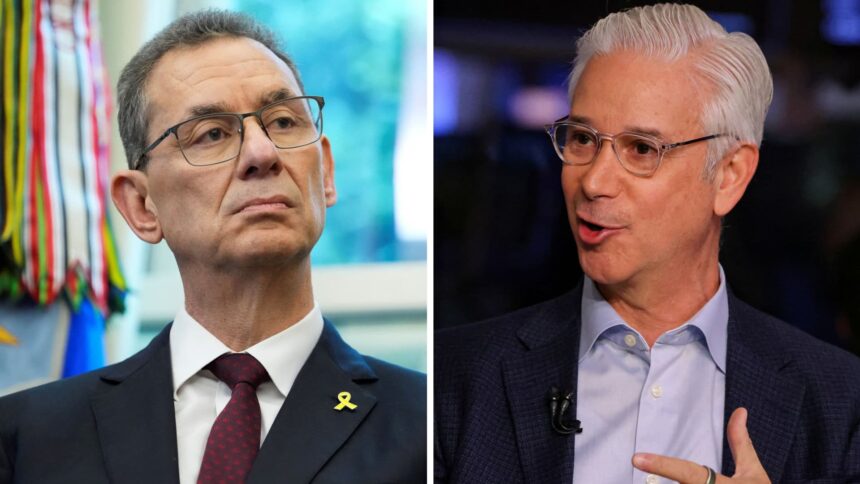
Albert Bourla, CEO of Pfizer, Charlie Scharf, Wells Fargo & Firm CEO and Kathy Warden, Northrop Grumman Chair & CEO converse through the Put money into America Discussion board on Oct. 15, 2025.
Aaron Clamage | CNBC
Wells Fargo CEO Charlie Scharf and Pfizer CEO Albert Bourla sounded the alarm Wednesday over the potential for the the U.S. to lose its aggressive edge to China, however mentioned synthetic intelligence might assist America keep its lead.
Talking at CNBC’s inaugural Invest in America Forum in Washington, D.C., the 2 executives mentioned that whereas the U.S. nonetheless leads in lots of sectors, inconsistent coverage and underinvestment is ceding floor to China. AI, they mentioned, poses each dangers and advantages for the U.S. financial system.
Scharf mentioned AI will doubtless cut back the dimensions of workforces — however will enhance productiveness.
“We’ll doubtless have much less individuals, completely,” Scharf mentioned. “After we take a look at the instruments that we have applied simply for those who are coding, you see 20%, 30%, 40% enchancment in coders. We’ve not diminished our head rely by 20%, 30% or 40%. We’re really doing greater than we in any other case would have been capable of do.”
Wells Fargo massive financial institution friends like JPMorgan and Goldman Sachs are already hiring fewer individuals due to AI developments.
Scharf additionally mentioned the monetary sector is poised for main regulatory modifications regardless of an ongoing political stalemate in Washington.
“We finally do count on vital modifications in capital necessities, liquidity necessities,” he mentioned. “We do count on to see modifications which is able to permit individuals within the trade, not simply massive banks and medium-sized banks, however smaller banks as properly, to do extra in these [local] communities.”
Bourla, in the meantime, expressed concern about China’s rising energy in biotechnology and prescribed drugs, pointing to a surge in analysis and improvement spending, regulatory reforms and a nationwide technique centered on life sciences.
“They [China] filed extra patents this 12 months than the U.S.,” Bourla mentioned. “That is by no means occurred in historical past. 5 years in the past, the cut up was 90%-10%. … The hole is closing, however they most likely will change into [better than us] until we get our act collectively.”
Bourla urged the U.S. to shift focus from attempting to sluggish China’s progress towards bettering its personal productiveness and innovation.
“We spend extra time attempting to consider the best way to decelerate China quite than assume how we will change into higher than them,” Bourla mentioned. “We have to have regulatory modifications right here. We have to have stability. Tariffs and pricing was not serving to.”
Pfizer just lately agreed to a drug pricing take care of the Trump administration as a part of a broader effort to take away long-standing uncertainties round pricing, Medicaid reimbursements and distribution. As a part of the settlement, Pfizer secured a three-year exemption from pharmaceutical-specific tariffs, contingent on further investments in U.S. manufacturing.
“Tariffs and the uncertainty of drastic correction of U.S. pricing — with this deal, we’re eradicating each uncertainties,” Bourla mentioned Wednesday.
He additionally known as synthetic intelligence the subsequent frontier for drugs, predicting that AI will revolutionize drug discovery by dramatically accelerating timelines for locating therapies for ailments like Alzheimer’s and most cancers.
“We tried for years to search out cures … AI will make it occur,” Bourla mentioned.