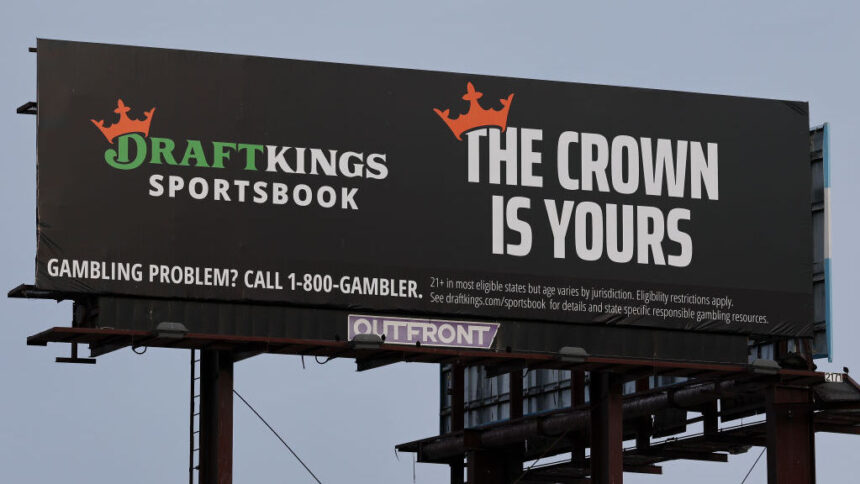
Americans have wagered more than $520 billion on sports since the Supreme Court struck down the federal betting ban in 2018 (1). The industry calls that a success story, but it’s a whole other ball game for the finances of younger Americans and their family.
A new study from the Federal Reserve Bank of New York found that credit delinquency rates — being 90 days or more behind on a car loan, credit card, or any other credit account — have risen in every state that legalized mobile sports betting, and the hit is falling hardest on adults under 40 (1).
These implications run deep for parents watching their son or daughter burn through money on DraftKings or FanDuel. Your first instinct is to help, but that inclination can make things worse.
The study compared betting activity and consumer credit outcomes from states that legalized mobile sports betting against those that have not.
Researchers used the New York Fed Consumer Credit Panel, a nationally representative sample of random Equifax credit reports, to track delinquency trends (2). It found that delinquency rates rose 0.31 percentage points from a baseline of 10.71% in counties that legalized betting (3).
While only about 3.1% of people in these counties took up betting after legalization, the implied delinquency rate increased 10 percentage points for bettors of all ages. For bettors under 40 specifically, it jumped to 26% points — meaning more than one in four were falling behind on their bills. For that age group, credit card delinquency rose 7.9% and auto loan delinquency rose 5.6% (4).
Adults between the ages of 40 to 64, on the other hand, experienced a 7.4% jump in delinquency rates, a fraction of their younger counterparts.
The damage doesn’t show up right away either. Delinquencies started climbing about a year after legalization and kept rising for three years with no sign of stopping (5).
That lag makes sense when you think about how betting works.
Nobody blows their budget on day one. They may lose a few smaller bets in the beginning, but will eventually set their sights on bigger, more riskier wagers down the line as their confidence grows, aided in part by previous successes. By the time they realize how much they’ve staked with their credit card, it’s usually more than they can easily pay off.
Read More: 5 essential money moves to make once you’ve saved $50,000
A key finding in the study shows how the financial damage of mobile betting metastasizes beyond borders.
Counties within 15 miles of a legal state, where mobile betting is still technically illegal, saw delinquency rise of about 58% of what legal counties experienced, even though betting activity there was only 15% (6).
This is because the residents drive into a neighboring state where sports betting is legalized, set up their sportsbook account, and place their wagers.
Since they only need to be physically present in a place where betting is legalized (and not necessarily a resident), no laws are being broken.
However, this means they have no access to the responsible gambling resources — counselling services, education programs, addiction hotlines — that are funded by tax revenue to offset the negative effects of gambling in states where it is legal (7). This explains why casual betting is causing a disproportionate amount of financial harm.
Gambling debt is unusually good at hiding.
“Unlike alcohol or drug addiction, you can’t see or smell a gambling problem, so people can rack up debt in secret for years. They can have 15 credit cards a spouse doesn’t know about, two or three mortgages on the house or maybe they’ve raided their retirement savings” says Gary Gray, director of the North Carolina Council on Problem Gambling (8).
A family member could be struggling with gambling addiction, and you wouldn’t know. This is especially true for young adults that don’t know it’s a problem because they see everyone do it and believe it’s normal.
A 2025 survey by U.S. News & World Report found that nearly one in three sports bettors said they had debt they attributed to gambling — and one in three hid those debts from a loved one (9).
By the time the sport betting issue surfaces, the instinct for most parents is to step in and fix it. Pay the balance, cover the car payment, make it go away.
Gray says that’s usually the wrong move. “If you bail them out, six months later they’re right back in deeper” (10).
His advice — and what other counselors have repeatedly advised — is to deal with the behavior before the debt.
-
Talk to them. Some teenagers don’t realize that it’s wrong until you point it out, because they see their friends do it, or because their environment has made it easily accessible to them.
-
Don’t blame them. Elliott Rapaport, founder and CEO of Birches Health, says to approach them with empathy. “Shame and stigma is already one of the biggest barriers to treatment” he said. Rapaport suggests starting the conversation with a simple “Is everything OK?” (11).
-
Don’t pay their debt. While you should offer support, don’t pay their debt. You should set a hard line on what you will and won’t cover if they get into gambling debt.
-
You should also nudge them towards professional help — the National Problem Gambling Helpline is available at 1-800-522-4700, 24-hours a day (12). It’s a better first call than a bank transfer.
Join 250,000+ readers and get Moneywise’s best stories and exclusive interviews first — clear insights curated and delivered weekly. Subscribe now.
We rely only on vetted sources and credible third-party reporting. For details, see our editorial ethics and guidelines.
Federal Reserve Bank of New York Staff Report (1,3,4,5,6); Federal Reserve Bank of New York (2); Liberty Street Economy (7); NC Health News (8,10); U.S. News & World Report (9); NC Health News (11); National Council on Problem Gambling (12)
This article provides information only and should not be construed as advice. It is provided without warranty of any kind.