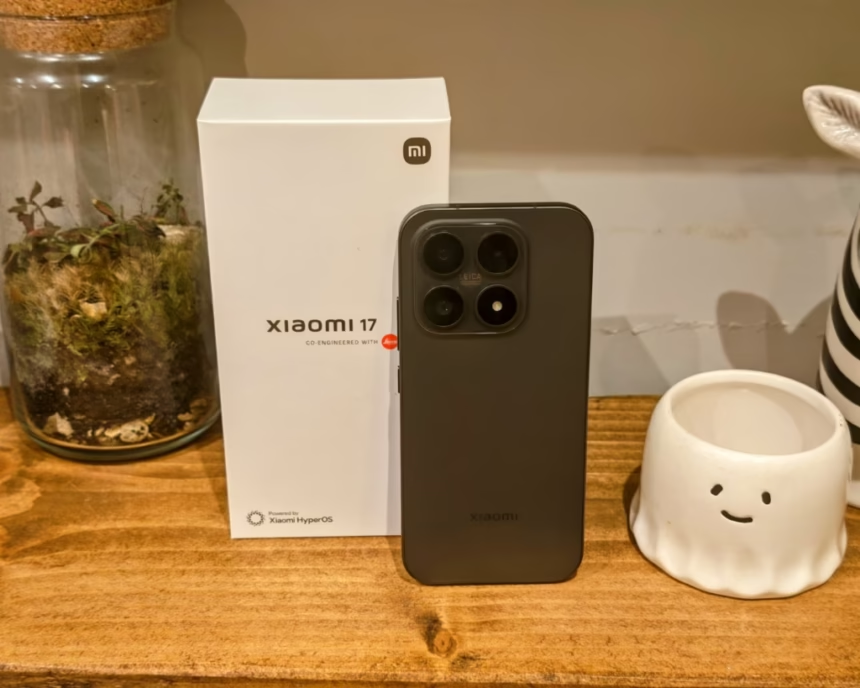
Any links to online stores should be assumed to be affiliates. The company or PR agency provides all or most review samples. They have no control over my content, and I provide my honest opinion.
Xiaomi 17 Review
Xiaomi 17 Review
Summary
The Xiaomi 17 is an iterative upgrade, but it’s still one of the most compelling compact flagship Android phones I’ve used. The headline feature is the 7,000 mAh silicon-carbon battery, which delivers genuinely class-leading endurance for a 6.3-inch handset, and the combination of 100 W wired and 50 W wireless charging makes it easy to live with day to day. Performance is predictably excellent thanks to the Snapdragon 8 Elite Gen 5 and UFS 4.1 storage, while the bright LTPO AMOLED panel and ultrasonic fingerprint sensor round out a very strong hardware package.
Where it falls short is in areas Xiaomi hasn’t meaningfully advanced: the rear camera hardware feels dated for the money, with a particularly underwhelming 2.6x telephoto compared with rivals, and HyperOS still isn’t as clean or cohesive as Google’s Pixel experience. If you prioritise battery life and top-tier performance in a compact chassis, this is the phone to beat; if camera quality and software polish come first, the Pixel 10 Pro remains the smarter buy.
Pros
-
Class-leading 7,000 mAh battery
-
Excellent flagship-grade performance
-
Fast 100 W wired charging
-
Bright, smooth LTPO AMOLED
-
Premium, compact 191 g build
Cons
-
Ageing rear camera hardware
-
Weak 2.6x telephoto zoom
-
HyperOS less polished than Pixel
-
Noticeable warmth under sustained loads
I reviewed the Xiaomi 15 this time last year and the Xiaomi 14 the year before that, and thought they were superb. They are also among the few small flagship-spec phones on the market, with the Samsung Galaxy S25 and Pixel 10 Pro as the only real competition.
The Xiaomi 17 represents another incremental step forward for Xiaomi’s compact flagship line. While the improvements aren’t revolutionary, the combination of a dramatically larger battery and the latest Snapdragon chipset makes this one of the most appealing small Android phones you can buy in 2026.
Related Reviews
Specification
| Body | |
| Dimensions | 151.1 x 71.8 x 8.1 mm (5.95 x 2.83 x 0.32 in) |
| Weight | 191 g (6.74 oz) |
| Build | Glass front (Dragon Crystal Glass), aluminium frame |
| SIM | Dual Nano-SIM |
| IP Rating | IP68 dust and water resistant (up to 1.5 m for 30 min) |
| Display | |
| Type | LTPO AMOLED, 68 B colours, 2160 Hz PWM dimming, 120 Hz refresh rate, Dolby Vision, HDR Vivid, HDR10+, peak brightness 3500 nits |
| Display Size | 6.3 inches (~97.1 cm²), ~89.5% screen-to-body ratio |
| Resolution | 1220 x 2656 pixels, 19.5:9 ratio (~464 ppi) |
| Protection | Xiaomi Dragon Crystal Glass |
| Operating System | |
| OS | Android 16, HyperOS 3 |
| Chipset | |
| Chipset | Qualcomm SM8850-AC Snapdragon 8 Elite Gen 5 (3 nm) |
| CPU | Octa-core (2×4.6 GHz Oryon V3 Phoenix L + 6×3.62 GHz Oryon V3 Phoenix M) |
| GPU | Adreno 840 |
| Memory | |
| RAM / Storage | 256 GB 12 GB RAM / 512 GB 12 GB RAM / 512 GB 16 GB RAM / 1 TB 16 GB RAM (UFS 4.1, no microSD slot) |
| Main Camera | |
| Main Camera | Triple: 50 MP (f/1.7, 23 mm wide, 1/1.31″, 1.2 µm, PDAF, OIS) + 50 MP (f/2.0, 60 mm telephoto, OIS, 2.6x optical zoom) + 50 MP (f/2.4, 17 mm ultrawide, 102°) |
| Main Camera Features | Laser AF, colour spectrum sensor, Leica lens, Dual-LED dual-tone flash, HDR, panorama |
| Main Video Recording | 8K @ 30 fps (HDR), 4K @ 30/60 fps (HDR10+, Dolby Vision, 10-bit LOG), 1080p @ 30/60/120/240/960 fps, 720p @ 1920 fps, gyro-EIS |
| Selfie Camera | |
| Selfie Camera | 50 MP (f/2.2, 21 mm wide, PDAF) |
| Selfie Features / Video | HDR, panorama; 4K @ 30/60 fps, 1080p @ 30/60 fps, HDR10+, gyro-EIS |
| Audio | |
| Audio | Stereo speakers with Dolby Atmos, Hi-Res 24-bit/192 kHz, Hi-Res Wireless, Snapdragon Sound |
| 3.5 mm jack | No |
| Connectivity | |
| Connectivity | Wi-Fi 802.11 a/b/g/n/ac/6/7 (dual-band, Wi-Fi Direct), Bluetooth 5.4 (aptX HD, Adaptive, LHDC 5), NFC, Infrared port, USB-C 3.2 (DisplayPort/OTG), no FM radio |
| Positioning | GPS (L1+L5), BDS (B1I+B1c+B2a), Galileo (E1+E5a), QZSS (L1+L5), NavIC (L5), GLONASS |
| Sensors | Under-display ultrasonic fingerprint, accelerometer, proximity, gyro, compass, barometer |
| Battery | |
| Battery | 7000 mAh (Si/C Li-Ion, non-removable) |
| Charging | 100 W wired (PD3.0/QC3+/PPS), 50 W wireless, 22.5 W reverse wireless |
In comparison to last year’s model, there have been the usual incremental upgrades:
- The usual upgrade to the latest flagship chipset, which this year is the Snapdragon 8 Elite Gen 5 (3 nm)
- Minor improvements to the display, though it is fractionally smaller with 6.3″ vs 6.36″ and a small reduction in resolution
- Internal storage has been upgraded to UFS 4.1 vs UFS 4.0
- Essentially the same rear cameras
- Selfie camera has been upgraded to 50MP vs 32MP
- Battery has had a massive upgrade from 5240 mAh to 7000 mAh
- Wired charging upgraded to 100W vs 90W and reverse wireless is now 22.5W vs 10W
The standout improvement is undoubtedly the battery. A 33% increase in capacity is remarkable for a phone that’s actually slightly smaller than its predecessor. This is where silicon-carbon battery technology really shows its worth, cramming 7000 mAh into a chassis that weighs just 191g.
For context, the Samsung Galaxy S25 Ultra with its 6.9″ display only manages a 5000 mAh battery, yet weighs considerably more at 232g. The Pixel 10 Pro with its 6.3″ screen has a 5060 mAh cell. The Xiaomi 17’s battery capacity is genuinely class-leading for a phone of this size.
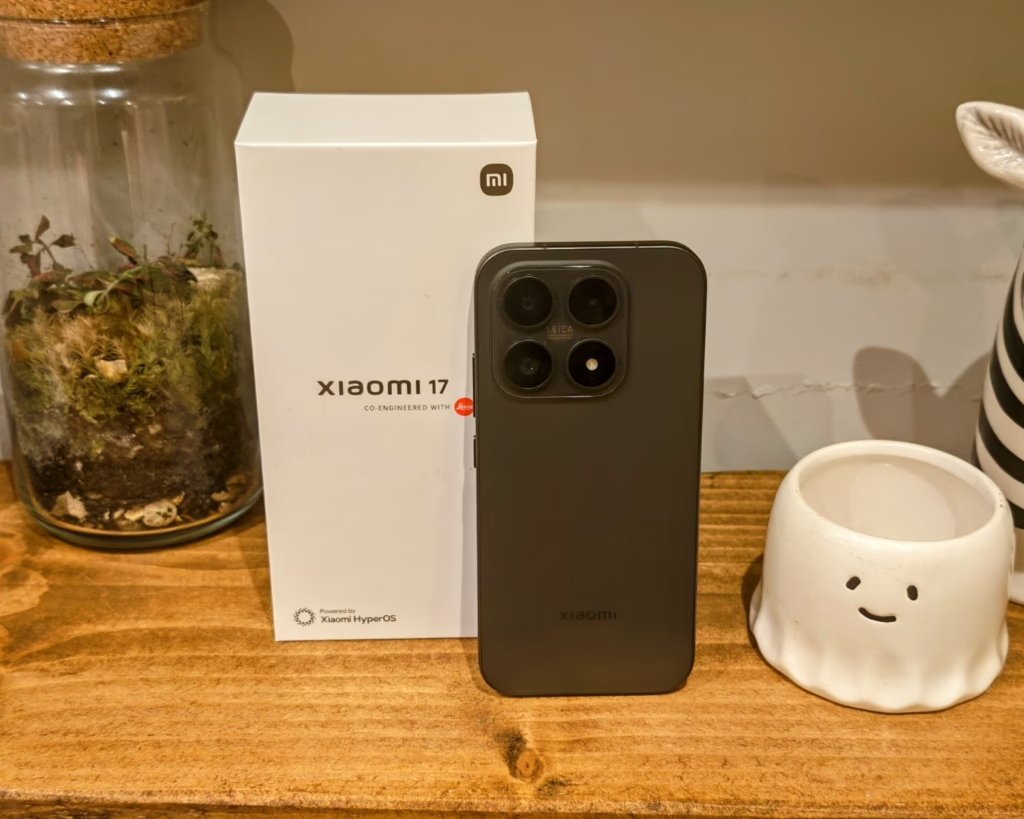
The Xiaomi 17 maintains the refined design language established by its predecessor, with flat edges and minimal bezels creating a premium aesthetic. At 151.1 x 71.8 x 8.1 mm and 191g, it’s one of the most compact flagship phones available, yet somehow houses a 7000 mAh battery.
Build quality is excellent throughout. The aluminium frame feels solid without being overly heavy, and the matte glass back does an admirable job resisting fingerprints. The IP68 certification provides proper dust and water resistance, rated for submersion up to 1.5 metres for 30 minutes.
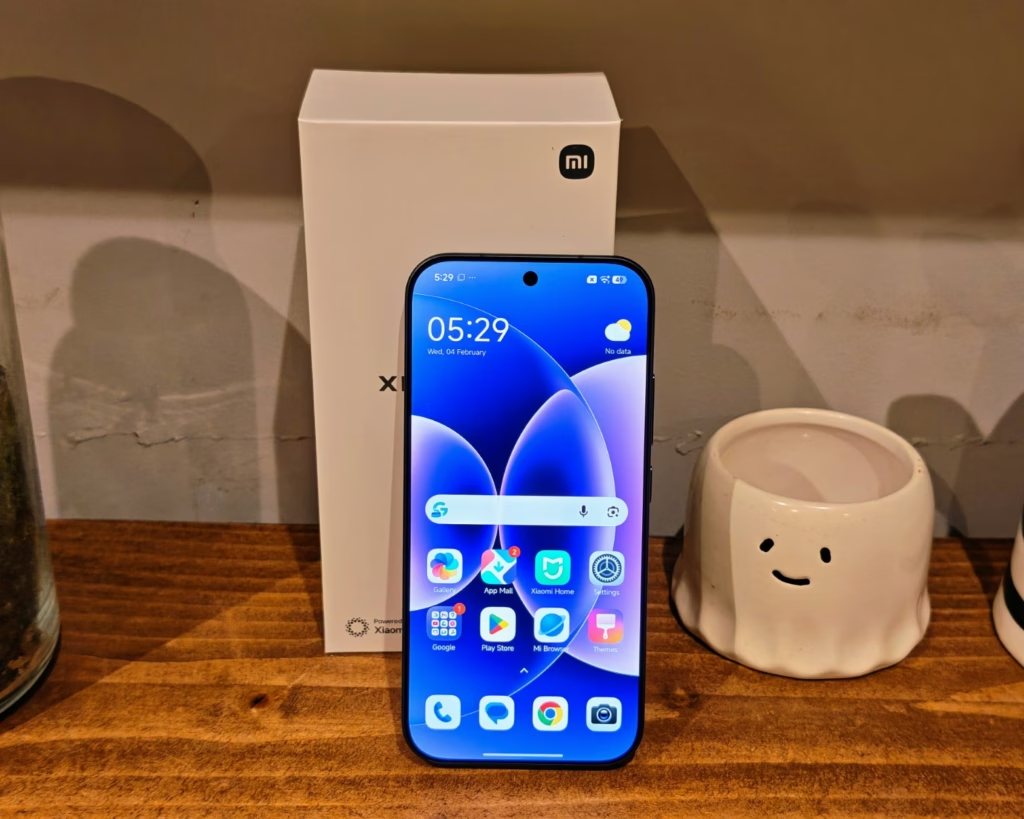
The screen bezels are impressively thin on all sides, achieving a 89.5% screen-to-body ratio. This is a touch better than the Xiaomi 15’s 90%, despite the fractionally smaller display. The Dragon Crystal Glass protection should offer better scratch resistance than standard Gorilla Glass, though I’d still recommend a screen protector for daily peace of mind.
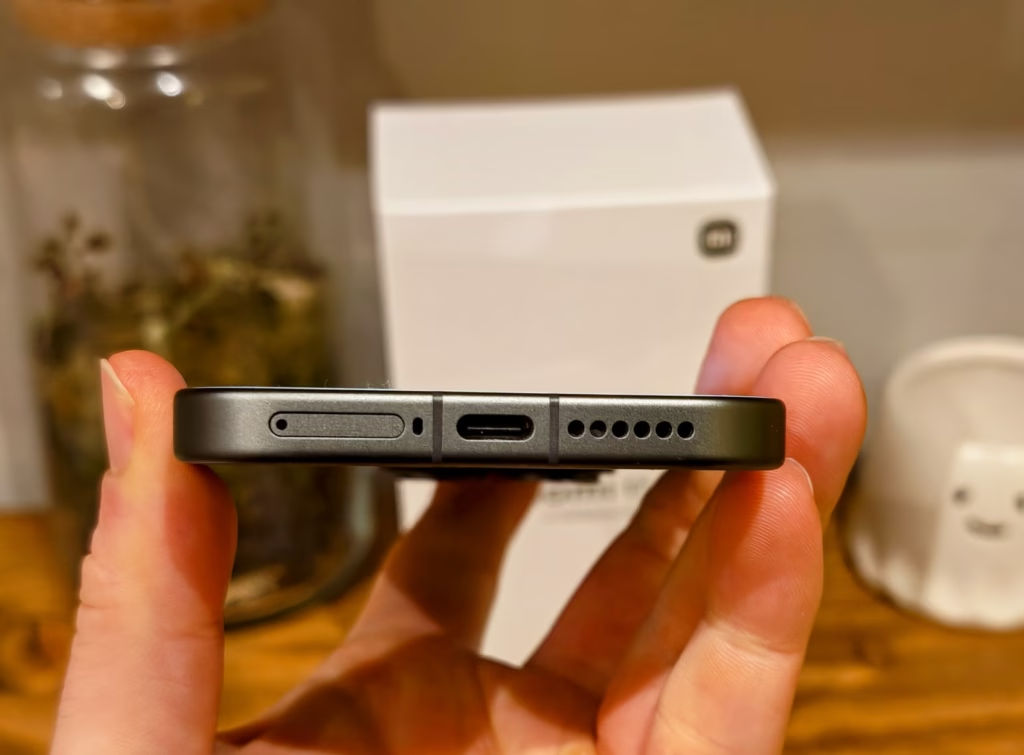
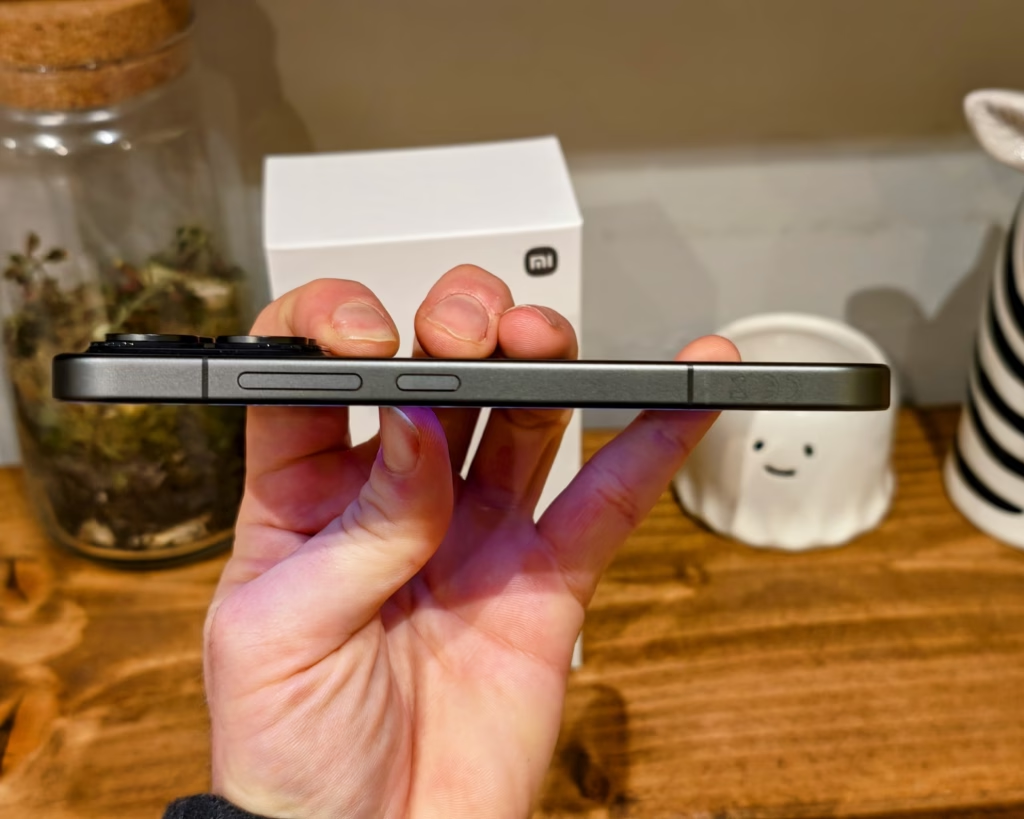
One aspect worth noting is the phone does get noticeably warm during intensive tasks. The Snapdragon 8 Elite Gen 5 is a powerful chip, and in a compact chassis like this, heat dissipation can be challenging. Xiaomi has implemented what they call a Stereoscopic Annular Cold Pump cooling system, which uses a Tesla valve mechanism to maintain efficient heat transfer. While this prevents thermal throttling better than you’d expect, the phone’s exterior will still warm up during gaming or when using that 100W fast charger.
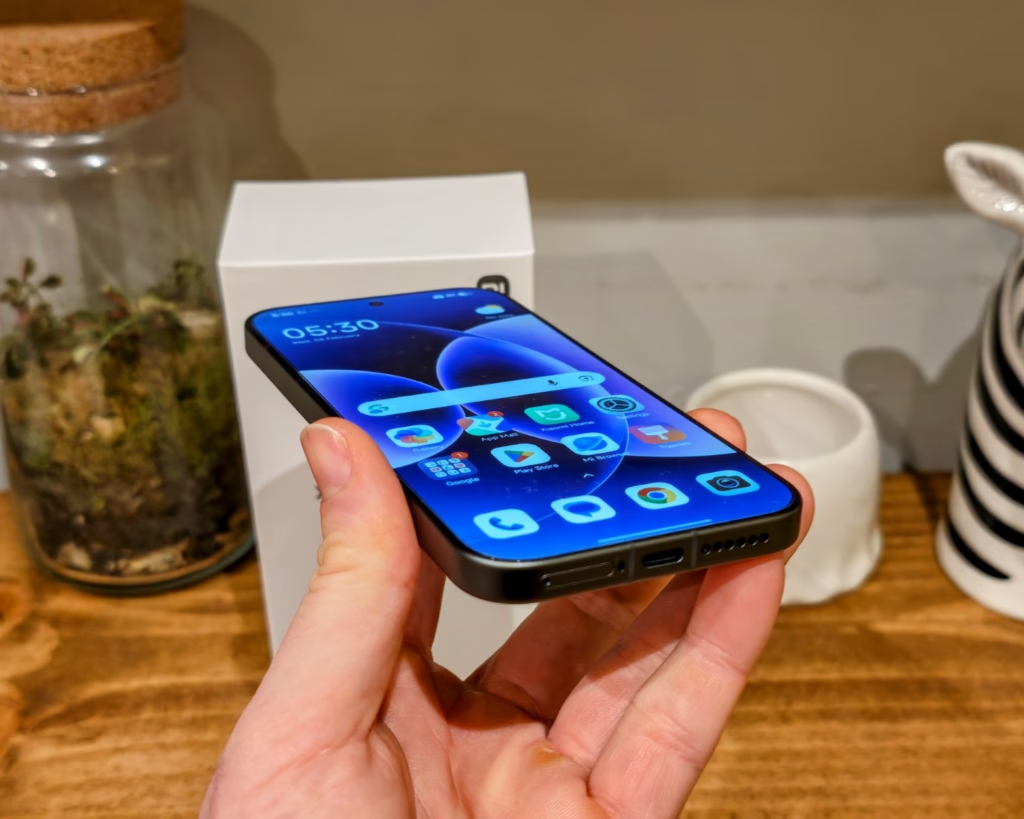
In practice, I found the warmth never reached uncomfortable levels during normal use. Gaming sessions or fast charging will make it noticeably warm to touch, but that’s simply physics at work – you can’t pack this much power into a small space without generating heat. The good news is the cooling system does its job well enough that I never experienced performance throttling or overheating warnings during my testing.
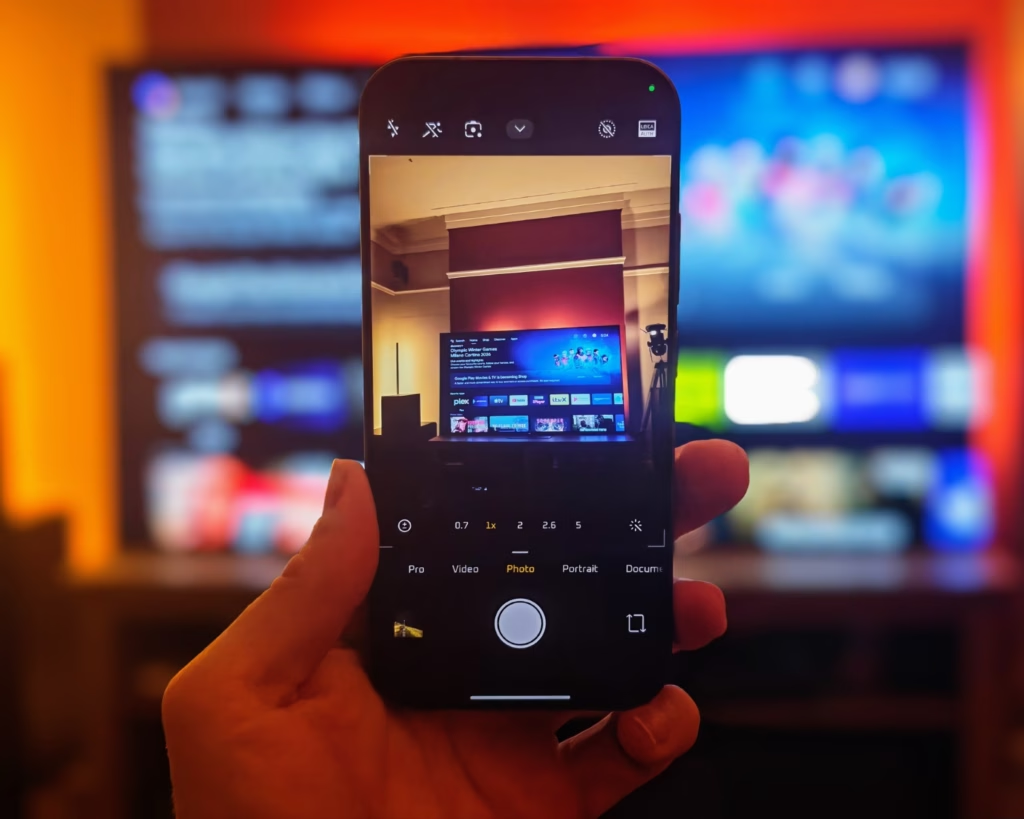
The rear-facing camera hardware is the same as the previous two generations, with a bump in resolution for the selfie camera.
Camera performance will likely have improved between generations due to improved image processing, but the overall performance is largely the same as that of the Xiaomi 15.
While I wouldn’t regard this as a class-leading camera phone, the overall performance is good. The main camera can produce excellent photos across a wide range of conditions and I found night photography produced good quality images.
The main sensor is the Light Hunter 950, a 1/1.31″ 50MP sensor with an f/1.7 aperture and OIS. In good lighting conditions, this produces sharp images with accurate colours and excellent dynamic range. The Leica colour science gives photos a distinctive look, though I find it occasionally oversaturates colours compared to the more natural processing from Google’s Pixel phones.
Low-light performance is solid, though not exceptional. Night mode does a decent job bringing out detail without introducing excessive noise, but in very challenging lighting, you’ll notice the images don’t quite match the computational photography prowess of the Pixel 10 Pro. That said, for most situations, you’ll get perfectly usable results.
I’d say that my main criticism is that the 2.6x zoom only provides a limited benefit. The default camera controls go up to 5x zoom, and you can obviously zoom further than this. I did find that digital zoom up to 10x produced decent quality images. In the picture of North Pier, the text for Joe Longthorne is still legible, whereas some phones will produce very blurred text due to the digital zoom.
However, if you were to compare it to the 200MP 3.7x zoom on the Honor Magic8 Pro, the performance is quite poor. The telephoto lens uses a 50MP sensor with f/2.0 aperture and OIS, which is the same as previous generations. The 2.6x optical zoom is functional but nothing special. Where this lens does excel is in macro photography – it can focus as close as 10cm, producing impressive close-up shots that genuinely rival dedicated macro lenses.
The 50MP ultrawide camera (f/2.4, 102° field of view) maintains consistency with the other lenses but shows some softness towards the edges of the frame. It’s perfectly adequate for group shots and landscapes, but doesn’t quite match the detail and dynamic range of the main sensor.
The upgraded 50MP selfie camera is a welcome improvement over the 32MP unit in the Xiaomi 15. With PDAF, it produces sharp selfies with accurate colours. The inclusion of autofocus means you can get properly sharp results even in less-than-ideal lighting.
Video recording capabilities are comprehensive, with 8K at 30fps, 4K Dolby Vision recording at 60fps, and various slow-motion options. The stabilisation is effective, and the ability to shoot 10-bit LOG video gives enthusiasts proper flexibility in post-processing.
The Snapdragon 8 Elite Gen 5 is built on TSMC’s 3nm process and features Qualcomm’s custom Oryon cores. With two performance cores clocked at 4.6 GHz and six efficiency cores at 3.62 GHz, this is one of the fastest mobile chipsets available.
As usual for Xiaomi, I was only able to run a limited number of benchmarks:
Geekbench achieved 3294 single-core and 8593 multicore. Then, in PCMark, it achieved 17874 in Work 3.0.
These scores place the Xiaomi 17 among the fastest Android phones currently available. Single-core performance is particularly impressive, matching or exceeding the Apple A19 found in the iPhone 17. Multi-core performance significantly outpaces Apple’s offering, though real-world performance differences are minimal for typical smartphone tasks.
In everyday use, the phone feels incredibly responsive. Apps launch instantly, multitasking is seamless, and even the most demanding games run smoothly at high settings. The UFS 4.1 storage contributes to the snappy experience, with fast app loading times and quick file transfers.
However, there are some thermal considerations. During sustained gaming sessions or heavy multitasking, the Snapdragon 8 Elite Gen 5 does generate significant heat. While Xiaomi’s cooling system prevents severe throttling, you will notice the phone getting warm. In benchmark loops testing sustained performance, the GPU in particular shows some throttling after extended periods.
For most users, this won’t be an issue. Gaming sessions of 30-45 minutes shouldn’t cause problems, and normal smartphone use won’t push the chip hard enough to trigger significant thermal management. It’s only during truly sustained loads – like running benchmarks repeatedly or gaming for hours – that the thermal limitations become apparent.
The Adreno 840 GPU is similarly powerful, capable of running demanding games like Genshin Impact at maximum settings. Frame rates remain stable during typical gaming sessions, though again, extended play will eventually lead to some throttling as the phone warms up.
Due to the limited hardware improvements elsewhere, the battery is perhaps the standout feature. This is one of the smallest flagship phones on the market, yet Xiaomi have crammed a 7000 mAh Si/C Li-Ion battery in there.
That is a 33% increase in capacity from the previous generation. And, because this has a small 6.3″ screen, it will likely outperform most, if not all, other flagship phones.
The battery is so good I didn’t really pay much attention to the longevity; it can last me a couple of days which is longer than I’d ever leave my phone without charging.
In more structured testing, I routinely ended days with 50-60% battery remaining after moderate to heavy use. This included several hours of screen-on time, background app refresh, location services enabled, and the usual mix of browsing, social media, and messaging.
For lighter users, three days between charges isn’t unrealistic. Even power users who spend hours on their phones daily should comfortably make it through a full day with battery to spare.
The combination of the efficient Snapdragon 8 Elite Gen 5, LTPO display (which can drop to 1Hz when idle), and that massive battery creates what is genuinely the best battery life I’ve experienced on a compact flagship phone.
Additionally, you then get 100W wired charging. Unlike other brands, this uses Power Delivery 3.0, so even though there is no included charger, it should be relatively cheap to get a fast charger for this. It is worth noting that not all chargers will do 100W; I tested with a Ugreen power bank and achieved 50W, but the Honor Magic 8 Pro only took a 25W charge.
In my testing with a compatible 100W charger, the Xiaomi 17 charged from 0-50% in around 15 minutes and reached 100% in approximately 40 minutes. That’s genuinely impressive for a 7000 mAh battery.
The 50W wireless charging is similarly quick, fully charging the phone in about an hour and a half. More importantly, the 22.5W reverse wireless charging is actually useful – it’s fast enough to properly charge wireless earbuds or give a friend’s phone a meaningful top-up, rather than the token 10W offerings from most phones.
The Xiaomi 17 ships with Android 16 and HyperOS 3, representing Xiaomi’s latest software iteration. The interface is clean and modern, with smooth animations and a consistent design language throughout.
HyperOS 3 introduces several new features, including improved AI capabilities through what Xiaomi calls HyperIsland (their take on Apple’s Dynamic Island). There are new clock designs, AI-powered photo sorting, and the ability to locate the phone even when it’s switched off.
One significant improvement I noticed was the ultrasonic fingerprint sensor. Compared to the optical sensor in the Xiaomi 15, this is noticeably faster and more reliable, especially with wet or slightly dirty fingers. It works consistently well, unlocking the phone almost instantaneously.
Xiaomi has committed to four major Android updates and several years of security patches for the Xiaomi 17. On the 12th of February, I was on the December 2025 security patch.
The software experience is generally smooth and well-optimised. There are still some pre-installed Chinese apps that need removing, and the default keyboard isn’t ideal for English users (I immediately installed Gboard). Some bloatware is present, though less than on Xiaomi’s more affordable devices.
Customisation options are extensive, allowing you to tweak everything from the home screen layout to system animations and icon packs. The notification system is well-implemented, and the settings menu is logically organised.
That said, the software experience still doesn’t quite match the clean simplicity of Google’s Pixel UI.
At the time of writing, I have not been provided the official RRP. You can pick the Xiaomi 17 up from a grey import site like Wonda for $757.
The Xiaomi 15 launched with an RRP of £899 for the 12GB/256GB model. Launch offers had the £999 12GB/512GB discounted to £749 plus a free tablet and 100W HyperCharger charger.
I’d expect the Xiaomi 17 to launch for the same price as previous generations, assuming it gets a global release.
The Pixel 10 Pro has an RRP of £999 and is available for £849.
The Samsung Galaxy S25 has an RRP of £799.
Personally, I think the Samsung Galaxy S25 is poor for the money, but the Pixel is a viable alternative. The hardware may not be quite as good, especially the battery and chipset, but the camera performance will almost certainly be better, and the OS will be much less bloated with far better long-term support.
The Xiaomi 17 makes the most sense if you want the absolute best hardware in a compact package and can live with HyperOS’s quirks. The battery life alone makes it worth considering – no other phone this size can match it.
If camera quality and software experience are your priorities, the Pixel 10 Pro remains the better choice despite its inferior hardware specifications. Google’s computational photography and clean Android experience are genuine advantages.
The Samsung Galaxy S25, meanwhile, feels like the worst value of the three. It costs £799, has a smaller battery than the Xiaomi, uses a less powerful variant of the Snapdragon chipset, and comes with only 128GB base storage. Unless you’re deeply invested in Samsung’s ecosystem, I’d struggle to recommend it over either the Xiaomi or Pixel.
The very minor hardware improvements for the past couple of generations are a little disappointing but not unexpected. If you look at the Samsung Galaxy S25 vs S24, there is effectively no difference in hardware and the Pixel 10 Pro vs 9 Pro has barely any difference, just a tiny bump in battery and small screen spec changes.
Where the Xiaomi 17 genuinely excels is in battery life. The 7000 mAh silicon-carbon cell is remarkable in a phone this size, delivering two-day battery life that no competitor can match. Combined with 100W wired and 50W wireless charging, this is simply the best battery experience available on a compact flagship.
Performance is excellent, with the Snapdragon 8 Elite Gen 5 delivering top-tier speed in day-to-day use. Thermal management is good considering the compact chassis, though sustained gaming will eventually lead to warmth and some throttling.
The camera system is solid rather than spectacular. It’s the same hardware as the Xiaomi 15, which itself was similar to the Xiaomi 14. While image quality is good and the Leica colour science is distinctive, it doesn’t match the computational photography prowess of the Pixel 10 Pro. The limited 2.6x optical zoom feels particularly inadequate compared to competitors offering 5x or more.
The display is excellent – bright, sharp, and smooth with its 120Hz refresh rate and 3500 nits peak brightness. The ultrasonic fingerprint sensor is a welcome upgrade over previous optical sensors.
Software remains HyperOS’s weakest point. It’s perfectly functional and offers extensive customisation, but it lacks the refinement and simplicity of Google’s Pixel UI. F
Build quality is premium throughout, with solid materials and IP68 water resistance. At 191g, it’s impressively light for a phone with a 7000 mAh battery.
I would recommend the Xiaomi 17 to anyone who wants the best battery life possible in a compact flagship phone and can live with HyperOS’s quirks. The hardware is genuinely impressive, particularly that battery, and performance is top-tier.
However, if camera quality and software experience are your priorities, the Pixel 10 Pro remains the better choice. And if you value a polished, cohesive ecosystem experience, the iPhone 17 Pro (assuming you’re willing to move to iOS) offers that in a similarly compact package.
The Xiaomi 17 is an excellent phone that does a few things brilliantly – battery life, performance, and display quality. It’s let down somewhat by an ageing camera system and software that, while improved, still trails Google’s implementation. But for anyone prioritising battery life and raw performance in a compact form factor, this is the phone to beat.
Xiaomi 17 Review
Xiaomi 17 Review
Summary
The Xiaomi 17 is an iterative upgrade, but it’s still one of the most compelling compact flagship Android phones I’ve used. The headline feature is the 7,000 mAh silicon-carbon battery, which delivers genuinely class-leading endurance for a 6.3-inch handset, and the combination of 100 W wired and 50 W wireless charging makes it easy to live with day to day. Performance is predictably excellent thanks to the Snapdragon 8 Elite Gen 5 and UFS 4.1 storage, while the bright LTPO AMOLED panel and ultrasonic fingerprint sensor round out a very strong hardware package.
Where it falls short is in areas Xiaomi hasn’t meaningfully advanced: the rear camera hardware feels dated for the money, with a particularly underwhelming 2.6x telephoto compared with rivals, and HyperOS still isn’t as clean or cohesive as Google’s Pixel experience. If you prioritise battery life and top-tier performance in a compact chassis, this is the phone to beat; if camera quality and software polish come first, the Pixel 10 Pro remains the smarter buy.
Pros
-
Class-leading 7,000 mAh battery
-
Excellent flagship-grade performance
-
Fast 100 W wired charging
-
Bright, smooth LTPO AMOLED
-
Premium, compact 191 g build
Cons
-
Ageing rear camera hardware
-
Weak 2.6x telephoto zoom
-
HyperOS less polished than Pixel
-
Noticeable warmth under sustained loads

I am James, a UK-based tech enthusiast and the Editor and Owner of Mighty Gadget, which I’ve proudly run since 2007. Passionate about all things technology, my expertise spans from computers and networking to mobile, wearables, and smart home devices.
As a fitness fanatic who loves running and cycling, I also have a keen interest in fitness-related technology, and I take every opportunity to cover this niche on my blog. My diverse interests allow me to bring a unique perspective to tech blogging, merging lifestyle, fitness, and the latest tech trends.
I’m proud to share that Vuelio has consistently ranked Mighty Gadget as one of the top technology blogs in the UK. With my dedication to technology and drive to share my insights, I aim to continue providing my readers with engaging and informative content.