Carlos Beltrán and Andruw Jones have been elected into the Baseball Hall of Fame, the BBWAA announced Tuesday night. The slugging center fields join Jeff Kent (elected by the Contemporary Baseball Era Committee last mont) in the 2026 class. As we sift through the vote percentages and look for the biggest takeaways, some winners and losers emerge beyond the obvious winner in Beltrán and Jones. Let’s walk through a few.
Wait, what? Altuve is still active. How can he be a winner here?
It’s indirect. There are times we see a domino effect in voting. There was always a Coors Field stigma attached to Rockies players, but once Larry Walker got in the Hall, it was mostly smooth sailing for Todd Helton. This is a different situation, obviously, but the 2017 Astros have the electronic sign-stealing scandal attached to them. In my opinion, it’s why it took Beltrán four tries to get in rather than two or even just one.
Now that “El Jefe” from that 2017 championship team is in, does it clear a less rocky path for Altuve? It feels likely. He’s at 2,388 career hits with a .303 average with three batting titles, appealing to old-school voters along with WAR and JAWS numbers that likely please new-school voters.
I’ll allow for the possibility that Altuve’s case is treated differently than Beltrán’s, but this has to serve as good news overall for the 2017 MVP.
A second baseman with good prospects to make the Hall of Fame is Utley. I’ve discussed him as a worthy peak Hall of Fame candidate for the past three years and he’s really making good headway. After getting 28.8% of the vote in his first year and 39.8% last year, he’s now gotten 59.1% this time around, his third year on the ballot. If needed, there are seven more tries and his vote percentage will surely only continue to rise, especially given the relatively weak ballot we have on tap next year.
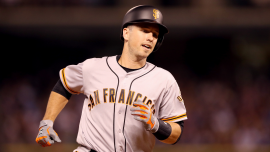
Who will be on 2027 Baseball Hall of Fame ballot? Buster Posey headlines newcomers
Matt Snyder
Loser: Manny Ramírez
Manny is now done on the ballot after failing to reach 75% on his 10th and final year. Ramírez got just 38.8% of the vote. We’ve seen Barry Bonds and Roger Clemens shut out twice by the Era Committee, too, and Ramírez was suspended twice for PEDs (neither Bonds nor Clemens were ever suspended). Simply, unless something extreme happens in the coming years or even decades, Ramírez will never make the Hall of Fame.
Loser: Alex Rodríguez
In his fifth year, A-Rod made progress again — it’s just not enough to believe he’s eventually going to get all the way to the 75% of the vote he needs to make the Hall of Fame. He’s now gone, respectively, from 34.3% to 35.7% to 34.8% to 37.1% to 40.0%. He no longer needs to more than double his vote tally, but it’s pretty close to that. It’s hard to see that happening.
Loser: Robinson Canó
Canó, opposite of Altuve, is an indirect loser. His stats show a résumé that is worthy of induction into the Hall of Fame. He’s a career .301/.351/.488 (124 OPS+) hitter with 68.7 WAR and some of the best power stats we’ve ever seen from a second baseman. At that position, he’s second in home runs, fifth in RBI, sixth in slugging percentage and 10th in WAR.
He was also nailed with an 80-game suspension for a failed PED test in 2018. Given the fate of Ramírez and how things are going for A-Rod, we can probably put the proverbial nail in the coffin of Canó’s Hall of Fame case before he even gets on the ballot.
Winners: Félix Hernández and a generation of starting pitchers
Something I’ve been harping on for a decade (I’m not kidding) is that only the absolute, top-shelf aces from the last few generations of starting pitchers are getting in. That remains the case. Of the top 50 starting pitchers in WAR in the Wild Card Era (1995-present), only Randy Johnson, Pedro Martínez, Roy Halladay, Mike Mussina, Greg Maddux, CC Sabathia, Tom Glavine and John Smoltz are in the Hall of Fame. Past generations have more than 20 starters who made it. I’ve already mapped this out (most recently in making Cole Hamels’ case). Sure, Justin Verlander, Max Scherzer, Clayton Kershaw and probably (hopefully? surely?) Zack Greinke are headed to Cooperstown once eligible, but there’s still a shortfall compared to past generations.
Perhaps we’re making progress. King Felix got 46.1% of the vote in his second try, an 25.5-point rise from his first year. Hamels debuted at a nice 23.8%. Even Andy Pettitte with his PED baggage and Mark Buehrle (a traditionally unappealing case for many voters and fans alike) showed up nicely this time around — 48.5% and 20%, respectively. Pettitte has work to do, but he has a chance to make it in his final years on the ballot.
Maybe this bodes well for the cases of Jon Lester (coming on the ballot next year), David Price (2028), Stephen Strasburg (2028), Adam Wainwright (2029), Corey Kluber (2029) and others.