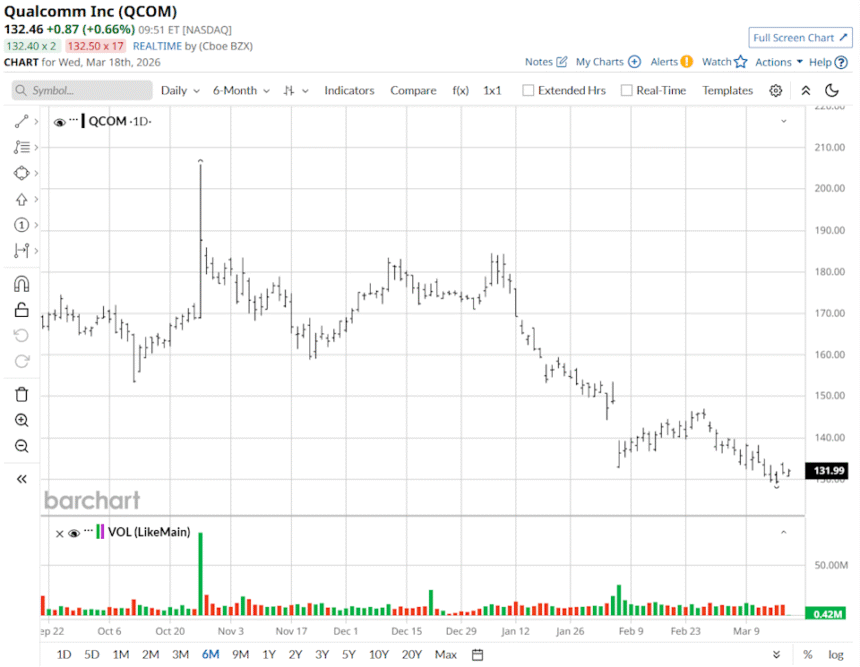
On March 16, Seaport Research downgraded Qualcomm (QCOM) stock to a “Sell” rating, assigning a price target of $100. The stock currently trades 30% above this level, which means that analysts are looking at significant downside in the coming weeks.
Seaport Research isn’t the only firm that rates QCOM stock as a “Sell.” Bank of America Securities and Morgan Stanley are also bearish on its prospects, assigning “Underperform” and “Underweight” ratings with price targets of $145 and $132, respectively. Over the course of the last two months, multiple analysts have lowered their targets for QCOM stock, with Qualcomm having already lost 24% so far in 2026.
On a slightly positive note, the company is doing all it can to regain investor trust, recently announcing a stock buyback program worth $20 billion. This is on top of the $2.1 billion remaining from its previous buyback announced in November 2024. There is no set timeline for the freshly announced buyback program, which will happen at the discretion of management upon prevailing market conditions.
Qualcomm is a fabless semiconductor company that specializes in mobile processors, 5G, IoT, and chips for the automotive industry, among others. The company is currently headquartered in San Diego, California.
QCOM stock is down roughly 18% in the last 12 months, a significant underperformance compared to the iShares Semiconductor ETF’s (SOXX) 64% gain in the same period. The reasons for this underperformance are mainly associated with supply constraints in the smartphone industry, which drives the company’s core business.

A natural question following the stock buyback news amid fundamental issues in the stock is whether the company can afford to spend so much money on buying back its own shares. After all, if industry headwinds are likely to keep QCOM stock under pressure, is a buyback worth the hassle for investors?
Right now, Qualcomm sits on $7.2 billion in cash and cash equivalents with free cash flow healthy enough to support the buyback, so there is hardly concern there. The company also shouldn’t have a problem supporting its dividend, which was just raised to $0.92. That gives the stock a forward dividend yield of 2.71%, well above the five-year average trailing-12-month dividend yield of 2.13%. At a time when it is facing pressure from multiple fronts, QCOM stock could become a favorite for income-focused investors once again.