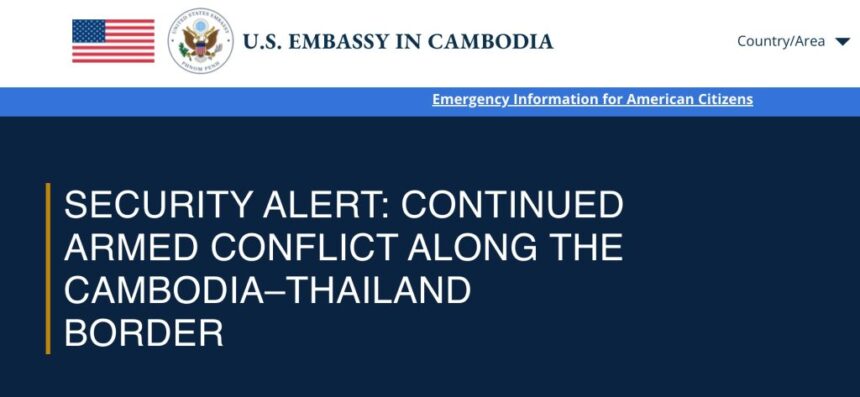
The United States has issued an updated warning urging Americans to avoid travel within 50 kilometers (about 31 miles) of the Cambodia–Thailand border, citing continued armed conflict, cross-border fire, and reports of Thai airstrikes that have extended beyond the immediate frontier.
In a security alert dated December 22, 2025, the U.S. Mission in Cambodia said it is monitoring “ongoing conflict along the Cambodia–Thailand border,” noting that since December 11 there have been reports of isolated Thai airstrikes both in provinces adjacent to the border and in areas up to 80 kilometers away, with the broader security situation described as volatile.
Separately, the U.S. Department of State’s destination guidance for Thailand and Cambodia underscores the practical effect for travelers: “Do not travel to areas within 50km of the Thai-Cambodian border due to ongoing fighting between Thai and Cambodian military forces.”
The warning is significant because it applies to a wide buffer zone on both sides of the border, potentially affecting overland itineraries and border crossings, even for travelers who do not intend to visit front-line areas. U.S. guidance also emphasizes that the U.S. government has limited ability to provide emergency services in affected provinces if conditions deteriorate further.
What’s Driving the Warning

The travel warning comes amid a rapidly evolving conflict along the countries’ 817-kilometer (508-mile) land border, where fighting has expanded across multiple points and has included rocket and artillery exchanges as well as air operations.
According to Reuters, the latest escalation has persisted into a third week, with at least 80 people reported killed so far. Officials and aid reporting cited by international media also indicate mass displacement, with more than half a million people forced from their homes in the border region.
The Associated Press reported that the current round of fighting reignited on December 8, after a border skirmish the day before injured Thai soldiers, followed by Thai airstrikes and Cambodian rocket fire.
While both governments blame the other for initiating attacks and violating prior commitments, the operational reality for civilians and travelers has been an unpredictable security environment that can shift quickly from localized clashes to broader exchanges.
In practical terms, this is not simply a “border dispute” in the abstract. Recent reporting indicates fighting has impacted multiple provinces and has disrupted cross-border movement, including at major checkpoints. In mid-December, Thailand was working to repatriate thousands of citizens stranded after Cambodia closed the Poipet border crossing, a critical transit point, amid ongoing clashes.
Diplomacy Under Pressure, but No Quick Resolution
Regional diplomacy has intensified, with ASEAN convening emergency discussions in Kuala Lumpur. Reuters reported that Thailand and Cambodia agreed to hold a December 24 meeting of defense officials aimed at resuming a ceasefire framework.
However, public statements from officials suggest the talks will be difficult and highly technical—focused on verification, timelines, and compliance—rather than a simple announcement of intent. Thai Foreign Minister Sihasak Phuangketkeow captured this stance in remarks reported: “A ceasefire cannot just be declared, it needs a discussion.”
The AP similarly described Thai officials arguing that prior ceasefire efforts were rushed and lacked sufficient implementation detail, contributing to renewed fighting. With allegations involving heavy weapons, drones, and landmines circulating alongside counterclaims, diplomats are attempting to stabilize conditions while preserving room for bilateral negotiation.
What Travelers Should Do Now
For travelers in Thailand or Cambodia—or those planning overland routes—the core implications are straightforward:
- Do not enter the 50-kilometer border zone on either side. This buffer is large, and travelers should treat it as a meaningful operational boundary, not a suggestion.
- Expect transport disruption near border provinces, including sudden checkpoint changes and closures at key crossings (as seen at Poipet).
- Plan for limited consular reach in affected areas and ensure independent contingency options (alternate routes, accommodation flexibility, emergency funds, and communications).
- If you are a U.S. citizen, enroll in STEP and monitor official embassy messaging closely, as conditions and guidance can change quickly.
The bottom line: the United States is signaling that the border conflict now presents material, unpredictable risk—including spillover beyond immediate frontier districts—and that travelers should route plans accordingly until the security situation stabilizes.