By Tom Polansek
WATERMAN, Illinois (Reuters) -A commerce mission to Nigeria. A memorandum of understanding with Vietnam. A surge of purchases from Bangladesh.
These international locations usually are not sometimes main prospects for soybeans from the U.S. farm belt. However determined farmers, their commerce organizations and President Donald Trump‘s administration are turning to far corners of the world in hopes of averting a catastrophe for agriculture from a commerce battle that has stored China from buying U.S. provides.
The efforts to date are failing to offset the lack of the nation’s greatest buyer for the crop, knowledge and interviews present, with monetary ache extending to tractor makers and different agricultural companies.
For the primary time in additional than 20 years, Chinese language importers haven’t but purchased soybeans from the autumn U.S. harvest, forcing farmers to retailer their crops on hopes that costs will ultimately rise from round a five-year low. It’s a danger that delays their means to usher in cash from crop gross sales at a time once they face rising prices for every part from labor and vitality to fertilizer.
In an indication that tough instances are anticipated to proceed in rural America, Trump has promised to offer proceeds from tariff revenues to farmers, who largely supported his campaigns for president.
On Thursday, U.S. Treasury Secretary Scott Bessent stated the federal government would make an announcement on Tuesday about assist for farmers.
Tit-for-tat tariffs that Washington and Beijing imposed on one another’s items this 12 months have made U.S. soybeans too costly for Chinese language consumers, main importers to purchase from South America as an alternative.
However various markets for U.S. exports are tiny by comparability and haven’t changed China, lengthy the world’s greatest importer by far.
CRISIS ACUTE FOR ILLINOIS SOYBEAN FARMERS The disaster is especially acute in Illinois, the biggest U.S. soybean producing and exporting state.
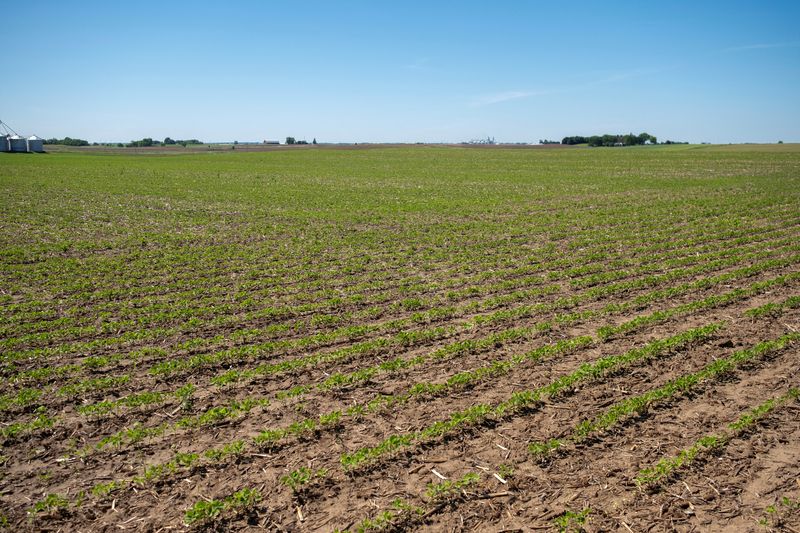
About 60 miles (97 km) west of Chicago, the place town and suburbs begin to give solution to inexperienced fields, farmer Ryan Frieders, 49, shall be storing a lot of his beans in bins after beforehand promoting a few of his anticipated harvest at costs under the price of manufacturing.
After months of labor that included planting seeds, fertilizing fields and spraying weedkillers, Illinois growers are dealing with losses of as much as $8 per acre due to low crop costs and weak exports, based on College of Illinois estimates.
U.S. soybean exports to China dropped 39% by quantity to five.9 million metric tons from January to July, earlier than the autumn harvest started, the most recent authorities knowledge present. By worth, shipments sank 51% to $2.5 billion, robbing farmers of billions of {dollars}’ value of enterprise.
The U.S. made a giant improve in exports to Bangladesh at simply over 400,000 tonnes, a fraction of China’s typical demand. Regardless of rising shipments to Vietnam, Egypt, Thailand and Malaysia, complete U.S. soybean exports had been down 8% by quantity from the identical interval a 12 months in the past to 18.9 million tonnes.
Together with business officers, Frieders, who farms in Waterman, Illinois, traveled to Turkey and Saudi Arabia in February to fulfill with consumers and go to processors on a visit sponsored by the U.S. Soybean Export Council commerce group.
“There’s speak about India and increasing there, and Southeast Asia, and North Africa: these are markets of the long run,” stated Frieders, including, “there is not this misplaced market that we have not checked out that might simply all of the sudden explode and be a brand new China.”
SOY INDUSTRY SEEKS TO IMPROVE TRADE
U.S. Agriculture Secretary Brooke Rollins stated on social media in September that Taiwan dedicated to $10 billion in U.S. agriculture purchases over the subsequent 4 years, together with soybeans. She referred to as the dedication a “game-changer,” but it surely was deceptive: such a dedication wouldn’t signify a rise.
The U.S. exported $3.8 billion value of U.S. agricultural merchandise to Taiwan in 2024, based on U.S. knowledge. If that very same tempo of gross sales continued over 4 years, it will complete $15 billion.
The U.S. Division of Agriculture didn’t reply to a request for remark about Rollins’ assertion.
Trade teams have additionally tried to spice up U.S. exports.
Throughout a commerce mission in June, co-sponsored by the U.S. Soybean Export Council, Vietnam’s agriculture minister signed memorandums of understanding to purchase greater than $1.4 billion in U.S. farm merchandise, together with soybeans, the council stated.
The council additionally met with Nigerian importers and soybean processors in June to advertise commerce, hoping to construct off a modest 64,000 metric tons shipped there final 12 months, based on the U.S. Mission in Nigeria. In August, the U.S. Mission in Nigeria stated it additionally joined the American Soybean Affiliation at a commencement ceremony involving aquaculture, an business that may use soy as fish meals.
By July, although, the U.S. had not exported any soybeans to Nigeria this 12 months, based on U.S. knowledge.
Illinois hosted agricultural consumers from Peru, Colombia, Nicaragua, El Salvador, Mexico and the Dominican Republic on an annual tour of farms and crop dealing with amenities in August.
The U.S. didn’t export soy to Peru by means of July, whereas Nicaragua and El Salvador purchased a negligible quantity, U.S. knowledge present. Exports had been largely flat to Mexico and right down to the Dominican Republic.
Farmers hope the efforts pay dividends over the long term, although they’re struggling now.
CHINA DOMINATES GLOBAL SOY IMPORTS
With greater than 1.4 billion individuals and the world’s greatest hog herd, China is difficult to exchange as a soybean purchaser. It has imported a mean of 61% of the world’s traded soybean provides over the previous 5 years, greater than the remainder of the world mixed, based on the American Soybean Affiliation.
In 2024, the U.S. exported almost 27 million metric tons of soybeans to China and 5 million metric tons to Mexico, the second greatest purchaser.
“The Soybean Farmers of our Nation are being harm as a result of China is, for ‘negotiating’ causes solely, not shopping for,” Trump wrote on Reality Social on Wednesday. He stated soybeans could be a significant subject of dialogue when he meets with Chinese language President Xi Jinping in 4 weeks.
China’s enterprise is now going to South America, because it did throughout Trump’s final commerce battle.
Final month, U.S. soybeans had been about 80 cents to 90 cents a bushel cheaper than Brazilian soybeans for cargo in September or October, however China’s 23% tariff on U.S. shipments added $2 a bushel to the fee for importers, merchants have stated.
In Argentina, the federal government of President Javier Milei briefly suspended export taxes on soybeans in September, luring Chinese language consumers who swiftly booked cargoes, merchants stated.
The offers infuriated U.S. farmers shut out of China as Bessent stated Washington was negotiating to assist Milei, a Trump ally, financially with a $20 billion swap line for Argentina.
“The frustration is overwhelming,” stated Caleb Ragland, 39, a Kentucky farmer and president of the American Soybean Affiliation.
CHINA’S ABSENCE IN THE MARKET SPILLS OVER TO OTHERS
The decline in earnings from crop manufacturing has spilled over into different sides of rural America.
Gear producer CNH, which sells tractors and combines, stated internet gross sales in its agriculture enterprise dropped 20% within the six months ending on June 30, in comparison with the earlier 12 months.
“The excellent news solely comes when China really begins to order,” CNH CEO Gerrit Marx stated in an August interview on the Farm Progress Present in Decatur, Illinois.
Decatur, house to Archer-Daniels-Midland’s North American headquarters, was previously often called the soy capital of the world due to its processing business, Mayor Julie Moore Wolfe stated.
On the Farm Progress Present, when requested the place the brand new soy capital was, the mayor dropped her voice to a whisper.
“It is likely to be Brazil,” she stated.
(Reporting by Tom Polansek. Modifying by Emily Schmall and Anna Driver)