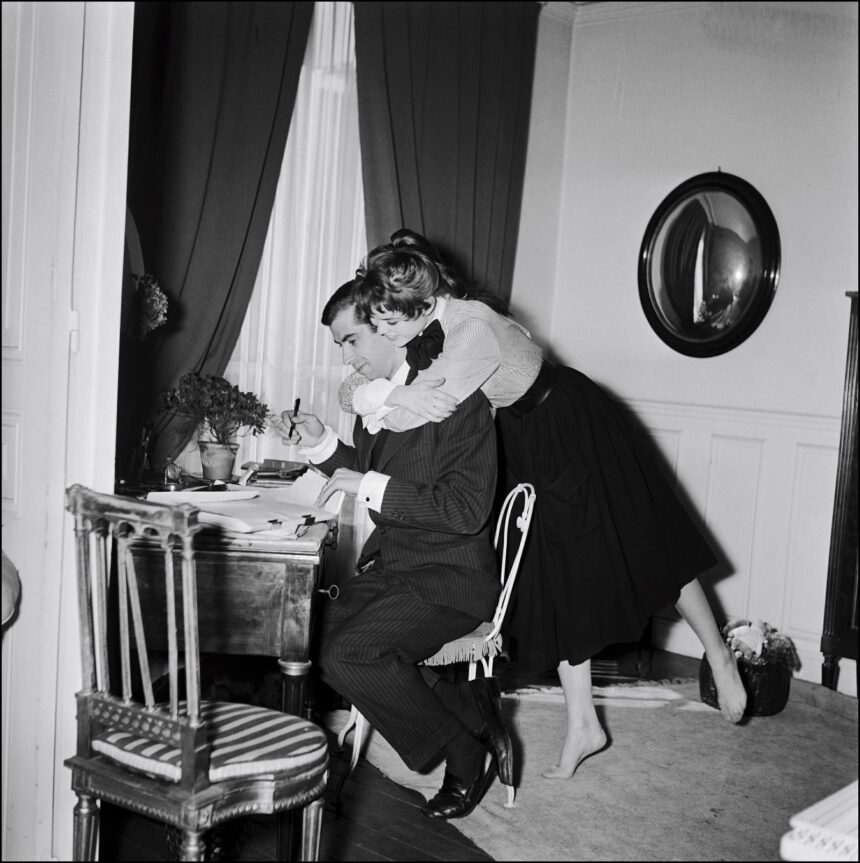
Brigitte Anne-Marie Bardot was born in 1934 in the seizième, in Paris, not too far from the Eiffel Tower. Her family was well-connected, straight-laced, and Catholic. Louis Bardot, her father, was a well-to-do businessman. Her mother, who had been a model known as “Toty,” didn’t much care for her daughters, Brigitte and her younger sister, Mijanou.
One day, the two sisters were playing under the drawing room table and managed to smash an antique Chinese vase on top of it. Bardot’s cold and distant mother was incensed. From that day on, they were to address her by the formal vous. “It was as if a wall, a barrier, had been erected,” Bardot later recalled, “that closed off the warmth of my childhood.”
Bardot started life in the public eye as a ballet dancer, showing considerable promise. She modeled hats, and later dresses, for the magazines. And then, in August 1953 (through the machinations of her mother), she was the Elle girl, photographed for their cover wearing a full-skirted dress (by the ready-to-wear brand Virginie) in pink and white gingham, which the French called toile de Vichy. She had wrist-length white gloves and was carrying a large-brimmed straw hat and a basket purse of wicker. With her then brunette hair pulled back and her fresh-faced looks, which are just a little knowing, this cover was a sensation.
Inside, the magazine showed her in full bella ragazza style: close-fitting sweaters or crisp shirts with full skirts to mid-calf, or tapered cropped trousers, worn with ballet flats. Bardot herself ordered flat shoes from Rose Repetto.
The filmmaker Marc Allégret, who had discovered Jean-Paul Belmondo, Michèle Morgan, and Louis Jourdan, among others, saw Bardot’s pictures. He sent his young protégé Roger Vadim (the son of a white Russian émigré) to see her. He was then 22 and he was bewitched. Her parents were horrified; in fact, Louis Bardot took a rifle to him. So they married in 1952, after she turned 18.