Colorado’s out of doors business, a marquee enterprise sector in a state recognized for its dedicated recreationists and considerable alternatives to benefit from the open air, is going through tough going because the Trump administration broadcasts tariffs, pauses them and reimposes the duties.
Whereas economists and politicians debate the deserves and downsides of upper taxes on imports, business representatives, state officers and enterprise homeowners say the small and mid-sized corporations that make up the majority of Colorado’s out of doors enterprise sector are battling the fallout.
And the brand new tariffs come on prime of duties which were traditionally increased than for a lot of different industries. By means of the years, out of doors companies have gone to China, Vietnam and different nations the place supplies and manufacturing amenities for technical gear and gear are extra accessible.
All these elements make it troublesome for out of doors companies to maneuver manufacturing to the U.S. At greatest, they are saying, it might take just a few years to develop the factories and essential experience.
Michael Mojica started transferring a few of the manufacturing for his enterprise, Outdoor Element, from China to Vietnam looking for decrease tariffs.
However the shift wasn’t fairly quick sufficient within the shortly altering commerce area. He acquired phrase from his logistics firm that, despite the fact that the cargo was on the water, enhance in tariffs on metal and aluminum introduced Aug. 18 would pile one other 50% onto the 28% price he already was paying on these items.
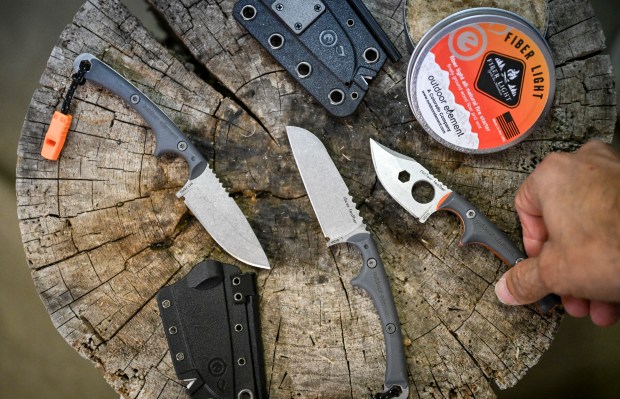
Out of doors Component makes use of the metals for merchandise that embody multitool carabiners, stoves, knives and fire-starting gear.
“I used to be planning to pay $4,200 for tariffs. I ended up paying $12,600. There went my revenue,” Mojica mentioned.
Out of doors Component, based mostly in Englewood, had its greatest 12 months in 2024. This 12 months, Mojica is questioning whether or not he’ll be capable of keep in enterprise.
“The curveball of tariffs is an actual factor,” Mojica mentioned. “I’ve found that most individuals don’t notice that it’s these small companies which are truly paying the tariffs, not the producer if we’re making them abroad.”
Mojica left his job as a mechanical engineer within the aerospace business in 2017 to chase his dream of turning a facet hustle of designing and producing out of doors gear into full-time work. Shifting to Colorado rekindled his love of the outside. He stays hopeful about holding his dream alive.
“I do my greatest as a small enterprise to, like, let’s pivot, let’s study, let’s educate ourselves, let’s be nimble,” Mojica mentioned.
Individuals within the out of doors business and different companies have in contrast the present challenges to what they went by way of in the course of the peak of the COVID-19 pandemic, mentioned Travis Campbell, proprietor and CEO of Eagle Creek, a travel-gear firm based mostly in Steamboat Springs.
“Most individuals I speak to would say this atmosphere is definitely far more difficult than the pandemic, given the magnitude of the prices and will increase in ranges of disruption, which is de facto saying one thing,” Campbell mentioned.
Multibillion-dollar financial infusion
The consequences of tariffs on out of doors companies aren’t any small factor for the nationwide or state economic system. The U.S. Bureau of Economic Analysis mentioned the out of doors recreation economic system accounted for two.3% of the nationwide gross home product in 2023. The total economic output was $1.2 trillion when it comes to gross output.
In Colorado, the out of doors business accounted for 3.2% of the state’s GDP in 2023, in response to the federal company.
A study conducted for the state discovered that the financial output related to out of doors recreation by Colorado residents totaled $65.8 billion in 2023, contributing $36.5 billion to the state’s GDP. The Statewide Complete Out of doors Recreation plan mentioned the financial exercise supported roughly 404,000 jobs in Colorado, which represented 12% of the whole labor pressure, and produced $22.2 billion in salaries and wages.
Different financial contributions in 2023 included $11.2 billion in native, state and federal tax income, in response to the research.
Colorado’s out of doors business is weak to adverse impacts from tariffs as a result of nearly all of the products are produced in Cambodia, Vietnam and different nations with excessive levies on imports to the U.S., a Sept. 4 report by the Polis administration mentioned. The business can also be largely made up of small companies.
“Tariffs on out of doors gear and gear threaten extra than simply stability sheets — they threaten Colorado communities,” Conor Corridor, director of the Colorado Outdoor Recreation Office, mentioned in an electronic mail.
“Tariffs threat stifling innovation, elevating prices for shoppers and undermining the very business that powers jobs, recreation and identification throughout Colorado,” Corridor added.
The Polis administration’s evaluation of the outcomes of tariffs mentioned a key sector of the out of doors business, sport-fishing, has been hit with increased tariffs on reels and rods produced in China and bait and aluminum from Canada.
The general efficient tariff price within the state is an estimated 21%, up from 3% in 2024, the report mentioned. Because of this, the Workplace of State Planning and Budgeting mentioned Coloradans may pay tons of of thousands and thousands of {dollars} extra for sturdy items.
“Colorado is a world-class vacation spot for out of doors recreation lovers and vacationers, and tariffs proceed to harm our economic system and worldwide fame, and it’s far previous time for the president to drop these mindless taxes on American households,” Gov. Jared Polis mentioned in a press release.
Historical past of tariffs
Industries from vehicles to attire to metal to timber to prescribed drugs are going through increased import taxes as President Donald Trump wages a commerce battle with nations around the globe. Nevertheless, the recreation business has traditionally handled increased tariffs.
The current will increase are sometimes stacked on prime of the earlier duties.
“The out of doors business has kind of been disproportionately tariffed relative to different attire and footwear” corporations, mentioned Jaclyn Levy, senior director of advocacy and authorities affairs on the Boulder-based Outdoor Industry Association.
Levy believes a part of the reason being that out of doors attire, footwear and gear are usually technical and complicated, limiting the place they are often produced.
“Oftentimes the locations should not within the Western Hemisphere in any respect, a lot much less in the USA,” Levy mentioned. “It’s not one thing which you can simply onshore.”
Previously, federal applications have helped ease a few of the increased costs on out of doors companies. A kind of was the Generalized System of Preferences program, which eradicated duties on 1000’s of merchandise from 119 designated nations. A aim of this system, permitted in 1974, was to encourage manufacturing in creating nations.
However the commerce choice program expired on the finish of 2020, and regardless of efforts by business teams and former bipartisan help, Congress hasn’t renewed it.
This system offset the fee and impacts of tariffs, Levy mentioned. Because the legislation expired 5 years in the past, out of doors corporations have paid a complete of about $2 billion greater than they might have with this system in place, she mentioned.

Onshoring isn’t simple
Firms which have thought-about transferring their manufacturing to the U.S. have run into huge hurdles, Levy mentioned.
The infrastructure, supplies and other people with the experience are sometimes not accessible. She mentioned a member of the Out of doors Trade Affiliation wished to fabricate its merchandise on this nation, however couldn’t rent sufficient sewers regardless of providing pay considerably above minimal wage and providing advantages and household go away.
“I’ve one member with light-weight tents and there are solely 10 producers on this planet who could make these supplies,” Levy mentioned.
Levy mentioned some corporations had been capable of replenish on stock after tariffs had been introduced earlier this 12 months. Now, companies say they’re beginning to elevate costs, freeze hiring and reduce on analysis and improvement.
Campbell, the Eagle Creek CEO, mentioned his firm moved most of its manufacturing to Indonesia. His firm had paid from about 17% to twenty% in what he referred to as “legacy” tariffs. The tariffs imposed by the Trump administration within the spring roughly doubled the charges.
Like many companies caught within the whirlwind of on-again, off-again will increase, Eagle Creek held off considerably elevating costs for patrons by sharing the financial beating with suppliers and slicing again spending.
However that may’t final ceaselessly, Campbell mentioned. He expects shoppers to start out seeing increased costs within the fall and subsequent spring.
“On an annualized foundation, the incremental value of the tariffs might be thousands and thousands of {dollars} to us,” Campbell mentioned. “It’s troublesome for any enterprise to soak up that magnitude in change in your value construction on the timeline that it was pushed by way of.”
Mojica mentioned Out of doors Component raised costs about 10% in April to assist cowl the upper tariffs. He’s holding again till the brand new 12 months on contemplating extra will increase to see if “issues cool down.” He has laid off a few individuals and his spouse went to work for the corporate without spending a dime — for now.
Campbell believes the altering charges and uncertainty surrounding the administration’s insurance policies will undermine one of many said targets of upper tariffs — elevated manufacturing within the U.S. He mentioned boosting home manufacturing would require “a number of {dollars} and many time” and certainty.
Mojica is manufacturing just a few of his merchandise within the U.S., however he wish to preserve a portion of his manufacturing in China as a sort of peaceable protest. “If we’re capable of have commerce with a rustic, we’re typically at peace with them.”
Get more business news by signing up for our Economy Now newsletter.