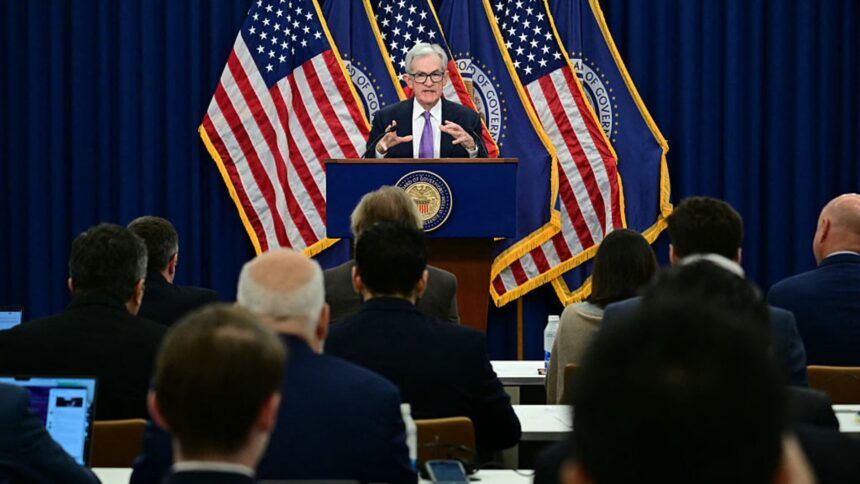
US Federal Reserve Chair Jerome Powell speaks throughout a press convention on the finish of a Financial Coverage Committee assembly in Washington, DC, on Oct. 29, 2025.
Jim Watson | AFP | Getty Pictures
The Federal Reserve on Wednesday accepted its second straight rate of interest minimize, although Chair Jerome Powell rattled markets when he threw doubt on whether or not one other discount is coming in December.
By a 10-2 vote, the central financial institution’s Federal Open Market Committee lowered its benchmark in a single day borrowing charge to a spread of three.75%-4%. Along with the speed transfer, the Fed introduced that it could be ending the discount of its asset purchases – a course of often known as quantitative tightening – on Dec 1.
Governor Stephen Miran once more forged a dissenting vote, preferring the Fed transfer extra rapidly with a half-point minimize. Kansas Metropolis Fed President Jeffrey Schmid joined Miran in dissenting however for the other cause – he most popular the Fed not minimize in any respect. Miran is an appointee of President Donald Trump, who has pushed arduous on the committee to decrease charges rapidly.
The speed additionally units a benchmark for a wide range of client merchandise resembling auto loans, mortgages and bank cards.
The post-meeting assertion didn’t present any route on what the committee’s plans are for December. On the September assembly, officers indicated the probability of three complete cuts this 12 months. The Fed meets as soon as extra in December.
Powell, nevertheless, cautioned in opposition to assuming {that a} charge minimize is a certain factor on the subsequent assembly.
“Within the committee’s discussions at this assembly, there have been strongly differing views about the right way to proceed in December,” Powell mentioned throughout his post-meeting information convention. “An additional discount within the coverage charge on the December assembly isn’t a foregone conclusion. Removed from it.”
He later added that there’s “a rising refrain” among the many 19 Fed officers to “a minimum of wait a cycle” earlier than reducing once more. Merchants lowered odds for a December minimize to 67% from 90% a day in the past, in keeping with the CME Group’s FedWatch.
Shares, which had been larger after the preliminary choice was launched, turned decrease on the chair’s feedback. Main averages slowly got here again in the course of the session with reporters.
The discount got here though the Fed basically has been flying blind currently on financial knowledge.
Aside from the buyer worth index launch final week, the federal government has suspended all knowledge assortment and reviews, that means such key measures as nonfarm payrolls, retail gross sales and a plethora of different macro knowledge is unavailable.
Within the post-meeting assertion, the committee acknowledged the uncertainty accompanying the dearth of knowledge, qualifying the best way it categorized broad financial situations.
“Accessible indicators recommend that financial exercise has been increasing at a reasonable tempo. Job positive factors have slowed this 12 months, and the unemployment charge has edged up however remained low via August; more moderen indicators are per these developments,” the assertion mentioned. “Inflation has moved up since earlier within the 12 months and stays considerably elevated.”
Every of these characterizations represented tweaks from the September assertion. Essentially the most important change was the view on broad financial exercise. In September, the FOMC mentioned exercise had moderated.
The assertion reiterated issues that policymakers have over the labor market, saying that “draw back dangers to employment rose in latest months.”
Even earlier than the shutdown, proof had begun to construct that whereas layoffs have been contained, the tempo of hiring had flattened. On the similar time, inflation has held significantly above the Fed’s 2% annual aim. The CPI report final week, launched due to its significance to Social Safety cost-of-living changes, confirmed the annual charge at 3%, pushed by larger power prices in addition to a number of objects with direct or oblique hyperlinks to Trump’s tariffs.
The Fed tries to strike a steadiness between full employment and steady costs. Officers currently, although, have mentioned they see a barely larger threat posed by the roles image. Together with the rate of interest choice, the Fed mentioned its means of decreasing the quantity of bonds it holds on the central financial institution’s $6.6 trillion steadiness sheet will finish.
This system, also called QT, had shaved some $2.3 trillion off the Fed’s portfolio of Treasurys and mortgage-backed securities. As an alternative of reinvesting maturing proceeds from the securities, the Fed has been permitting them to roll off the steadiness sheet at a restricted stage every month. Nonetheless, latest indicators of some tightening in short-term lending markets have raised concern that the roll-off has gone far sufficient.
An implementation notice accompanying the choice indicated the Fed will likely be rolling proceeds from maturing mortgage securities into shorter-term payments.
Markets just lately had begun anticipating that the Fed would finish QT both in October or by the top of the 12 months. The Fed expanded its holdings in the course of the Covid disaster, pushing the steadiness sheet from simply over $4 trillion to shut to $9 trillion. Powell has mentioned that whereas the Fed discovered it essential to shrink its holdings, he didn’t foresee a return to pre-pandemic ranges.
The truth is, Evercore ISI analyst Krishna Guha mentioned he may foresee a situation the place the Fed truly restarts the purchases early in 2026 for “natural progress functions” as market situations shift. The Fed not often eases financial coverage throughout financial expansions and bull markets in shares. Main averages, although risky, have been posting a sequence of document highs, boosted by additional positive factors in Large Tech shares and a sturdy earnings season.
Historical past has proven that the market continues to rise when the Fed does minimize beneath such circumstances. Nonetheless, simpler coverage additionally poses the danger of upper inflation, a situation that pressured the Fed right into a sequence of aggressive charge hikes.
Correction: This story has been up to date to right that Jeffrey Schmid is president of the Kansas Metropolis Fed, and that the Fed raised rates of interest following an inflation spike.