President Trump Just Gave Stock Investors 2 Reasons to Worry About Another Market Crash
Share
9 Min Read
SHARE
Extreme tariffs not too long ago reinstated by President Trump have pushed the common tax on U.S. imports to its highest degree in many years.
Trump fired the Bureau of Labor Statistics (BLS) commissioner after insinuating the newest nonfarm payrolls numbers have been faux.
The mixture of extreme tariffs, questions on financial information integrity, and already excessive valuations may result in one other inventory market crash.
The U.S. inventory market has taken buyers for a bumpy trip this yr. The benchmark S&P 500(SNPINDEX: ^GSPC) fell as a lot as 19% from its file excessive when President Donald Trump introduced sweeping “Liberation Day” tariffs on April 2, however the index swiftly rebounded when he paused the duties for 90 days.
Nonetheless, Trump simply gave buyers two causes to fret about one other market crash: He not too long ago reinstated modified variations of the extreme tariffs introduced earlier this yr, and he fired the Bureau of Labor Statistics commissioner in a method that threatens to politicize the impartial company liable for gathering financial information.
Here is what buyers ought to know.
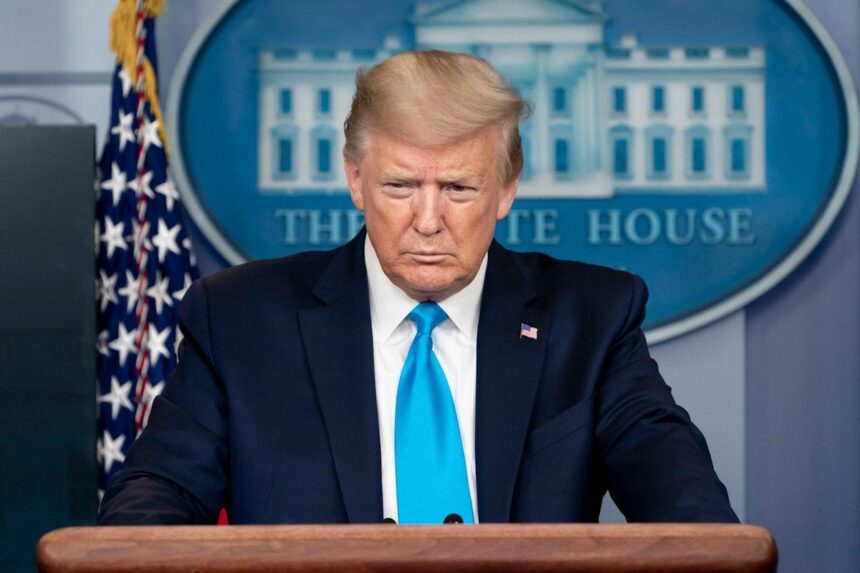
Picture supply: Official White Home Picture by Andrea Hanks.
Trump not too long ago reinstated the reciprocal tariffs first introduced on April 2. After a monthslong pause, throughout which the U.S. struck commerce offers with a couple of nations, the brand new duties took impact on Aug. 7. Listed beneath are the tariff charges on prime U.S. buying and selling companions.
European Union: 15%
Mexico: 25%
China: 30%
Canada: 35%
Japan: 15%
Importantly, Canadian and Mexican imports in compliance with the free-trade settlement aren’t topic to tariffs listed above. Additionally, the 30% tariff on Chinese language imports excludes pre-existing duties, and the speed is topic to alter relying on the end result of ongoing commerce talks, which ought to conclude within the coming days.
The Finances Lab at Yale estimates tariffs have elevated the common tax on U.S. imports to 18.6%, the best degree since 1933. Economists at Goldman Sachs and JPMorgan Chase put the determine nearer to 17%, however the massive image is identical: The U.S. authorities is taxing imports at a fee not seen in almost a century.
The results are troublesome to foretell because of the lack of historic information, however economists usually anticipate a one-time improve in inflation and a persistent drag on gross home product (GDP). As an example, the Finances Lab at Yale estimates tariffs will decrease GDP progress by 0.5 share factors within the subsequent two years, and the Tax Basis estimates tariffs will cut back GDP by 0.8% over the subsequent decade.
That would sink the inventory market as a result of financial turbulence would result in weaker company earnings. Consequently, Wall Road analysts have minimize their earnings estimates for the S&P 500. The January consensus referred to as for 14% progress in 2025, however the present consensus requires 9.6% progress. And that quantity could also be revised even decrease after the dismal nonfarm payrolls report launched earlier this month.
Latest information from the Bureau of Labor Statistics (BLS) suggests tariffs are beginning to harm the labor market. Nonfarm payrolls, which measure the variety of staff throughout the U.S. financial system excluding farm staff, elevated 73,000 in July. That was an enormous miss versus the consensus estimate that referred to as for 110,000.
Much more alarming have been the downward revisions to nonfarm payrolls information from earlier months, as detailed beneath:
Nonfarm payrolls have been initially reported to have elevated 144,000 in Could, however that determine was revised all the way down to 19,000.
Nonfarm payrolls have been initially reported to have elevated 147,000 in June, however that determine was revised all the way down to 14,000.
Revisions are commonplace as a result of surveys used to estimate the variety of staff within the financial system proceed to roll in for weeks after the preliminary report. However Trump, with out providing proof, asserted the newest downward revisions have been a politically motivated assault. He reacted by firing BLS Commissioner Erika McEntarfer.
In some methods, that call is much more worrisome than the dismal nonfarm payrolls numbers themselves. JPMorgan analyst Michael Feroli commented, “The chance of politicizing the information assortment course of shouldn’t be missed.” And Barclays analyst Ajay Rajadhyaksha wrote, “This transfer may result in markets questioning information integrity, particularly for releases that shock buyers.”
Briefly, buyers now have trigger to wonder if the subsequent BLS commissioner will manipulate information to make Trump joyful. In spite of everything, McEntarfer seemingly misplaced her job just because the company launched information that annoyed the president, because it instructed the labor market was weakening in response to his tariffs and the uncertainty they’ve created.
To summarize, Trump has imposed probably the most extreme tariffs the U.S. financial system has seen in many years. In flip, Wall Road analysts have considerably decreased their S&P 500 earnings estimates, and additional downward revisions are attainable (if not going) following the newest nonfarm payrolls report.
In the meantime, Trump created extra uncertainty by firing the BLS commissioner whereas asserting with out proof the newest nonfarm payrolls numbers have been phony. That begs the query: Will buyers marvel if future BLS information has been manipulated? In that case, the implications for the inventory market may very well be disastrous.
These occasions are notably worrisome as a result of the S&P 500 already trades at a really wealthy valuation of twenty-two.2 instances ahead earnings. Traditionally, the S&P 500 has dropped 6.4% within the yr following incidents the place its ahead price-to-earnings a number of topped 22, in keeping with hedge fund supervisor Leon Cooperman.
Briefly, the inventory market can be on shaky floor with out tariffs or questions on information integrity, however these variables make the present state of affairs particularly precarious. So, buyers ought to mentally put together for a decline. Which means avoiding shares that commerce at absurd valuations and constructing a modest money place.
Before you purchase inventory in S&P 500 Index, take into account this:
The Motley Idiot Inventory Advisor analyst staff simply recognized what they consider are the 10 best stocks for buyers to purchase now… and S&P 500 Index wasn’t considered one of them. The ten shares that made the minimize may produce monster returns within the coming years.
Think about when Netflix made this record on December 17, 2004… for those who invested $1,000 on the time of our advice, you’d have $636,563!* Or when Nvidia made this record on April 15, 2005… for those who invested $1,000 on the time of our advice, you’d have $1,108,033!*
Now, it’s value noting Inventory Advisor’s whole common return is 1,047% — a market-crushing outperformance in comparison with 181% for the S&P 500. Don’t miss out on the newest prime 10 record, accessible once you be a part of Inventory Advisor.
JPMorgan Chase is an promoting companion of Motley Idiot Cash. Trevor Jennewine has no place in any of the shares talked about. The Motley Idiot has positions in and recommends Goldman Sachs Group and JPMorgan Chase. The Motley Idiot recommends Barclays Plc. The Motley Idiot has a disclosure policy.