Palestinian actor Motaz Malhees gets emotional just thinking about two lines from his film “The Voice of Hind Rajab,” the Oscar-nominated docudrama on 5-year-old Palestinian girl Hind Rajab’s desperate plea to humanitarian workers in Gaza before she was killed by Israeli forces.
Malhees, who listened to actual recordings of Rajab’s call while she was trapped inside a car that was reportedly attacked by an Israeli military tank, said he experienced a panic attack hearing Rajab say she was in “the butterfly class” in preschool.
“That hit me deep in my heart,” said Malhees in an interview with JS.
Another line struck him: Rajab saying her loved ones in the car, likely dead while covered in blood, were “sleeping.”
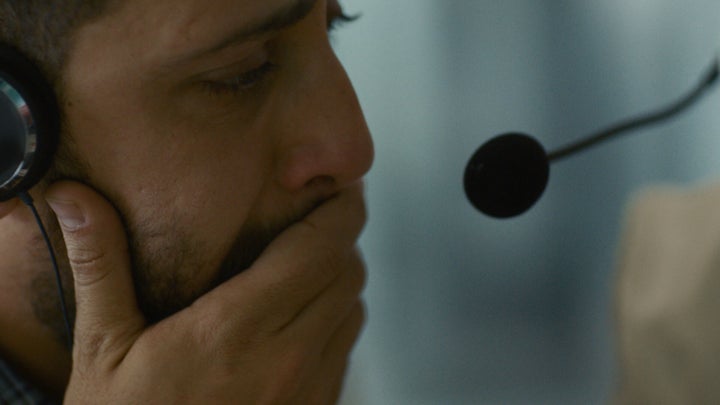
The actor said the two moments “destroyed” him as he listened to Rajab’s call through an earpiece on set. It provided further fuel for him to help share the 5-year-old’s story with “every cell” in his body.
“Put your child there and think of the story — drop all the flags, all the names, all of everything. Put your child in there. This is abnormal. We are in a time where the world needs to really move and do something,” said Malhees of Israel’s devastating, U.S.-backed offensive in Gaza that has fueled a humanitarian crisis in the besieged territory.
Courtesy of Watermelon Pictures/Watermelon+
Malhees — who plays emergency operator Omar Alqam of the Palestine Red Crescent Society — is among the all-Palestinian cast in Tunisian director Kaouther Ben Hania’s film, which is nominated for Best International Feature Film at Sunday’s Academy Awards.
Filming began less than a year after Rajab and her cousin dialed the Palestine Red Crescent Society after the two, along with relatives, attempted to flee Gaza City when an Israeli tank pelted their vehicle with bullets, killing most of their loved ones, according to a detailed analysis by Forensic Architecture.
After her cousin was killed, the 5-year-old remained on the line as rescue workers tried to reach her and bring her to safety.
Rajab was found dead in the car weeks later. Two paramedics were also killed, likely by Israeli forces, as they attempted to rescue her in an ambulance, per Forensic Architecture.
The film captures Rajab speaking with Alqam, who, in real life, was raising a newborn baby boy at the time.
“He couldn’t play with or hold him for a couple of months,” said Malhees, who is now friends with Alqam.
“He told me he felt disconnected from his son, disconnected from his wife.”
The actor credits his emotional conversations with Alqam, whom he describes as a “hero,” for playing a significant role in his portrayal of the emergency worker on screen.
Since the film’s record 23-plus-minute ovation following its Venice premiere, it has earned a Golden Globe nomination and received sweeping critical acclaim.
Despite the film’s success, Malhees will likely not attend Sunday’s Oscars ceremony due to the Trump administration’s ban on entry to the United States for Palestinians, as highlighted by Zeteo last month.
“It pisses me off and it hurts, but I thought of it in a different way,” Malhees told JS. “I’m banned as the physical me but my art is there. My story is there. What I want to tell the world is there. I’m in every single frame in this story with my soul there.”

Li Jing/Xinhua News Agency via Getty Images
The story hits close to home for Malhees, who recalled “weeping” and “shaking” while reading the script before the cameras even started rolling.
Malhees grew up in the Jenin refugee camp in the occupied West Bank.
He recalls being 10 years old when, in 2002, Israeli forces invaded the refugee camp with tanks, vehicles and helicopters while access to electricity and water were cut off.
Malhees, who began his journey as an actor at Jenin’s Freedom Theatre, said he felt a massive responsibility in helping bring the story of Rajab’s final moments to the big screen.
“I just want to give it all I can, everything in my hands, in my heart and my body, I’m just going to just pour it there for the world,” said Malhees of the film.
“And because I want them to hear it, I want them to see this story, I want this story to never happen again to other children.”