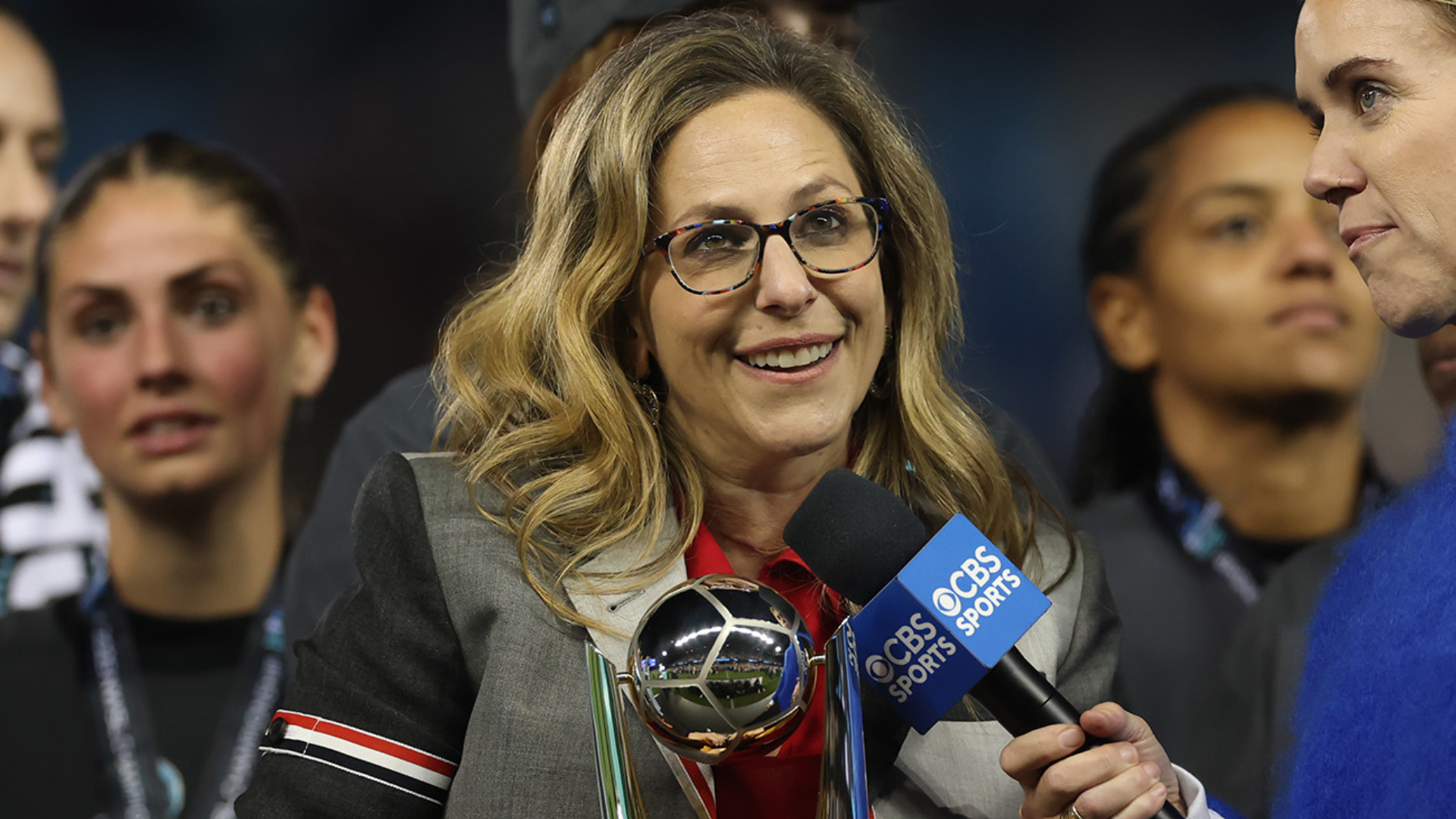
As Trinity Rodman took to a stage in Los Angeles on Thursday to celebrate her new contract with the Washington Spirit, one that makes her the highest-paid women’s soccer player in the world, it was hard not to reflect on the months-long ordeal that preceded the week’s big news. The Spirit’s higher-ups did not hesitate to note that the NWSL’s new high impact player rule helped to enable Rodman’s return, a victory for a team that was once handicapped by a salary cap that may not have otherwise allowed them to re-sign their star player.
The crowning achievement for the HIP rule, though, comes with a large asterisk. The league celebration — and defense — of its new policy comes a week after the NWSL Players Association filed a grievance against it, arguing the HIP rule was not collectively bargained and violates federal labor law. The rule is not simply one of many disputes sports leagues face from player unions, but gets at the heart of a new-age existential dilemma in an ever-evolving sport — is the HIP rule enough to ensure that NWSL teams can compete with the most ambitious overseas clubs for top-tier talent?
Naturally, the answer varies depending on who you ask. NWSL commissioner Jessica Berman described the HIP rule as a meet-in-the-middle approach for a league that needs to make a move but one that baked financial responsibility into the construction of the policy.
“in my best judgment, my fundamental responsibility is to be a responsible steward of capital,” Berman told CBS Sports. “There’s hundreds of millions of dollars being invested in training facilities, in stadiums, in coaches, in training environments, in business staff and to the extent we are unlocking incremental investment in this space, it is our responsibility to make sure that is specifically tailored to our commercial business.”
NWSLPA executive director Meghann Burke, though, believes the HIP rule is not an adequate response to the new, investment-focused realities of the rapidly growing women’s game.
“The problem is, though, we merely transformed to keep up with the rest of the world,” Burke said. “We didn’t transform to lead and that is a proud feature of how the U.S. has historically dominated in the women’s game. We’ve done things no one else is doing. Well, now the rest of the world’s doing it so I do tend to agree that our current system does not allow us to compete with the rest of the world.”
The HIP rule’s unique eligibility construct
The HIP rule allows each NWSL team to spend an additional $1 million on player wages without a hit to the salary cap, which will clock in at $3.7 million for the 2026 season. One of the most noticeable elements of the rule’s language, though, is that there is a list of criteria players need to check off for the rule to be triggered. Players need to be eligible through just one category, some more straightforward than others — a playing time threshold for the U.S. women’s national team, inclusion on year-end awards lists and most surprisingly, cracking a media-generated list of top players. (Disclosure, and example of the potential awkwardness of this rule, I was a voting member of The Guardian’s list of the 100 best female soccer players for 2025.)
Berman said the criteria became part of the HIP rule in a conscious decision from the NWSL to create a list that was not subjective but objective, “or done by third parties, independent third parties that we are not involved with … those lists are a proxy for players who are recognized globally.”
“It has to move the needle from a business perspective,” Berman said, describing the reasoning behind the list of criteria. “There has to be a clear benefit to the growth of the business and there’s still tons of room within the $3.7 million of our salary cap for [general managers] and scouts and others to identify emerging talent who can become eligible during their time there and don’t actually need the rule. The rule can kick in when they become globally recognized as a top player. … And I think just importantly, when I talk about the responsibility that we have as a league, the very specific role of the league vis-a-vis the clubs is to influence and guide behavior based on macro trends that we see. For the overall growth and health of the business this rule, in the aggregate over the term of the [collective bargaining agreement], has the potential to invest $15 million. It’s a lot of capital being poured into player compensation and it is our responsibility to make sure that that additional investment is rationally related to our ability to continue to grow the business so that this league can continue to thrive and be sustainable.”
Berman admitted the HIP rule is “not perfect,” to the point that a handful of high-profile players are currently ineligible for those funds. Burke, in some sense, agreed and argued that the current criteria is an imperfect barometer for fair market value. “How you assess a player’s fair market value is nuanced based on several criteria and what you’re able to pay a player is also nuanced and not only based on what someone else thinks it is,” Burke said. “Fair market value is what a willing party is willing to offer and a willing party is willing to accept. It’s not decided by journalists and so this does not make sense and it is wildly inappropriate to take a discretion of how to construct a roster out of the hands of the GMs, if you’re claiming it’s a roster classification, and put it in the hands of the media.”
A collective bargaining dispute
The foundation of the NWSLPA’s grievance is that the league did not collectively bargain with the union before implementing the HIP rule, a notion the NWSL has rejected.
“The history of the rule is that this is something we’ve been talking about since 2022 and when we negotiated our CBA, we very intentionally negotiated for this exact right that we then exercised, including giving the union the opportunity to consult in good faith, which is what we’re required to do under the CBA,” Berman said. “I do just want to say, as a labor lawyer, I take our responsibilities under the CBA and under labor law very seriously and this was very intentional from the CBA negotiations and how this was executed and implemented.”
Burke disagreed with the claim that there was adequate time to bargain in good faith. She said Berman “socialized” a proposal to “create an additional spend with certain criteria to access that stipulated” shortly after the NWSL Championship in late November before receiving a phone call on Dec. 1 from the league’s counsel, who listed “criteria that I knew would be deeply problematic and are completely different than the designated player role in MLS.” Burke then received a document with the rule’s language on Dec. 11.
“I had a feeling it was going to go over like a lead balloon with our membership based on prior conversations and where I know this group wants to see the league go and — previously, we’d had some conversations around the idea or concept of a designated player rule and there was a resistance to that concept,” Burke said. “My job is to facilitate discussion and lead dialogue within the union so I try to let folks react without putting my thumb on the scale so I just shared it as it was presented to the board and I would say the chatter was immediately not approving of the rule. We had some discussion via text or WhatsApp and decided, this kind of proposal deserves a robust discussion, not just reactions over text.”
The NWSLPA held a board meeting on Dec. 16, Burke said, and afterwards told the league they felt the HIP rule was an unwise proposal, but the NWSL pressed on and made the new policy public information on Dec. 23.
“We advised the league that, if they move forward over our objection and refuse to bargain with us in good faith, that they could anticipate we’d be filing agreements,” Burke said. “Candidly, this could also be an unfair labor practice but we’re exercising our rights using the grievance procedure. … I’ll just say part of the reason this has been played out publicly is that they informed the media of the proposed high impact play rule at the exact same time they informed us.”
The NWSLPA also alleges that the league’s description of the HIP rule as a roster classification is false and that it is instead a salary classification, which is something the league cannot institute without a green light from the union.
“It doesn’t surprise me that internally they might have been thinking about a possible solution but to the extent they think they negotiated a right to do something, what they negotiated is clearly that out in Section 8.16, which is that they can increase this holiday cap or they can reduce the cap charge for certain roster classifications,” Burke said. “A, this is not a roster classification and B, at no point in negotiations did they lay this out, no.”
Maintaining a competitive edge
The specter of a potential Rodman departure will always be joined at the hip with the NWSL’s new rule, if only for its timing, but the concern extends beyond the league’s brightest star. She chose to stay while USWNT colleagues like Naomi Girma, Alyssa Thompson and Emily Fox left in recent years, forcing questions of the NWSL’s ability to actually compete with Europe’s most driven clubs.
Berman, as she has for the entirety of her spell in charge of the NWSL, sold the league’s product as a whole — competitive play, an increased number of individualized training facilities and other investments that make the U.S. organization a destination league in the women’s game. Those investments, she argues, are all in the hopes of bolstering the NWSL’s finances in a way that feeds the league’s entire ecosystem.
“There’s hundreds of millions of dollars being invested in training facilities, in stadiums, in coaches, in training environments, in business staff and to the extent we are unlocking incremental investment in this space, it is our responsibility to make sure that is specifically tailored to our commercial business,” Berman said. “Said in another way? We are a business. We need to generate revenue. What will help support the increase in the revenue streams that are part of the revenue share that the player is benefit from is increasing sponsorship and increasing media rights and it is, in our best judgment, that to the extent, we have the right under the CBA, which we do, to curate a classification of players that has a reduced salary cap charge. It is our responsibility to make sure that those incremental dollars are being used in service of our business objectives.”
Burke is not so sure that the NWSL has done enough to edge out its competitors.
“That’s where I acknowledge the investments that a lot of teams are making and by the way, a lot of infrastructure that is inherited by Arsenal and Chelsea and Manchester United and Man[chester] City, they’re not having to go out and convince local governments to build training facilities because they have one that they use that the men built how many years ago.” Burke said. “I can appreciate the challenges we have in the NWSL and I do think it’s something we’re proud of and our players are proud of, but the one controllable that doesn’t require government approval or a timeline or permitting or whatnot is an increased compensation and that’s why we think our proposal is so reasonable. It’s almost painfully reasonable. $1 million per team [added to the salary cap] is very modest. It’s very modest and we’ve simply said, take what you’re already willing to increase for now and do it the right way. Don’t impose these weird constraints that are going to further hamstring you.”
While the NWSLPA hopes for a higher salary cap that applies to all players, no matter their accolades, it is not the only possible solution Burke has in mind — nor is it her primary ask.
“There are a lot of remedies that an arbitrator could fashion and perhaps that is one remedy that an arbitrator could determine is appropriate here but in all honesty, what we’ve been asking for in every public statement we’ve made is come to the table,” she said. “Bargain in good faith. Bargain in good faith. Just bargain in good faith, what they have not done.”