Marc Jacobs is a man reckoning with his past. His show notes said as much: “Memories, both bittersweet and beautiful, are a faculty of purpose, influencing current and future actions—who we are, what we create, what we leave behind, and what we carry forward.”
For the first time in two years we were back at the Park Avenue Armory, an on-again, off-again show venue of Jacobs’s. Tonight, the Brobdingnian folding table and chairs by the late artist Robert Therrien from that spring 2024 show were shrunken down to life size, and positioned at the far corner of the enormous space. Perched on the table was a small painting by Anna Weyant, commissioned just last week, of a daisy, its petals plucked and pinned like scientific specimens or keepsakes in a scrapbook. To see the painting required a walk across the Armory; from the distance of the single row of chairs where the audience sat, it was vanishingly small.
That seemed to be part of Jacobs’s point. The internet may run on nostalgia, but our memories, like our dreams, are our own, and for the most part they’re interesting to us alone. Still, they make up a life, and Jacobs appeared to be reconsidering his.
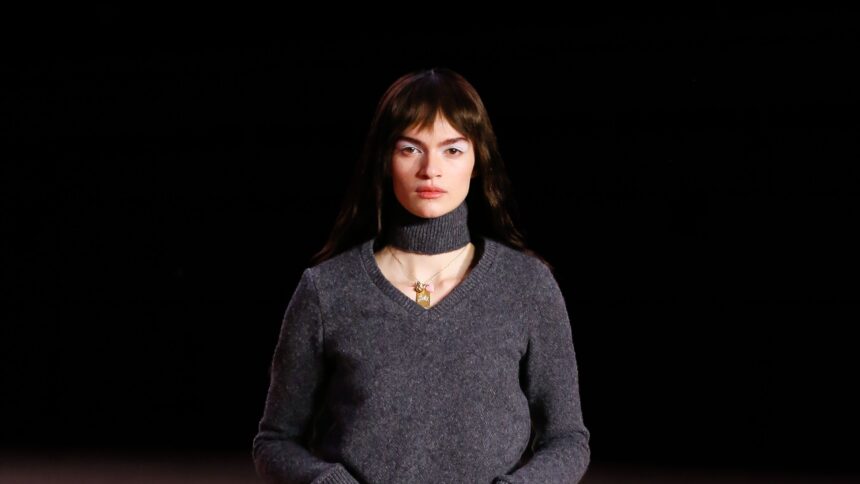
Bjork’s “Joga” on the soundtrack provided a clue. The song was released in 1997. It was the year Jacobs was named the first creative director of Louis Vuitton, and a pre-world wide web high point of his American sportswear era, when he sent out v-necks, and button-downs, and straight skirts; prim little suits; and shift dresses that a generation of fashion editors adopted as a kind of uniform. I can vouch for that: I was crashing Marc Jacobs shows in that era, and I aspired to be one of those Marc Jacobs customers.
The intervening decades have left their mark on Marc and on fashion, of course, even as we are in the midst of a ’90s revival, with the Ryan Murphy JFK Jr. and Carolyn Bessette Kennedy Love Story premiering next week. These days, to look at the late ’90s collections of Jacobs (and his designer peers, Bessette Kennedy’s employer Calvin Klein, included), many people would call them plain. Here the proportions were tweaked: Waistbands were loose—enough to slip your hands in on a straight skirt, or to hoick up a mini high above the waist. Coats were worn front-to-back, a row of buttons marching up the spine, and the frogging on jackets and shirts glittered like it was made from AI. But even with all those weirdening adjustments, these were clothes of a different kind than we’ve grown accustomed to from Jacobs of late.
Following a Covid-time pause, Jacobs returned to the runway flaunting a taste for wild exaggeration, with silhouettes taken to the extreme in the manner of designer icons of his, like Vivienne Westwood and Rei Kawakubo. It was fashion as performance art, and it for made great pictures, but nobody was wearing these pieces to the office, or out on a first date. Tonight’s collection, though, it got the heart pumping. “What a great show! Clothes we can wear,” cheered Jacobs’s friend, the designer Anna Sui.
Michael Burke, the chairman and CEO of LVMH Americas, and Sidney Toledano, a senior advisor to Bernard Arnault, were both in the audience. LVMH is reportedly reinvesting in the Marc Jacobs brand after a sale to Authentic Brands Group failed to go through. There’s a generation that grew up on Jacobs that hasn’t spent with him in half a decade, maybe more. I’d call this quite a well-timed stroll down memory lane.