Synthetic intelligence, apparently, is the brand new “faux information.”
Blaming AI is an more and more in style technique for politicians searching for to dodge accountability for one thing embarrassing — amongst others.
AI isn’t an individual, in spite of everything. It may possibly’t leak or file go well with. It does make errors, a credibility drawback that makes it laborious to find out reality from fiction within the age of mis- and disinformation.
And when fact is tough to discern, the untruthful profit, analysts say. The phenomenon is extensively often known as “the liar’s dividend.”
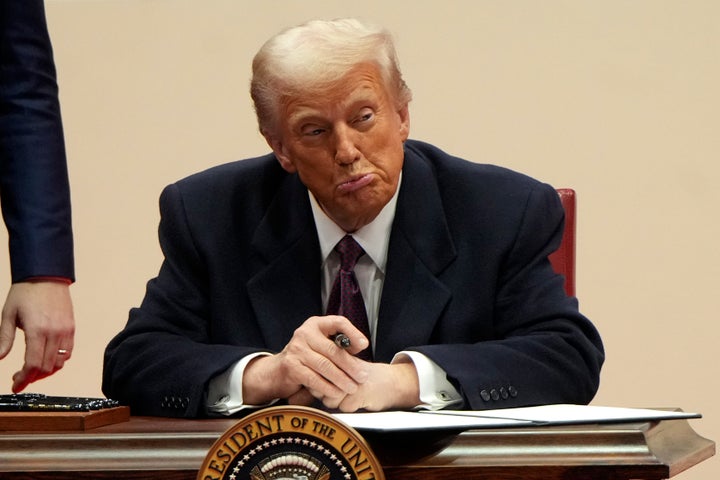
On Tuesday, President Donald Trump endorsed the practice. Requested about viral footage exhibiting somebody tossing one thing out an upper-story White Home window, the president replied, “No, that’s in all probability AI” — after his press workforce had indicated to reporters that the video was actual.
However Trump, identified for insisting the reality is what he says it’s, declared himself all in on the AI-blaming phenomenon.
“If one thing occurs that’s actually dangerous,” he advised reporters, “perhaps I’ll have to only blame AI.”
AI is getting blamed — typically pretty, typically not
On the identical day in Caracas, Venezuelan Communications Minister Freddy Ñáñez questioned the veracity of a Trump administration video it mentioned confirmed a U.S. strike on a vessel in Caribbean that focused Venezuela’s Tren de Aragua gang and killed 11. A video of the strike posted to Fact Social reveals a protracted, multi-engine speedboat at sea when a brilliant flash of sunshine bursts over it. The boat is then briefly seen lined in flames.
“Based mostly on the video supplied, it is vitally doubtless that it was created utilizing Synthetic Intelligence,” Ñáñez mentioned on his Telegram account, describing “virtually cartoonish animation.”
Blaming AI can at occasions be a praise. (“He’s like an AI-generated participant,” tennis participant Alexander Bublik mentioned of his U.S. Open opponent Jannik Sinner’s expertise on ESPN ). However when utilized by the highly effective, the apply, consultants say, will be harmful.
Digital forensics knowledgeable Hany Farid warned for years concerning the rising capabilities of AI “deepfake” photographs, voices and video to help in fraud or political disinformation campaigns, however there was all the time a deeper drawback.
“I’ve all the time contended that the bigger difficulty is that while you enter this world the place something will be faux, then nothing must be actual,” mentioned Farid, a professor on the College of California, Berkeley. “You get to disclaim any actuality as a result of all you need to say is, ‘It’s a deepfake.’”
That wasn’t so a decade or two in the past, he famous. Trump issued a uncommon apology (“if anyone was offended”) in 2016 for his feedback about touching girls with out their consent on the infamous “Entry Hollywood” tape. His opponent, Democrat Hillary Clinton, mentioned she was wrong to name a few of his supporters “a basket of deplorables.”
Toby Walsh, chief scientist and professor of AI on the College of New South Wales in Sydney, mentioned blaming AI results in issues not simply within the digital world however the actual world as effectively.
“It results in a darkish future the place we not maintain politicians (or anybody else) accountable,” Walsh mentioned in an e mail. “”It was once that should you had been caught on tape saying one thing, you needed to personal it. That is not the case.”
Considering the ‘liar’s dividend’
Danielle Okay. Citron of the Boston College Faculty of Legislation and Robert Chesney of the College of Texas foresaw the problem in analysis revealed in 2019. In it, they describe what they referred to as “the liar’s dividend.”
“If the general public loses religion in what they hear and see and fact turns into a matter of opinion, then energy flows to these whose opinions are most outstanding—empowering authorities alongside the way in which,” they wrote within the California Legislation Overview. “A skeptical public might be primed to doubt the authenticity of actual audio and video proof.”
Polling suggests many Individuals are cautious about AI. About half of U.S. adults mentioned the elevated use of AI in day by day life made them really feel “extra involved than excited,” in keeping with a Pew Research Center ballot from August 2024.
Pew’s polling signifies that individuals have turn out to be extra involved concerning the elevated use of AI lately.

MEHMET ESER by way of Getty Photographs
Most U.S. adults seem to mistrust AI-generated data after they know that’s the supply, in keeping with a Quinnipiac poll from April. About three-quarters mentioned they may solely belief the knowledge generated by AI “a number of the time” or “rarely.” In that ballot, about 6 in 10 U.S. adults mentioned they had been “very involved” about political leaders utilizing AI to distribute faux or deceptive data.
They’ve purpose, and Trump has performed a large position in muddying trust and truth.
Trump’s historical past of misinformation and even lies to go well with his narrative predates AI. He’s well-known for the usage of “faux information,” a buzz time period now extensively identified to indicate skepticism about media reviews. Leslie Stahl of CBS’ “60 Minutes” has mentioned that Trump told her off camera in 2016 that he tries to “discredit” journalists in order that after they report destructive tales, they received’t be believed.
Trump’s declare on Tuesday that AI was behind the White Home window video wasn’t his first try to blame AI. In 2023, he insisted that the anti-Trump Lincoln Mission used AI in a video to make him “look dangerous.”
Within the spot titled ” Feeble,” a feminine narrator taunts Trump. “Hey Donald … you’re weak. You appear unsteady. You need assistance getting round.” She questions his ”manhood,” accompanied by a picture of two blue drugs. The video continues with footage of Trump stumbling over phrases.
“The perverts and losers on the failed and once-disbanded Lincoln Mission, and others, are utilizing A.I. (Synthetic Intelligence) of their Pretend tv commercials with a view to make me look as dangerous and pathetic as Crooked Joe Biden,” Trump posted on Truth Social.
The Lincoln Mission advised The Related Press on the time that AI was not used within the spot.
Related Press writers Ali Swenson in New York, Matt O’Brien in Windfall, Rhode Island, Linley Sanders in Washington and Jorge Rueda in Caracas, Venezuela, contributed to this report.