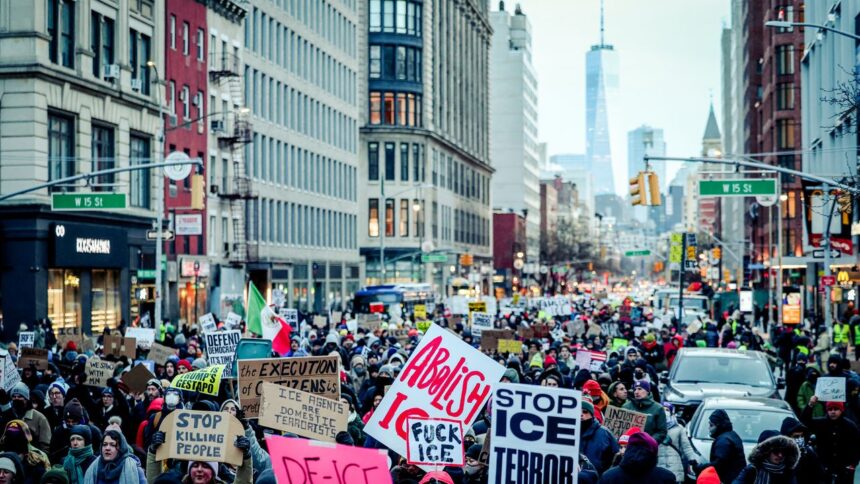
Today, it’s not business as usual across America. While Friday is known as one of the busiest, most profitable shopping days of the week, stores across the country have closed their doors for the day as part of the National Shutdown.
The national strike signals dissent with ICE and corresponds with demonstrations in many cities. Typically, this type of act is industry-specific (see the 2023 SAG-AFTRA strike that lasted 118 days and pushed back Hollywood productions for years, as well as the current New York Nurses Strike that started on January 12 and is still ongoing), but today’s national strike is the first general strike since the Strike for Black Lives in 2020.
The ways that participating businesses heard about the strike are diverse: The team behind bi-coastal vintage store Happy Isles, Lily Kaizer and Kate Corcoran, learned about it through a video Patti Harrison shared; Zulaikha Aziz, founder of fine jewelry brand Mazahri, saw both former United States Secretary of Labor Robert Reich and the Somali Student Association at University of Minnesota’s calls to action; Albert Mendez, founder of the Austin-based concept store Rocha, said it was the talk at Paris market; and many more simply cite people sharing their participation in the strike on social media as their first indication of its potential.
“My feed was blowing up with calls to action,” says Megan O’Neill, owner of burgeoning shoe company Nyla. “As much as Instagram can be a pain, it’s really incredible for igniting a movement.”
Unsurprisingly, the majority of the brands participating in the strike (which spans industries including restaurants, fitness studios, and more, as well as fashion) are small, independently-owned businesses. It comes at a time when the economy is especially brutal, and there has been a dramatic decline in vitality for small businesses. Overall, it’s a huge risk for each of these brands to take.
For New York-based handbag and accessories designer Brandon Blackwood, the decision to close for the day came with business implications. “We postponed our Valentine’s Day drop, which is a huge moment yearly for the brand,” the designer says. The decision included moving internal meetings, adjusting the launch calendar, and liaising with the warehouse to adjust inventory, packing stations, and more. “From a logistics standpoint, it’s manageable, but it does require intention and alignment across the teams. Everyone understood why we were doing it, which made it easier.”
James Veloria cofounder Brandon Veloria Giordano cites his immigrant mother as an inspiration behind the decision to close. “She wanted to open her own small business, a hair salon, but was never able to do it in her short life,” he says, “I know there are countless other stories like my family’s, so it only feels right to show solidarity with our immigrant community.”
Kathleen Sorbara, owner of the Williamsburg shop that bears her last name, felt compelled to participate in the day in the wake of the killings of Alex Pretti and Renee Good. “My business’s DNA has always aligned with my personal beliefs,” she says. “I think that’s the beauty of being a small business owner—I don’t have C-suites to report up to.” While the doors of Sorbara may be closed, she plans to run the payroll for employees as if it were a regular workday.
“It’s been meaningful to see so many small businesses come together in a unified way,” says Mendez, adding that when he heard about it while in Paris, he felt excited. “I’ve been protected, supported, and cared for by immigrant communities my entire life, so we wholeheartedly condemn the assault on not only undocumented immigrants, but also US citizens.”