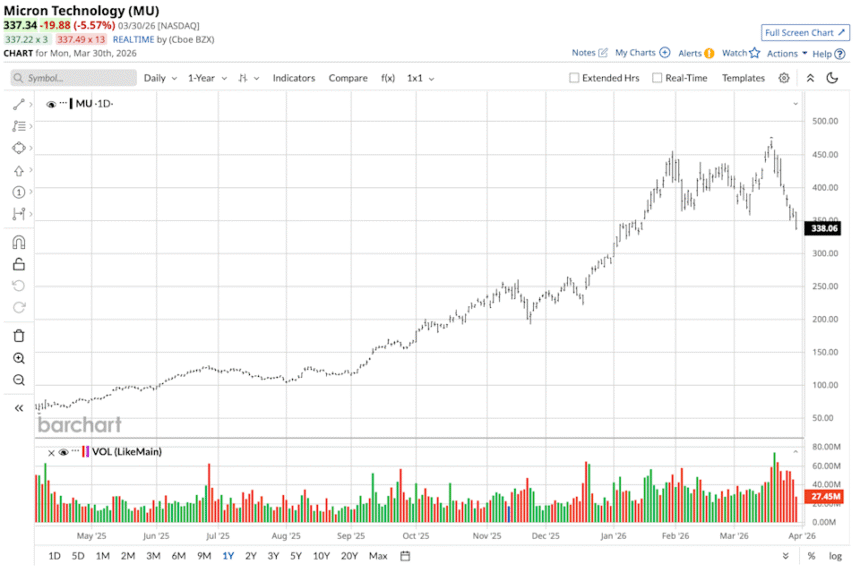
Micron Technology (MU) has found itself caught in a familiar market pattern — a knee-jerk reaction to a change in the way we think about a particular type of technology. In this case, the recent introduction of TurboQuant from Alphabet (GOOGL) — a program that promises to cut memory usage in half — is presenting AI efficiency fears.
While this may initially be seen as a negative for memory and storage-related companies as a whole, if we take a step back and think about it for a moment, I believe this is yet another example of the markets overreacting to change. One report from Bank of America analyst Vivek Arya recently aimed to ease concerns by pointing out that AI capital expenditures are actually driving memory usage, “not efficiency measures.”
This kind of panic is not a new trend, either. Investors witnessed something similar in early 2025 after news of DeepSeek emerged. The initial fear of reduced spending and efficiency gave way to even more spending later.
Based in Boise, Idaho, Micron is one of the world’s leading memory and storage companies. With a market capitalization of roughly $363 billion, Micron is of critical importance in the semiconductor business, especially in DRAM and NAND, which are vital in AI and data-center infrastructure.
The price of MU stock has declined significantly of late. Shares are down 28% from the 52-week high of $471.34, and in the last five days alone, MU is down by 15%. Such a significant fall in price is likely to shift market sentiment, and in comparison to the market’s general movement, it is more of a beta-driven fall than anything else.

From a valuation perspective, however, things are starting to look interesting again. With record profitability and expanding margins, this is no longer the cyclical memory business that investors used to discount so heavily. Gross margins came in above 74% in the most recent quarter, a level that would have seemed unreasonable even a few years ago. While MU stock may not be “cheap” in absolute terms, it’s becoming reasonable in relation to earnings and structural positioning in AI.
Micron also offers a dividend, which was recently raised by 30% to a quarterly rate of $0.15 per share.