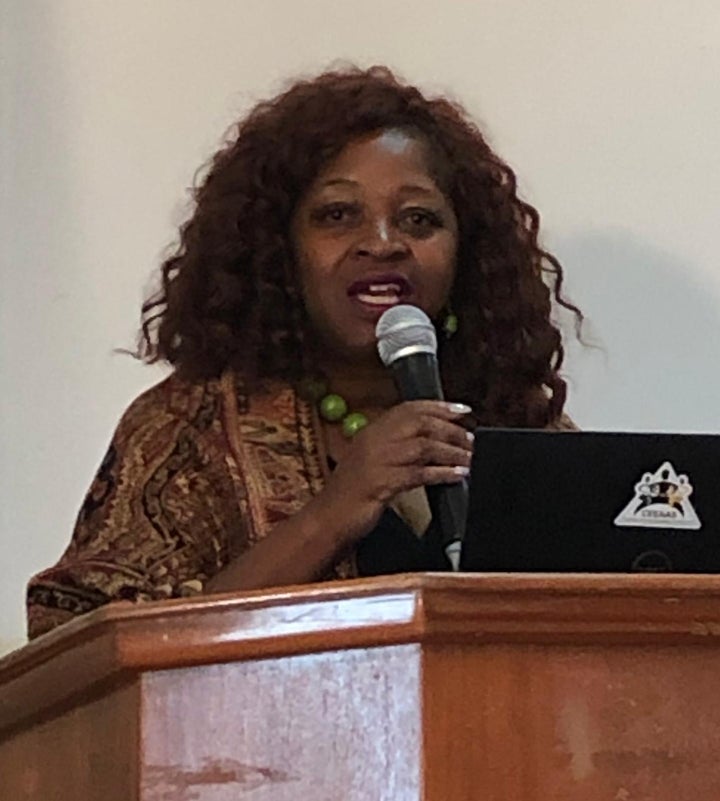
In two weeks, I am scheduled to deliver the most significant lecture of my academic career. It’s one of the highest honors in my field — like winning an Oscar in education. My flight is booked. My hotel is reserved. I even know what I plan to wear.
And yet, I am asking myself a question I never imagined I would have to consider: Should I go?
Not because I am unprepared. Not because I am unwilling. Not even because of the long lines due to of TSA officer shortages. But because I would have to pass through major airports, including Chicago, where the increasingly visible and unpredictable presence of Immigration and Customs Enforcement (ICE) agents has created a climate of fear. And I am scared.
The American Educational Research Association (AERA) annual meeting is the largest gathering of educational researchers in the world. With more than 15,000 attendees and over 2,500 sessions, it is a cornerstone of scholarly exchange. This year’s conference is being held April 8-12 in Los Angeles and is centered on the theme, “Unforgetting Histories and Imagining Futures: Constructing a New Vision for Education Research.”
I have the distinct honor of delivering the AERA Social Justice in Education Award Lecture. I am the 22nd recipient of this prestigious recognition in the organization’s 110-year history, joining a strong lineage of scholars whose work has shaped the field in enduring ways. I am also scheduled to participate in a presidential session. These are not small moments. They are the kinds of milestones that mark a career.
I find myself in a profound internal struggle, not only of the mind, but of the spirit. I have spent my career encouraging educators to speak truth, even when our hands tremble and our voices shake — and I have lived that commitment in the face of harsh political attacks. Indeed, that is why I am receiving the award.
And yet, I cannot escape the irony that I am planning to speak on “Beyond Learned Powerlessness to Educational Liberation,” while wrestling with the very conditions that make that liberation feel uncertain.
But what does it mean to speak of liberation while navigating conditions that feel increasingly constraining? I understand that fear is not incidental. It is strategic and carefully cultivated by the current administration. It is meant to unsettle and silence us. So I wrestle with it, pushing against its grip.
Dr. Adelaide L. Sanford, a scholar-activist, advises educators to find ways to “be courageous without being suicidal.” Her wisdom has never felt more relevant. Thirteen people have died in ICE custody this year alone. In the face of overly aggressive ICE agents, choosing to place oneself in potentially vulnerable situations does not feel like courage. It feels like an unnecessary risk.
Reports of ICE-related encounters in airports, along with broader enforcement actions, have heightened anxiety among so many travelers. I am not alone in my hesitation.
Many international scholars have already decided not to attend this year’s AERA conference due to visa restrictions and concerns about the current political climate. One AERA interest group sent a message to colleagues in Africa and the Caribbean expressing solidarity with their concern, fatigue, uncertainty and fear.
What does it mean for a global research community when scholars are too afraid to travel?
Photo Courtesy Of Gloria Swindler Boutte
What does it mean for knowledge production when certain voices are absent, not by choice, but by circumstance? And what does it mean for those of us who can travel, but must weigh that decision against our sense of safety?
Just two weeks before this defining moment in my career, I find myself sitting with these questions. This is not how academic life is supposed to feel. Preparing for a major lecture should be about refining ideas, not calculating risk. It should be about intellectual excitement, not personal safety. It should be about community, not caution.
The question before me is simple, but heavy. Do I board the plane? Or do I put my lecture, my voice and my reputation on ice?
I have not yet decided what I will do. But I know that when scholars begin to question whether it is safe to show up to airports, conferences and the very spaces where knowledge is shared, we are no longer just dealing with inconvenience. We are confronting a profound threat to intellectual freedom and democratic exchange.
Gloria Swindler Boutte, Ph.D., is a Distinguished Professor at the University of South Carolina and a Public Voices Fellow of the OpEd Project in partnership with the National Black Child Development Institute.
Do you have a compelling personal story you’d like to see published on JS? Find out what we’re looking for here and send us a pitch at [email protected].