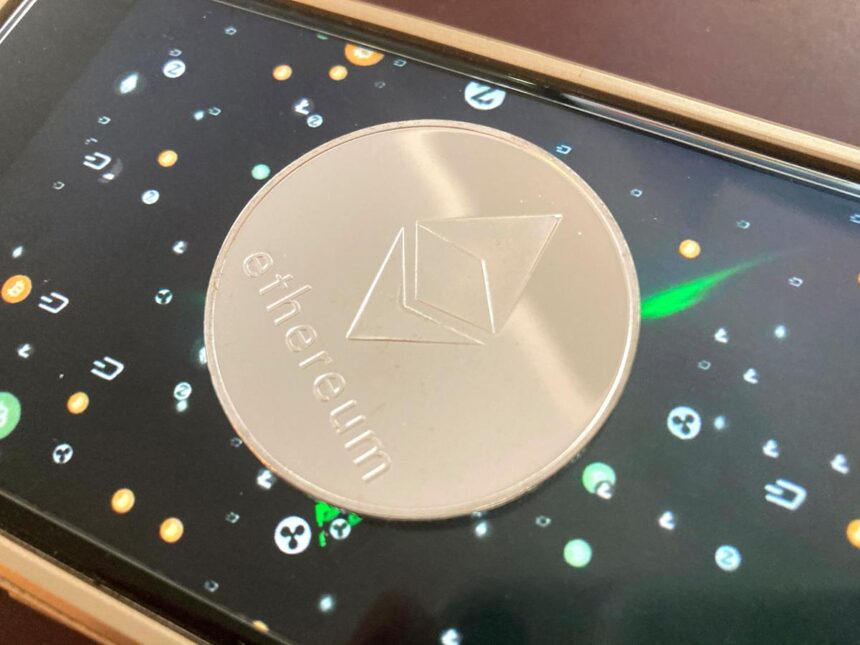
Ether, the native cryptocurrency used on the ethereum platform, remains significantly more volatile than the S&P 500 for many investors. But it’s no longer a moonshot — it’s a foundational piece of a modern digital portfolio.
Here’s how to start investing in ethereum.
Before placing a trade, it’s important to understand what you’re actually buying.
Ethereum is the blockchain, while ether (ETH-USD) is the cryptocurrency that runs on it. When people say they’re “buying ethereum,” they’re usually buying ETH — the digital asset used to run applications and store value.
Some investors trade short-term, others accumulate their holdings slowly, and still others focus on earning a yield by locking up their ETH to help run the network — a process known as staking.
In 2026, you generally have three ways to invest in ether:
-
Direct ownership: You buy the actual tokens and hold them on a centralized exchange or in a wallet. This lets you use the Ethereum network, interact with dApps (decentralized applications), or “stake” your coins to earn a yield.
-
Institutional exposure (ETFs): Offered by firms such as BlackRock and Fidelity, ether ETFs provide price exposure through a standard brokerage account without dealing with wallets or private keys. You buy shares in a fund that holds ETH for you. This hands-off approach comes with a management fee and doesn’t allow interaction with decentralized apps.
-
Derivative exposure: Using fintech apps such as Robinhood or PayPal lets you easily track prices. This approach offers simple onboarding and easy-to-use interfaces, making it ideal for casual investors, though spreads — and associated fees — are usually slightly higher, and you may face some limitations on how you move the assets.
Where you buy ether matters. Your platform affects fees, security, and how easily you can move your crypto once you buy it.
Many investors start here. These platforms offer the most liquidity and the widest range of ethereum-specific features, including liquid staking, which is a way to earn staking rewards while still receiving a tradable token that keeps your funds usable.
-
Coinbase: Simple and familiar, like a banking app. It offers a clean interface, strong security, recurring buys, and easy portfolio tracking.
-
Kraken: Known for strong security and transparency. Offers some of the lowest trading fees through Kraken Pro, which is free to use. Features, including simple staking and clear fee breakdowns, make it beginner-friendly. Not available in New York or Maine.
-
Binance: Offers a simple “Lite” mode with an easy, one-tap interface. Beginners can earn $3-$5 a day in crypto rewards through its Learn & Earn feature. Features like Copy Trading and its zero-fee Convert tool help make crypto more accessible,
In 2026, fees on these platforms vary based on how you trade. Using a “simple buy” button (the default option) might cost you a 1.5% to 2.0% convenience fee. However, if you use the advanced trading version (like Coinbase Advanced), you can often get fees down to 0.4% to 0.6%.
Fintech and payment apps
If you already have money sitting in a PayPal, Venmo, or Robinhood account, you can buy ETH almost instantly.
These apps offer peak convenience, but that comes with trade-offs.
-
Robinhood: Robinhood has become a massive player in the ETH space by offering “commission-free” trades. However, they make their money through the spread between the price you’re shown and the price at which the trade is actually executed. As of July 2025, Robinhood typically earns about $0.80 to $0.90 for every $100 in ETH trades routed to their market makers — roughly an 0.85% hidden cost.
-
PayPal and Venmo: These apps are great for small, casual buys. However, for orders under $75, you’ll pay a flat fee of around 2.2%. For larger orders, the percentage drops, but it rarely becomes as cheap as a dedicated exchange. You also can’t currently transfer your ETH to an external wallet.
Spot ethereum ETFs were approved in 2024, making ETH accessible to retail investors in a more regulated financial product.
If you buy an ETF such as BlackRock’s iShares Ethereum Trust (ETHA) or Fidelity’s Ethereum Fund (FETH), you don’t have to manage wallets or keys. You’re buying a regulated security. Ethereum ETFs also make it possible to utilize tax advantages through retirement accounts.
Ethereum staking rewards became available through ETFs in mid-2025 after clearing a major regulatory hurdle. Grayscale Investments converted its flagship funds into staking ETFs and began distributing rewards in January 2026 — the first major U.S. issuer to actually send staking income (about $0.08 per share initially) to shareholders.
Meanwhile, firms including BlackRock have filed plans with the SEC to roll out their own dedicated staking versions, including BlackRock’s ETHB.
However, you still won’t be able to realize the full yield of staking ethereum through an ETF. Blackrock’s upcoming fund, for example, will share 82% of staking rewards with investors, but the remaining 18% will be split between BlackRock and its execution agent, Coinbase.
The Know Your Customer (KYC) identity verification process is now fast and mostly automated. KYC is required by U.S. law for any financial platform handling traditional currency, and it exists to prevent identity theft, fraud, and money laundering.
You’ll start by entering basic personal information, such as your full legal name, residential address, and Social Security number. This creates your verified financial identity and ties the account to a real, unique person.
Next, you’ll confirm your identity using a government-issued ID, such as a driver’s license or passport. The platform will ask you to take a clear photo of the document with your phone or webcam.
Most exchanges also now run a quick “liveness check,” where you move your head or follow simple on-screen prompts. This proves you’re physically present and not using a staged photo or deepfake.
Once the system matches your face to your ID and checks public records, approval is quick.
Once verified, you need to move U.S. dollars into whatever system you’re using to buy ETH.
Here are the most common ways to do that:
-
ACH bank transfer: Free. The best for most investors. It might take three days for the funds to clear for withdrawal, but most exchanges let you trade the moment you initiate the transfer.
-
Wire transfer: The standard for transfers over $25,000. It typically clears within two to four hours.
-
Debit card / Apple Pay: Instant, but expensive. You’ll likely pay a 3% to 5% surcharge.
When you’re ready to place the trade, the exchange or platform will ask how you want the order handled. That choice matters more than most beginners realize.
-
Market order: This is the “buy now” button. You purchase instantly at the current price. It’s easy, but during heavy volatility, the price might shift slightly between the time you click and the time the trade executes (known as slippage).
-
Limit order: You choose the price. If ETH is $2,100 but you only want it at $1,950, you can set a limit order. If it never hits that level, there’s no trade. This is how disciplined investors operate.
The best strategy for most investors isn’t trying to nail the perfect entry — it’s implementing a tried-and-true practice called dollar-cost averaging.
With dollar-cost averaging, you invest a fixed amount on a set schedule — for example, $50 every Tuesday. When prices are high, your money buys less ETH. When prices are low, it buys more. Over time, this smooths out your average cost.
In traditional finance, you rely on a bank to hold your money. In crypto, ownership comes down to one thing: Who controls the private keys — aka the master password to your digital assets.
If your ETH sits on an exchange, you don’t technically control it. You hold a claim to it, but real ownership means controlling the private keys yourself.
Before moving funds, though, decide how much responsibility fits your skill level and how much money you’re protecting.
Here are the three primary custody options.
Your ETH remains on a platform such as Coinbase or Binance. Modern exchanges use strong security and operate under tighter regulations than in the past. Still, they remain a single point of failure. Your assets depend on the exchange staying solvent and secure.
-
Pros: Password recovery is painless; selling or staking is seamless.
-
Cons: If the exchange is hacked or goes bankrupt, your assets may be at risk.
As you gain confidence, you might move funds to a software wallet such as MetaMask, Rainbow, or Coinbase Wallet. These give you direct control over your private keys and full access to the ethereum ecosystem, but they also make you fully responsible for security. Lose your recovery phrase, and there’s no customer support to reverse it.
-
Pros: Enables interaction with DeFi platforms, NFTs, and token swaps.
-
Cons: If your device is compromised or you authorize a malicious transaction, funds can be drained quickly.
For serious long-term storage, hardware wallets are the safest option. Devices like Ledger or Trezor keep your private keys completely offline. To approve a transaction, you must physically confirm it on the device. This helps block remote hackers, malware, and most digital attacks.
The IRS tracks crypto, and correctly reporting your taxes is more important than ever.
The biggest shift for investors this year is the full implementation of Form 1099-DA, a tax form that brokers and exchanges are now required to issue every time you sell ethereum or trade it for another token. The IRS receives a copy of that transaction record.
The form is designed to give both you and the IRS a clearer view of your gross proceeds, cost basis, and total tax liability from any digital asset transactions. After you receive Form 1099-DA, you’ll use the information to file your tax return — typically entering the details on Form 8949 and Schedule D to calculate your capital gains or losses.
If you buy ETH at $2,000 and later sell it at $3,000, you’ll owe capital gains tax on that $1,000 profit. How much tax you owe depends on how long you held the crypto.
-
Short-term: Held for less than a year; taxed at your ordinary income rate (your tax bracket).
-
Long-term: Held for more than a year; taxed at lower rates, typically 15% or 20%.
The IRS treats staking rewards as ordinary income the moment you receive them, not capital gains. The taxable amount is based on the fair market value of the reward ETH at that time.
To be clear, your originally staked ETH isn’t taxed just for staking (that only happens when you later sell or convert it to another crypto).
Since rewards are often distributed frequently, tracking them manually can get messy fast. Most investors now rely on crypto tax software like CoinTracker or TurboTax Crypto to automate the math.
Buying ethereum in 2026 means understanding the fees you’ll pay; quiet costs that chip away at your investment.
The most obvious costs are trading fees, and what you pay depends in large part on how you place your order.
If you use a “simple buy” or “instant buy” button, you’re paying for convenience. Fees on these one-click purchases can run around 1% to 1.5% or more on crypto exchanges. Switch to a Pro or Advanced trading interface, and fees usually drop to about 0.4% to 0.6% under maker-taker pricing, where you pay less for placing orders that add liquidity to the market rather than taking existing liquidity.
The layout may look more complex, but learning it can save you money over time, especially if you trade larger amounts.
Another cost many beginners overlook is the spread. This is the gap between the market price and the price the platform quotes you.
Some apps, like Robinhood, advertise zero commissions but quietly build their profit into the spread. You might see ethereum trading at one price on the market, but pay slightly more when you buy — or receive slightly less when you sell.
Every transaction on Ethereum requires “gas” — a fee paid in ETH to network validators.
In 2026, gas fees are much lower and more stable than they used to be, thanks to recent network upgrades. Transferring ETH to a private wallet now typically costs between $0.01 and $0.50, though costs can still rise when the network is extremely congested.
Finally, some centralized exchanges still charge a fixed withdrawal fee, which can be significantly higher than the actual gas fee. Bank transfers are usually free but often come with a waiting period before you can withdraw your crypto. Faster options like debit cards or instant payment services typically charge higher fees.
What is the difference between ethereum and Ether?
Ethereum is the blockchain network. Ether (ETH) is the native cryptocurrency used to pay transaction fees on that network. When purchasing on an exchange, you are buying ETH.
Ethereum runs on proof of stake, which means the network is secured by validators who lock up ETH instead of miners using computing power.
To “validate” transactions means ensuring transactions follow Ethereum’s rules — confirming the sender owns the ETH and that the same funds aren’t used twice. Validators also group transactions into blocks and vote to approve new blocks. When enough validators agree, the block is added to the blockchain.
Staking helps secure the network because validators have money in the game. If they break the rules, they can lose part of their staked ETH, which discourages fraud.
Most investors don’t run validators themselves. If you stake through an exchange like Coinbase, the platform handles the technical work and passes a portion of the rewards on to you, making it feel like passive income.
In February 2026, standard staking yields averaged just under 2% annually, though that rate can change depending on network conditions.
Proof of stake is a system where a blockchain is secured by participants who commit, or “stake,” their cryptocurrency as collateral instead of using mining, the way Bitcoin does.
Staking means locking ETH into the network so validators — specialized computers — can use it as financial backing while they check transactions, create new blocks, and keep the system running.
Bitcoin, by contrast, uses a proof-of-work system, where miners compete using powerful computers and massive amounts of energy to solve complex puzzles. The winner adds the next block and earns rewards.
Ethereum moved from proof of work to proof of stake in 2022 to reduce energy use and make the network more efficient. Instead of proving honesty through computing power, validators prove honesty by putting their own ETH at risk. If they follow the rules, they earn rewards. But if they cheat, they can lose some of their staked ETH.
Ethereum is volatile, and prices can swing fast. Regulatory changes, scams, and market crashes can result in loss. Staking and DeFi add technical risks. If you lose your private keys or send funds to the wrong place, recovery is difficult, if not impossible. Crypto offers upside, but there are no guarantees.
Bitcoin is simpler and often referred to as digital gold: It’s focused on scarcity and long-term value storage. Ethereum is a programmable platform powering apps, DeFi, and staking. “Better” depends on your goals, though many investors hold both types of crypto.