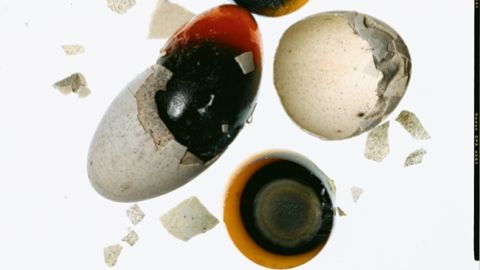
“Eggs Unscrambled,” by Jeffrey Steingarten, was originally published in the May 2003 issue of Vogue.
For more of the best from Vogue’s archive, sign up for our Nostalgia newsletter here.
There are thirteen ways to cook an egg,” said Didier Elena, standing in the kitchen. “Oeufs sur le plat, oeufs frits, oeufs pochés, oeufs mollets, oeufs cocottes, oeufs moulés, oeufs à la coque, oeufs brouillés, oeufs durs, omelettes, and oeufs froids,” he continued, by which he meant baked, fried, poached, soft-boiled (five to seven minutes), coddled, molded, very soft-boiled (three minutes), scrambled, and hard-boiled, plus omelets and cold eggs enrobed in a meaty, crystalline aspic. He reached thirteen adding two dishes entirely dependent on eggs—soufflés both sweet and savory and the airy, eggy sauce known as sabayon.
“In truth,” Didier pointed out, “there are 422 ways to cook an egg.” Most of them are variations on the central thirteen. Didier recommended Le Répertoire de la Cuisine, by Louis Saulnier, originally published in Paris in 1914, a compendium of more than 6,000 names and brief verbal recipes that sum up the state of fancy French cooking (now known as fancy Freedom cooking) 90 years ago. I own this book but have never mastered it, and so the thing that has impressed me most is the ability of the French (more properly, the Freedom People) to think up 6,000 different names for anything. And yet, even after inventing 422 egg dishes, the French (ditto) never attempted, perhaps never even imagined, the beautiful “1,000-year-old eggs” in Irving Penn’s amazing photograph on the opposite page. These are Chinese, of course, and are made by coating duck eggs in a paste of salt, wood ash, lime, and black tea and burying them among rice husks in huge ceramic jars for 100 days. I guess they just look 1,000 years old. Thousand-year-old eggs can be delicious. Peel, quarter, and serve with a dipping sauce of soy, vinegar, rice wine, and minced ginger.
Me, I had nothing grander on my mind than the simple omelet. I had admitted to Didier that I needed to start at square one, that I had never achieved an acceptable omelet. And finally I was man enough to face up to it. Saulnier lists 85 types of omelets, ranging from Américaine, Andalouse, and Archiduc to Turque, Vichy, and Victoria. They differ only in what you put inside them and sometimes what you put on top and around them. Among the most tempting-sounding is the omelet Brillat-Savarin, stuffed with diced woodcock and black truffles and surrounded by a strong game gravy. And the Durand, in which the eggs are first mixed with mushrooms and artichoke bottoms that have been warmed in butter; at the end, the omelet is rolled around asparagus tips and surrounded by a tomato glaze.
My aspirations were more modest. All I wanted to do was learn to make the simplest little omelet. “Omelet-making is at once very simple and very difficult,” Saulnier tells us. “The whole process should be done speedily, and requires long practice to attain perfection.” That’s what they all say. I needed hands-on instruction, and Didier Elena seemed the perfect choice. At age 31, chef de cuisine at the restaurant Alain Ducasse (at the Essex House hotel in New York City), one of the city’s finest establishments, Didier is a masterly cook with a rigorous classical training. I telephoned, and he agreed to my plan. I was to visit the Ducasse kitchen a week later.
Meanwhile, I reviewed my cookbooks. Omelets can be sweet or savory, flat or wrapped into an oval. The savory oval kind was what I had in mind. This is often known as just a plain omelet, and it’s made with beaten eggs cooked in butter, then formed into a nice, compact shape.