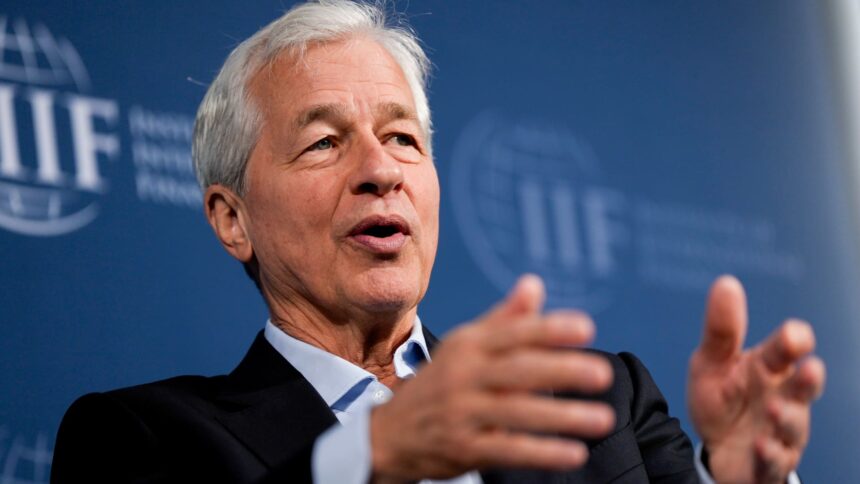
Jamie Dimon, chief government officer of JPMorgan Chase & Co., on the Institute of Worldwide Finance (IIF) through the annual conferences of the IMF and World Financial institution in Washington, DC, US, on Thursday, Oct. 24, 2024.
Kent Nishimura | Bloomberg | Getty Photographs
JPMorgan Chase stated fintech middlemen — the businesses which have helped a brand new era of economic apps join with conventional checking accounts — are flooding the financial institution’s programs with pointless information requests.
“Aggregators are accessing buyer information a number of occasions day by day, even when the shopper is just not actively utilizing the app,” a JPMorgan programs worker wrote final week in an inner memo to retail funds head Melissa Feldsher. “These entry requests are massively taxing our programs.”
Of 1.89 billion information requests from middlemen hitting JPMorgan’s programs in June, solely 13% have been initiated by a buyer for transactions, based on the memo, which was seen by CNBC.
The vast majority of information pulls, often called API calls, have been for functions starting from serving to fintech firms enhance their merchandise or forestall fraud to different efforts together with harvesting information on the market, stated an individual with data of the memo who declined to be recognized amid talks between JPMorgan and the fintechs.
JPMorgan, the largest U.S. financial institution by property, is preparing to cost the middlemen new charges for entry to programs that it says are more and more expensive to take care of. Negotiations between JPMorgan and the fintech middlemen are ongoing, however the brand new charges may begin as quickly as October, stated folks with data of the matter.
The financial institution’s transfer may result in upheaval within the fintech ecosystem, which flourished as aggregators together with Plaid and MX related conventional banks with newer arrivals. The API entry had been free for years, permitting middlemen to revenue from promoting connectivity to fintechs that in flip supplied accounts with no-fee checking or buying and selling companies.
The state of affairs modified in Could after the Client Monetary Safety Bureau filed a movement in support of a banking business lawsuit in search of to finish the so-called “open banking” rule.
That rule, finalized by the Biden-era CFPB within the waning months of that administration, mandated that banks had to offer information to licensed events at no cost. Per week after the rule’s passage, JPMorgan CEO Jamie Dimon known as on bankers to “fight back” in opposition to what he stated have been unfair laws.
Surging volumes
Information this month that JPMorgan was planning to cost for buyer information, first reported by Bloomberg, led to accusations from enterprise capital traders and fintech and crypto executives that JPMorgan was participating in “anti-competitive, rent-seeking conduct” by placing up paywalls to buyer information.
However JPMorgan says it bears the rising prices from sustaining the infrastructure wanted for the surge in volumes, in addition to elevated fraud claims linked to funds made within the fintech ecosystem.
The full quantity of API calls obtained by JPMorgan has greater than doubled previously two years, based on the memo.
Transactions involving cash despatched over digital ACH transactions have been 69% extra prone to end in fraud claims in the event that they concerned information middlemen, based on the memo.
JPMorgan noticed about $50 million in fraud claims from ACH transactions initiated via aggregators, a determine the financial institution expects to triple inside 5 years, the memo stated.
Among the many 13 fintech firms tracked within the financial institution’s memo, greater than half of all June exercise, with 1.08 billion API requests, got here from a single firm. Although the companies aren’t named, CNBC has realized that the biggest participant represented within the information is Plaid.
JPMorgan’s information exhibits that simply 6% of Plaid’s API calls have been initiated by prospects.
Plaid co-founders William Hockey and Zach Perret
Supply: Plaid
Granting entry
Plaid stated in a press release to CNBC that this determine “misrepresents how information entry works” as a result of all exercise begins when prospects grant permission to fintech firms once they join accounts. In fact, many shoppers do not intently learn the prolonged “Phrases and Situations” pages that comprise data-sharing disclosures earlier than opening new accounts.
“Calling a financial institution’s API when a consumer is just not current as soon as they’ve licensed a connection is a typical business observe supported by all main banks to ensure that shoppers to get vital alerts for overdraft charges or suspicious exercise,” Plaid advised CNBC.
Plaid additionally stated that JPMorgan’s claims of upper fraud amongst aggregators have been “deceptive,” although it did not elaborate.
“It’s not stunning that the amount of information entry is rising alongside demand from shoppers for monetary instruments which are smarter, sooner, and extra tailor-made to their wants,” Plaid stated.
“To be clear, we imagine it’s important that the information sharing ecosystem works for everybody, together with shoppers, fintech builders, and monetary establishments – lots of whom leverage open banking in their very own merchandise,” the corporate stated.
The proposed price schedules circulated by JPMorgan may end in Plaid paying $300 million in new annual charges, based on a Forbes report.
The remainder of the businesses tracked within the JPMorgan doc are far smaller entities; solely 4 different middlemen registered greater than 100 million month-to-month API calls.
Bid-ask unfold
If the Biden-era “open banking” rule is struck down by the courts, the primary query is just not whether or not the middlemen should pay for information however how a lot they should pay.
The back-and-forth between JPMorgan and the middlemen is a non-public course of, spilling into public view, to reach at a brand new actuality that’s acceptable to all.
JPMorgan has had productive conversations with a number of information aggregators who acknowledge that they’ll change the best way they pull information whether it is now not free, based on an individual with data of the negotiations.
“I feel either side absolutely acknowledge there are issues they might do to right-size name quantity,” this particular person stated.