Jerome Powell, chairman of the US Federal Reserve, through the Worldwide Financial Fund (IMF) and World Financial institution Fall conferences on the IMF headquarters in Washington, DC, US, on Thursday, Oct. 16, 2025.
Kent Nishimura | Bloomberg | Getty Pictures
The straightforward half for the Federal Reserve on Wednesday shall be saying an rate of interest lower when it wraps up its two-day coverage assembly. The laborious half shall be caring for different particulars which might be presenting substantial challenges to policymaking lately.
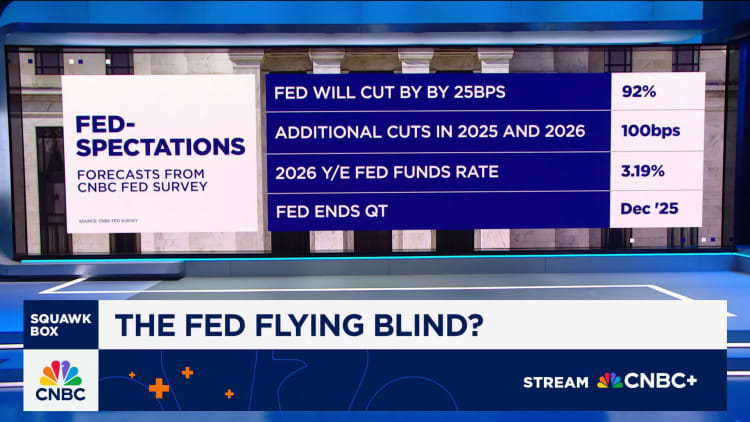
Markets are assigning a virtually 100% likelihood that the Federal Open Market Committee will approve a second consecutive quarter proportion level, or 25 foundation level, discount within the federal funds charge. The in a single day lending benchmark is presently focused between 4%-4.25%.
Past that, policymakers are more likely to debate, amongst different issues, the longer term path of reductions, the challenges posed by a scarcity of financial information and the timetable for ending the discount in its asset portfolio of Treasurys and mortgage-backed securities.
Underlining all of these deliberations shall be a rising divergence of opinion over what the longer term holds for financial coverage.
“They’re at a second within the coverage cycle the place there’s real disagreement between people who find themselves considering we’ll in all probability lower charges however I am not prepared to chop once more simply but, and individuals who assume regardless that there’s dangers, it is time to do extra now,” mentioned Invoice English, a Yale professor and the Fed’s former director of financial affairs. “There’s dissent between individuals who need to lower now, and individuals who need to wait and see a bit extra.”

Judging by latest statements and prevailing Wall Road sentiment, newly appointed Governor Stephen Miran is more likely to dissent in favor of a much bigger lower, as he did on the September FOMC assembly.
On the similar time, regional Presidents Beth Hammack of Cleveland, Lorie Logan of Dallas and Jeffrey Schmid of St. Louis have expressed reluctance to go a lot additional on cuts, although it’s miles from clear whether or not they may vote in opposition to a lower this week. Solely Miran, who wished a half-point discount, truly dissented in what was an 11-1 committee vote final month to chop by 1 / 4 level.
Left to attempt to straddle the distinction shall be Chair Jerome Powell, who in a latest speech gave an implied nod to an October lower when he expressed fear over the state of the labor market.
Buyers will look to the central financial institution chief, who will go away the place in Could 2026, for steering on the prevailing sentiment.
“I’d count on him to attempt to stroll a center floor, not tip his hand essentially, on December,” English mentioned, referring to the subsequent coverage assembly after this one. “I do not assume he desires to be locked right into a charge lower in December. However then again, it does appear to be he is apprehensive concerning the labor market and concerning the outlook for actual exercise, so he does not need to come throughout as hawkish.”
Markets presently are also pricing in a near-certainty of a December discount, in line with the CME Group’s FedWatch instrument, so it might take lots do dissuade Wall Road from anticipating extra Fed easing.
Worries about jobs
One huge motive officers are within the temper to decrease is concern over the labor market. Even with an absence of information, there are clear indicators that inflation is slowing even when layoffs, judging by state-level jobless claims submissions which might be nonetheless ongoing regardless of the federal shutdown, don’t look like accelerating.
The truth is, worries over jobs might preserve the Fed slicing effectively into 2026, mentioned Luke Tilley, chief economist at Wilmington Belief.
“We count on 25 [basis points Wednesday] after which once more in December, after which once more in January and March and April,” Tilley mentioned. “Then that may carry them right down to what we consider because the impartial vary to 2.75% to three%.”

Fed officers in September indicated, by the “dot plot” of particular person members’ expectations, that they will not get to a charge that neither pushes nor restrains development — the so-called “impartial” charge — till 2027, and even then it will likely be 1 / 4 level above the place Tilley sees.
Nonetheless, he thinks the Fed will not have any selection however to react to labor market weak spot, significantly because it poses a problem to surprisingly robust financial development seen within the second half of this 12 months.
Worries over jobs have taken extra of the Fed’s focus at the same time as inflation stays effectively above the central financial institution’s 2% goal. The Bureau of Labor Statistics reported final week, in the one official information launch through the shutdown, that the annual inflation charge as measured by the patron value index was caught at 3% in September.
Lack of information problem
Exterior of the CPI report, central bankers face the extra problem of the info blackout that has accompanied the federal government shutdown.
“It is laborious to make coverage to realize two objectives … if you’re not getting information about about a minimum of one in all them,” Tilley mentioned, referring to the Fed’s twin mandate to maximise employment and preserve costs secure, and the absence of the September nonfarm payrolls report as a result of shutdown.
“I count on that to be communicated as extra uncertainty concerning the path ahead, that they should be able to pivot and maintain charges, if want be, or to cut back them quicker once they lastly do get information,” Tilley mentioned.
Lastly, markets shall be in search of extra definitive solutions on when the Fed will cease lowering its $6.6 trillion steadiness sheet, most of which is in Treasurys and mortgage-backed securities. Nicknamed quantitative tightening, or QT, the method has entailed permitting proceeds from maturing securities to roll off somewhat than being reinvested as regular.
In a latest speech, Powell indicated the time is getting nearer to the place the Fed will need to cease QT. Whereas monetary situations are largely nonetheless stable, there have been some small indicators these days that short-term markets are tightening up. With the Fed’s in a single day funding facility practically drained, officers are more likely to sign this week that QT is in its remaining levels.
Market commentary was cut up over whether or not the Fed will announce the precise finish of this system, or sign a future date when it would stop.
“There are indicators that they are getting near backside, so to talk, by way of getting by ample reserves and truly getting some tightness and liquidity. In order that’s why I’d count on an announcement, if not motion,” Tilley mentioned.