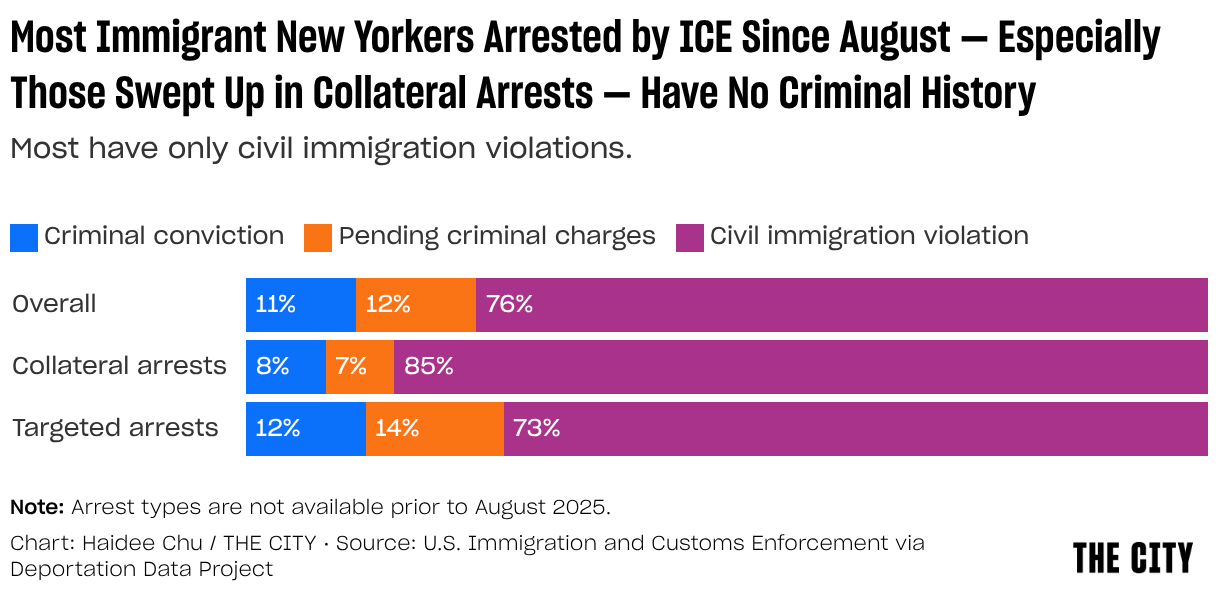
Immigration and Customs Enforcement agents have arrested 811 immigrants in New York City since August who happened to be in the wrong place at the wrong time. Of these “collateral” arrests — as the agency calls them — 85% involved people with no criminal history, according to newly obtained ICE data.
THE CITY had reported on several examples of those arrests, including that of a 28-year-old construction worker on the streets of Corona, Queens while he was headed to work one morning. Agents claimed they had been looking for his neighbor, but they took him instead.
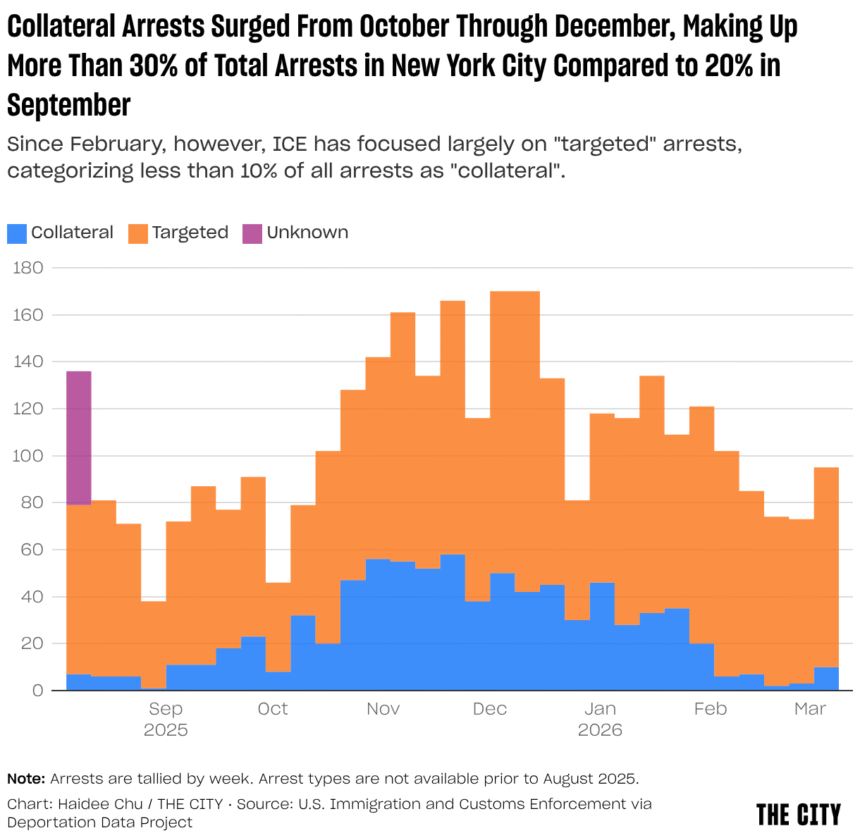
Overall, these “collateral” arrests accounted for 24% of all ICE arrests in New York City from August 2025 through March 10.
The Department of Homeland Security, which oversees ICE, has repeatedly said in the past that it’s focused on arresting “the worst of the worst” while regularly posting photos of immigrants convicted of crimes that ICE has arrested.
Yet even of the 2,491 people ICE targeted for arrest in New York City since August, 73% had no criminal convictions or pending charges.
The ICE arrest data analyzed by THE CITY was obtained by the Deportation Data Project through a Freedom of Information Act lawsuit and covers immigration arrests through March 10. It includes, for the first time, ICE’s own determination of whether a person was detained as part of a “targeted” operation or as a “collateral” arrest.
While the ICE data does not materially describe where or how a person was arrested, THE CITY found many of these “targeted” arrests took place at ICE check-ins and immigration court, where agents have been carrying a list of names and staking out hearings to detain immigrants since last year.
Asked about the latest ICE arrest data, an unnamed spokesperson disputed the agency’s own records.
“This story only reveals how the media manipulates data to peddle a false narrative that DHS is not targeting the worst of the worst,” the spokesperson said, pointing to several examples on DHS’s website of people arrested who were wanted for crimes in other countries.
“Nationwide, our law enforcement is targeting the worst of the worst criminal illegal aliens — including murderers, rapists, gang members, pedophiles, and terrorists,” adding that “70% of illegal aliens ICE arrested across the country have criminal convictions or pending criminal charges.”
ICE’s own data released by the Deportation Data Project, however, shows those people accounted for 59% of arrests nationwide since August, according to THE CITY’s analysis.
In New York City, that percentage was even lower: Just 24% of the 3,191 people ICE arrested had criminal convictions or pending charges, while 76% had no criminal history.
“This statistic doesn’t account for those wanted for violent crimes in their home country or another country, INTERPOL notices, human rights abusers, gang members, terrorists, etc. The list goes on,” the spokesperson said.
Advocates slammed the latest figures, saying it was another indication of a law enforcement agency needing to be reigned in.
“The Trump administration is not interested in actually delivering on what they say, which is making our communities more safer and secure,” said Murad Awawdeh, the president and CEO of the New York Immigration Coalition. “They are aimlessly, racially profiling people, but they’re looking for anyone that they can detain so they can meet their idiotic quotas.”
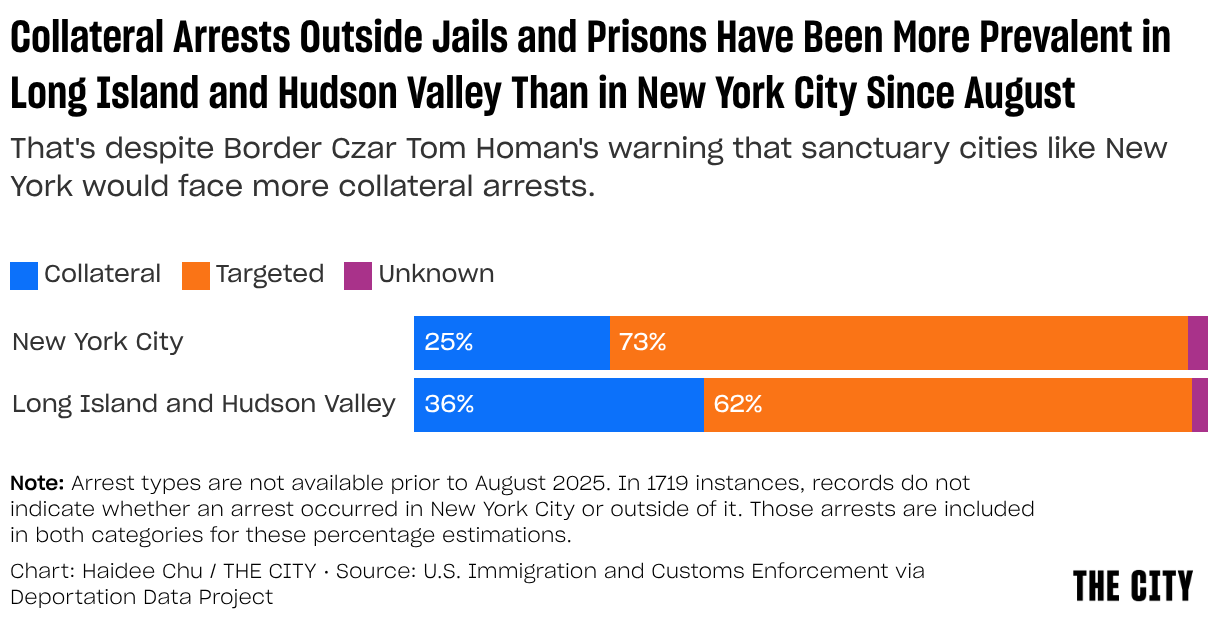
Border Czar Tom Homan has long reasoned that sanctuary cities like New York would face more of these “collateral arrests” because ICE isn’t allowed to go into local jails or coordinate with local police for the purposes of immigration enforcement.
“When you release a public safety threat out of a sanctuary jail and they won’t give us access to him, that means we got to go to the neighborhood and find him, and we will find him, but when we find him, he may be with others,” Homan said shortly after Donald Trump took office in 2025. “Others that don’t have a criminal conviction and are in the country illegally, they will be arrested too.”
But ICE’s own data shows a more complicated picture.
The agency’s data suggests a higher rate of “collateral” arrests outside of jails and prisons in the Hudson Valley and on Long Island, where sanctuary laws are generally less protective towards immigrants or do not exist at all, and where local police often assist ICE.
The collateral arrest rates for the region’s specific jurisdictions, however, can only be approximated because ICE did not reveal in its data the specific counties where it processed 1,719 arrests downstate since August.
Overall, ICE classified roughly 36% of immigration arrests outside jails and prisons in Long Island and along the Hudson Valley up to Ulster County since August as “collateral”, compared to roughly 25% of such arrests in New York City.
Immigrant advocates have been pushing state lawmakers to pass a bill called New York for All, which would extend sanctuary protections like those in New York City to the rest of the state, limit cooperation between local law enforcement and ICE agents.
“You would think that the bare minimum that our state could do is pass the New York for All act that would prohibit the collusion of local law enforcement, which is also racially profiling people for the purpose of handing them over to ICE around the state,” Yasmine Farhang, the Director of the Immigrant Defense Project.
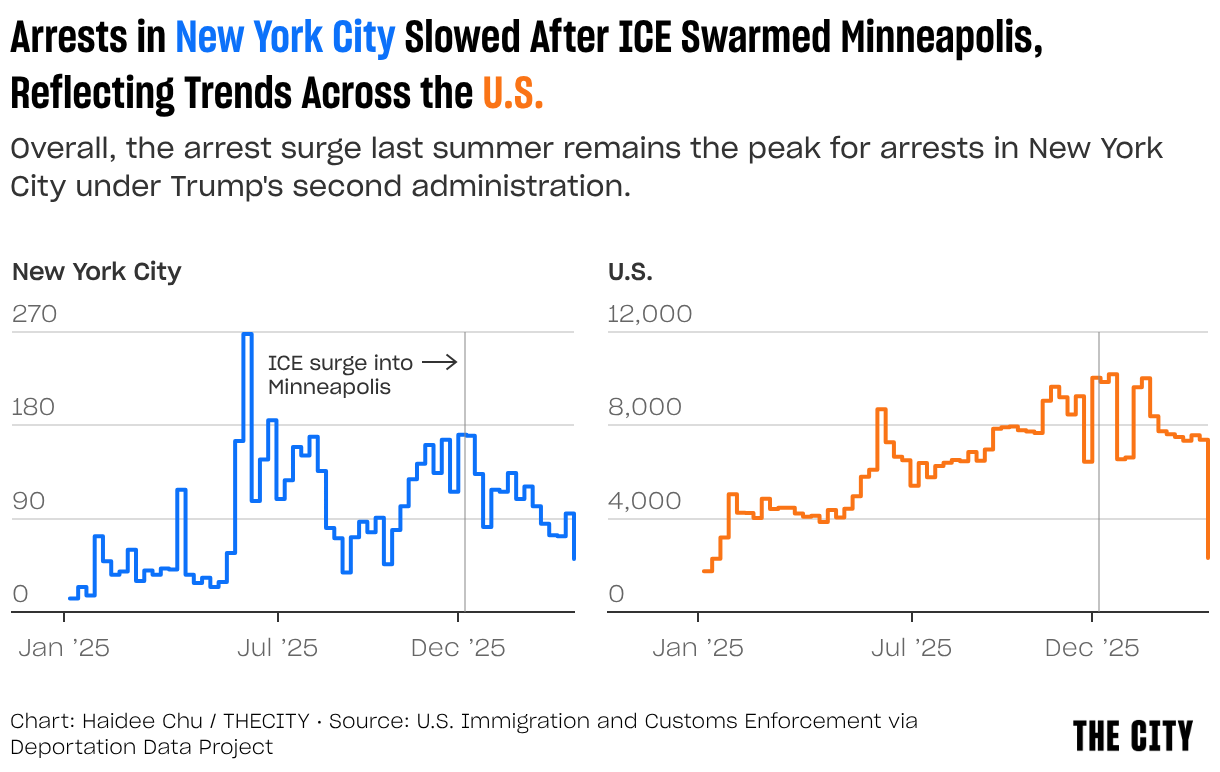
The latest data indicates ICE’s arrest surge last summer — when masked agents were grabbing people at immigration courts and staking out check-in offices — remains the peak of the agency’s enforcement efforts thus far in the five boroughs.
Arrests slowed for a period of time following a federal court order last August limiting the number of people ICE could detain at once inside 26 Federal Plaza holding cells — before picking up again between October and December, when THE CITY reported on an apparent increase in arrests on the street.
ICE arrests then declined in New York City in the weeks after DHS agents surged into Minneapolis in December in an effort dubbed “Operation Metro Surge”, where they later killed two protesters in January — Renee Good and Alex Pretti. Collateral arrests, in particular, have dropped dramatically since Pretti’s killing in late January, with just a few a week, compared to dozens of each week logged in the fall.
Department of Homeland Security Secretary Kristi Noem and Customs and Border Patrol Commander at Large Greg Bovino were both ousted in the aftermath of that politically unpopular operation. Honan was given a more prominent role as Trump confided to members of his inner circle that the mass deportation efforts may have gone too far, the Wall Street Journal reported.