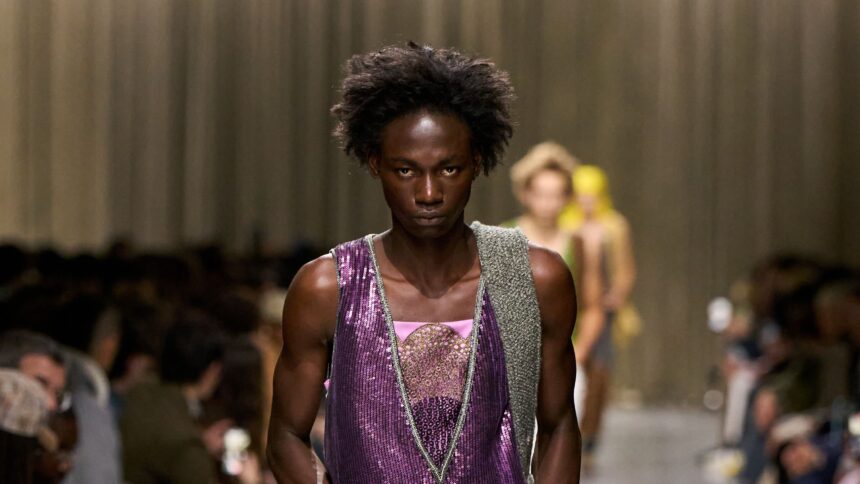
“I don’t want normality,” said Jonathan Anderson during his pre-show press conference which, entirely abnormally, was being filmed by Luca Guadagnino. He was referring to the wild wigs crafted by “genius” Guido Palau. Yet that anti-normal position extended across a collection in which Anderson assembled a collage of seemingly disparate elements into a coherently unconventional cast of characters. The clothes that shaped them were at once conceptually charged and commercially persuasive.
“Ultimately, the way I work is just collecting things or experiences throughout the process and then kind of infiltrating them in,” Anderson said. This collection’s accumulation began when his attention was caught by a plaque honouring Paul Poiret on the pavement outside Dior’s 30 Avenue Montaigne headquarters. Poiret founded his house in 1903 aged 23, a year younger than Anderson when he established JW Anderson in 2008. Over roughly two decades, Poiret dominated the fashion scene of Belle Époque Paris, inventing the precursor to the modern runway show along the way.
Anderson went on to acquire an unworn Poiret dress from 1922. Unboxing it from still-pristine tissue paper, he asked himself: “What is that, meeting with Christian Dior?” His answer opened the show. The first three looks took the upper portion of that dress, reworked by the Dior ateliers. These top halves were against something altogether more contemporary: jeans in blue wash, white, and distressed black, secured with Dior-buckled belts and finished with D-toed, reptile-pattern Cuban-heeled boots. That element came from the second foundational strand in Anderson’s fall 2026 collage. “I’d met this amazing singer and musician called Mk.gee,” he said. “I was trying to work out what these characters would be together, as a new radical.”
From there, the process widened. Anderson examined transitional moments in tailoring history: points of sudden collapse. Fringe-edged, double-breasted houndstooth jackets with full shoulders and bar hips nodded to the 1940s, yet were cut to jarringly short proportions. Single-breasted black jackets referenced the early 1960s, but were hyper-shrunken to expose the hipbone. “For me, Dior menswear is about tailoring,” he said. “But how do you play with it to find new shapes? I don’t want mechanical repetition. Not just 70 looks that are the same.” Tailcoats were ingeniously transformed into cable knits. Round-neck wool sweaters, as quotidian as garments come, were radicalized by being extended to ankle length. Throughout, Anderson purposefully upset the familiar by exposing it to the weird, either through fabrication, scale, or adjacency.
The loucheness and looseness of Poiret (who said he conceived his dresses to be seen from a distance and drew his own collage of inspirations from sources ranging from the Crusades to the Ballets Russes) was translated via Anderson into the structure and technical rigor of Dior. Butterfly-pattern jacquard trousers, worn with rock-star swagger, were woven from the archive of Poiret’s original supplier. So too were bolts of fabric, some bearing Poiret’s own designs, which were built into parkas and topcoats as cape-like panels, offset by grand shearling cuffs. Cropped puffer jackets were sculpted to curve cocoon-like from shoulder to coccyx.
As Anderson pointed out, Poiret was an enthusiast of fancy dress. He was also a fellow advocate of fashion’s ability to project and transmit character. The ruff collars worn by both some models and some in the audience (they came with the invite) epitomized this capacity: although both archaic and formal, it took only a purposefully off-kilter styling to transform them into the apparently anarchic and informal. They looked punkish, romantic, and a little dangerous. “For me, fashion shows are about showing ideas,” Anderson said. “It’s not a formula. I want to have a bit of fun with it.” This was an excellent collection of menswear that also offered female customers many reasons to browse away from their usual floor of the store, something Anderson said is already happening at Dior.