Nearly everyone in the food business who champions composting can pinpoint a reason why sustainability became one of their top pursuits
Christi Turner was living in an apartment and frustrated that there wasn’t a service that would pick up compost from multi-unit buildings, so she decided to start one.
Aiden Tibbetts was sourcing flowers from California for his Denver restaurant, Wildflower, but noticed a drop in quality during the drought of 2022, so he began picking them from his mother’s garden.
Heather Morrison wanted her restaurant to reflect the values of a society she hopes her daughter, Olivia — whom the Italian restaurant is named for — will grow up in.
“I’ve always wanted to be somebody that she could be proud of when she looks at our business and sees what we do,” said Morrison, who was awarded a special citation for outstanding service by the Michelin Guide this year.
But come next year, the staff at an estimated 2,500 to 3,000 restaurants in Denver will need to get used to tossing their food scraps into the compost bin. That’s because starting in September, all food vendors, apartment buildings and permitted events will need to pay for a compost hauler or find another way to repurpose their food scraps.
The restaurant requirement will come into effect four years after Denver voters overwhelmingly approved it at the polls. The 2022 ballot measure, titled Waste No More, cited restaurants as a major source of food waste — and composting as a way to keep that waste from landfills that emit climate-warming greenhouse gases. The Denver City Council officially adopted it last fall.
After it takes effect, city agencies led by the Office of Climate Action, Sustainability and Resiliency are expected to enforce the rule, which states that existing restaurants must have waste diversion plans in place come Sept. 1. (No penalties are listed in the rule language, though it calls its violation “unlawful.”) The climate action office is now developing regulations and educational materials for businesses, said Tay Dunklee, the office’s zero waste and circular economy manager.
“We as a city are committed to meeting the community’s expectations around sustainability and reducing waste. We also recognize that for some restaurants, this transition will take a lot of time and planning,” she said. There will also be a need to ramp up the scale of composting services to accommodate the new sources. “That certainly can’t happen overnight.”
Restaurant owners like Morrison are eager to get other restaurants on board, however, both to show them how composting leads to more nutrient-rich soil, which in turn can lead to more flavorful food. But also to help them understand the negative effect that food in a landfill can have on the environment.
“You have to make people psyched to do it,” she said.
‘Who put the glove in here?’
The composting part is easy, Morrison said. Restaurant staff scrape uneaten food from plates into a compost bin. Instead of going into the trash, food scraps from the kitchen — potato peels, onion butts, kale ribs — go into the compost bin, too.
It’s keeping consistent that’s hard. Licensed haulers and disposal sites serving the metro area differ on which types of compostable waste they take. The city of Denver, for instance, which collects compost from homes and smaller apartment dwellings, doesn’t take tea bags, coffee filters or certified compostable products such as takeout containers or cups.
Olivia pays $220 a month for compost hauling by Scraps Mile High, the company Turner started eight years ago and one of nine licensed haulers listed by the city on its website. Her service takes coffee filters, stained pizza boxes, paper towels and tissues along with food waste. Nearly 200 restaurants, cafes and caterers are clients.
A laminated poster in Olivia’s kitchen shows detailed images of what the company does and does not accept. “NO PLASTIC AT ALL!” reads the bottom of the section on what not to compost. (That includes sticker labels.)
“Even then, here and there, in the [heat] of the moment, someone takes a glove off,” said Paula Thomas, the restaurant’s director of sustainability, mimicking the gesture of tossing it in the trash. “Someone else calls someone else out: ‘Hey, who put the glove in here?’”
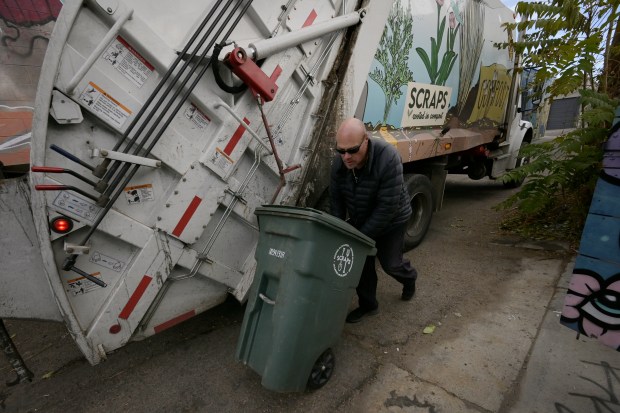
Twice a week, a Scraps rear-load truck rumbles up to the alley behind Olivia, 290 S. Downing St., and hauls away the restaurant’s food waste. From there, it goes to the company’s disposal site in Arvada, where it is sorted and goes through the natural process that turns it into compost. The company just started delivering its soil product, including to a distribution event in Edgewater, where it serves as its licensed compost hauler.
Having Denver restaurants see the entire chain — from food scrap to fertilizer and, potentially, food product again — would encourage and prepare those that don’t compost and whose owners see it as primarily another expense, Morrison and Thomas said. The city could lead field trips to disposal sites or have videos break down myths about compost’s odor (if properly ventilated, it doesn’t stink) and its efficiency. (Even the green plastic bags and clam shells eventually degrade, Turner said.)

The road to the rule’s adoption has been rocky. The city convened a task force that included Turner and other industry voices to help develop the regulations. City officials including from Mayor Mike Johnston’s office got involved earlier this year and, facing pressure from the restaurant industry, amended the composting requirements to exclude businesses making under $2 million or with 25 or fewer employees. Those exemptions were rejected by the City Council when it adopted the rule. But funding for the Waste No More initiative hangs in the balance, as earlier this month council members were hesitant to use millions collected through the city’s 10-cent bag fee to spread and enforce composting.
Local restaurants could play a major role in helping encourage the practice by touting its environmental and potentially nutritional benefits, Turner said.
“Not everyone thinks about the value stance of their restaurant every time they choose to dine,” Turner said. “But they can, and maybe they should. And maybe this is an opportunity for restaurants to really stand on their values.”

‘Flavor is nutrition. Color is nutrition.’
Some supporters of regenerative agriculture — a movement that champions the use of natural fertilizer instead of pesticides, as well as crop rotation, to improve the quality of soil — wonder whether the exponential increase in compost coming from Denver would actually make it to the farms that supply restaurants and supermarkets, thereby improving the quality of food.
The new requirements come with a caveat: Instead of contracting with a hauler, restaurants could appeal to the city with a custom arrangement for composting their food scraps.
That is already how chef Tibbetts does things at Wildflower, an Italian and Mexican restaurant inside the Gravity Haus hotel at 3638 Navajo St. He has paid a hauler $250 a month for composting services in the past, but suspended it after several missed pickups. “It’s sitting in a garbage area and it’s super stanky,” he said.
He now packs the restaurant’s food scraps into his car and drives them to his parents’ house in southeast Aurora, where they constructed a terraced garden made of stone that is fertilized using his compost.
No matter where the Tibbettses have lived, from Washington to Kansas to Colorado, the family farm has always followed. The decision to grow their own food — herbs, tomatoes and, yes, the wildflowers used at Wildflower — was partly a result of rising grocery store prices. But also for nutritional and flavor reasons.
“Flavor is nutrition. Color is nutrition,” Tibbetts said. “And we’re losing those things out of our food.” A grocery-store Roma tomato, for instance. “There is zero pigment, there is zero flavor. It tastes like water, it tastes like nothing.”
The real challenge, though, is getting large-scale farmers and food distributors such as Sysco to participate, Tibbetts said. He is skeptical about whether that will happen. “It’s going to take businesses working together and partnering on a scale that we haven’t seen for the past however many years, because we’ve gotten so addicted to cutting costs.”

On a small-scale level, though, composting offers inherent sustainability in both product and cost. In Olivia’s storage basement, Thomas ferments food scraps for use in future dishes.
She ferments apples and citrus fruits into vinegar. She saves cheese rinds for stocks and ferments them further into a fragrant white paste. Celery and fennel leaves turn into celery and fennel powders. The restaurant is licensed by the city to do this and also make kombucha, shoyu, sodas and other products she calls “flavor enhancers.”
“Normally, this trash is hidden with everything else,” Thomas said. “Then you start separating into compost. Then you can start seeing, ‘Is there value in my compost?’”
By saving more food, restaurants can reduce the size of their orders and save money, which could go to the compost hauler’s bill or another service.
Of course, not all of these practices are interesting, needed or practical at the majority of Denver restaurants, so the city’s Dunklee is encouraging them to be prudent in their goals.
“We’re certainly aware that all restaurants are different,” she said. “We just want to ensure that the materials are ultimately going to a permanent facility that meets the requirements of other jurisdictions.”