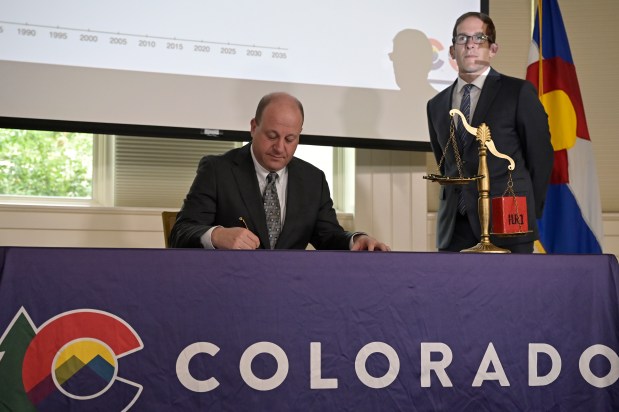
A gaggle of Democratic lawmakers introduced the breakthrough to their colleagues 4 days into the latest particular session — a tentative settlement struck to rewrite the state’s much-contested synthetic intelligence rules that may put an finish to greater than a yr of protracted debate.
The Sunday evening deal, reached after days of uncertainty throughout a session in any other case targeted on the state’s finances, would offer a path towards firmer tech oversight.
However by early the subsequent afternoon, the framework had collapsed. Main tech firms and a number one enterprise group hadn’t agreed to a key provision that may maintain firms liable if their AI-powered merchandise had been accountable for discriminating towards individuals who, say, had utilized for a job or a mortgage. That lawmakers had introduced a deal got here as a shock.
Anger and intensive lobbying adopted. Some teams that had supported the framework started to again away, simply hours after the negotiations had seemed to be reaching the end line. When one Democratic lawmaker referred to as a lobbyist good friend to speak in regards to the settlement, the lobbyist replied: “There isn’t a (expletive) deal.”
“The screaming was palpable,” mentioned Loren Furman, the president and CEO of the Colorado Chamber of Commerce, which had been negotiating with Google and one other lawmaker. Neither Google nor the chamber had agreed to the framework.
Final week’s deal-that-wasn’t renewed issues in regards to the affect of main expertise firms within the state Capitol, alongside broader frustrations that lawmakers and enterprise teams had been tasked — below stress from Gov. Jared Polis — with regulating a large trade in a matter of days.
For progressive lawmakers and their allies, there have been echoes of the common session within the spring, when lawmakers overwhelmingly handed laws regulating different tech sectors — social media, autonomous vehicles, ride-hailing apps — just for Gov. Jared Polis to step in and veto them.
“I consider that the governor’s workplace, and the affect that the tech trade has over the governor’s workplace, is a large drawback — notably when our constituents are rightfully and extremely involved in regards to the affect of AI,” mentioned Rep. Javier Mabrey, a Denver Democrat who was concerned within the particular session’s AI negotiations.
He additionally sponsored a bill that would have banned the use of rent-setting algorithms by landlords, which may hike prices on renters. That proposal, too, was vetoed by Polis earlier this yr.
Final week, as a substitute of rewriting the state’s present AI guidelines, which might have taken impact in February with none intervention, lawmakers merely delayed them. They’ll now take impact on June 30, greater than two years after they had been signed into legislation — an motion that had set off instant requires modifications to them by tech firms, authorities entities that use AI, and by Polis, who’d half-heartedly signed the invoice.
The delay means lawmakers will, as soon as once more, take up the problem within the coming months, now that they’ve purchased themselves extra time.
The rules, as now written, would require threat assessments and disclosures from firms that develop and use AI. Amid a tug-of-war over how the principles ought to be amended, the potential framework that emerged early final week demonstrated that there was seemingly a path out of the gridlock. Negotiators on both facet had been optimistic in regards to the subsequent spherical of talks.
Different lawmakers and negotiators, although, argued that the expertise firms and the chamber had been key teams that wanted to be extra straight concerned in approving the phrases of the deal earlier than it was introduced.
Furman mentioned the expertise sector is a big and rising a part of the state’s financial system; policymakers can’t shut the state off to these firms, she argued. She and others objected to the notion that there was ever a deal, on condition that they hadn’t agreed to it, and criticized the anti-tech feedback from different lawmakers.
“What I’m studying on this constructing is that you need to stakehold with all organizations, and if there are people who find themselves not on the desk, then if you assume you will have a deal, you won’t,” mentioned Rep. Michael Carter, an Aurora Democrat. He’d also sponsored an AI bill and was concerned within the closing negotiations.
Regulating tech
Lawmakers within the legislature’s Democratic majorities broadly agree that firms ought to be held accountable in the event that they make or use AI that discriminates towards folks throughout resume screenings, opinions of mortgage functions or well being care choices.
And legislators argue that the August negotiations got here near determining how to try this with out working afoul of Polis’ want to guard Huge Tech from rules that, he has mentioned, could harm Colorado’s ambitions of turning into an trade hub.
Polis, whose workplace declined an interview request, instructed reporters Thursday that his latest tech-friendly vetoes — and the continuing debate about AI rules — confirmed that such policymaking was “difficult and it’s essential to get it proper.”
A frequent AI user, Polis made his fortune within the early dot-com rush. Earlier this yr, he supported a tech-backed effort in Congress that may have blocked states from regulating AI for the subsequent decade.
“Coloradans are forward-looking (and) need to be on the slicing fringe of adapting completely different applied sciences in our every day lives and work lives,” Polis mentioned. “And on the identical time, we need to be shielded from discrimination. We need to be secure after we’re taking a automobile someplace.”
Tech and AI are difficult, mentioned Suresh Venkatasubramanian, a pc scientist who leads the Center for Technological Responsibility, Reimagination and Redesign at Brown College.
However they’re not so difficult, he continued, that they will’t be regulated. He’s referred to as for tighter, consumer-focused guardrails on synthetic intelligence, and he co-authored “A Blueprint for an AI Bill of Rights” for former President Joe Biden’s administration.
State legislators don’t have armies of workers members to speak by way of the particulars of synthetic intelligence or algorithmic decision-making, he mentioned. They’re typically overwhelmed by better-financed lobbyists and tech firms that, for all their futurist beliefs, are in the end companies attempting to maximise earnings.
Late this month, when lawmakers returned to Denver to debate the rules, greater than 150 lobbyists and companies registered a place on the invoice, with firms like Google, Amazon and Workday in addition to nationwide tech teams all current.
The businesses “have a whole lot of energy to point out up with a few key lobbyists and to overwhelm the skills that the legislatures have to consider this,” Venkatasubramanian mentioned, arguing that the businesses’ technique is to delay and stop. “And so they’ve accomplished this efficiently a lot of occasions. They arrive with full power, saying, ‘We’re tech firms, you might want to consider us or else we’ll go away your state.’ Individuals don’t know the way to reply to that.”
That’s what occurred when Rep. Jenny Willford, a Northglenn Democrat, sponsored a bill this year to require more safety measures of ride-hailing firms like Uber and Lyft. Willford sponsored the invoice, she has mentioned, as a result of she was allegedly sexually assaulted by a Lyft driver final yr.
The businesses mentioned the invoice’s provisions couldn’t be applied. Uber threatened to go away the state if the invoice handed, and it requested drivers and customers who opened its app to jot down to their lawmakers to oppose it. Uber had additionally made the identical risk in Minneapolis over a proposed minimum wage increase.
The invoice handed with bipartisan majorities. However Polis vetoed it, partially due to Uber’s risk to go away.
“The underside line is that this invoice was in the end about accountability and legal responsibility,” mentioned Willford, who was the lawmaker who was instructed by a lobbyist that no AI deal had been reached. “Them having legal responsibility for the hurt that they’ve prompted and the actions they didn’t take with a purpose to hold folks secure. We noticed that with the AI invoice this time round.”
Sen. Lindsey Daugherty, an Arvada Democrat who sponsored the vetoed invoice that may have regulated social media firms, mentioned her proposal was extra about defending children than cracking down on tech firms. Nonetheless, she mentioned, its veto underscored that tech payments had a better path to turning into legislation if the trade and Polis had been in your facet.

Weighing compliance, discrimination dangers
Furman, the state chamber’s CEO, argued that some tech payments needed to be vetoed as a result of firms basically couldn’t adjust to them. As for AI firms, she mentioned they weren’t against negotiating legal responsibility — together with who ought to bear the authorized value if an AI system utilized by an organization or a hospital is discovered to discriminate towards a job applicant or a affected person.
However she mentioned they couldn’t attain an settlement throughout a brief particular session.
“It takes a surgical method to determine learn how to get your events on the identical facet on this,” she mentioned. “If we had been in an everyday session, we in all probability may’ve gotten there.”
The duty of rewriting the state’s AI guidelines in every week was seemingly doomed from the beginning, agreed Senate Majority Chief Robert Rodriguez, who sponsored the preliminary guidelines and the latest try and rewrite them. Different lawmakers and negotiators had been pissed off that the AI invoice was a part of the particular session in any respect.
He mentioned tech firms had been cheap with him throughout negotiations, however the lobbying battle had been vicious.
“I used to be able to do the work, and conversations had been occurring,” Rodriguez mentioned. “However as soon as you place it on the particular session calendar, then you need to provide you with coverage (and) begin attempting to barter in a brief time frame.”
The necessity for the rules is actual, Venkatasubramanian mentioned, even when tech firms will wield appreciable muscle to dam them. Synthetic intelligence programs and automatic screening applications are outstanding throughout varied providers in america, and so they’re educated on knowledge from an imperfect society.
Bias could not even be intentional: He pointed to a 2019 paper a couple of widespread medical algorithm used to find out entry to high-risk remedy. Researchers discovered that it “routinely lets more healthy whites into the applications forward of blacks who’re much less wholesome,” according to the University of Chicago.
That was as a result of the mannequin was constructed on knowledge that primarily based the necessity for future remedy on the price of prior remedy, Venkatasubramanian defined. As a result of white folks had entry to costlier remedy for quite a lot of systemic causes, the mannequin picked up on that sample and directed them towards higher care.
The bias in AI programs and algorithms has been studied and understood for practically 20 years, he mentioned. Mitigating that threat was the purpose of labor unions, advocacy teams and progressive lawmakers through the particular session.
They mentioned they wished to present customers of these providers the power to see which knowledge knowledgeable AI’s choices about them, to appropriate it when it was mistaken, and to pursue lawsuits if the synthetic intelligence system or the corporate that deployed it used the expertise to discriminate.
The invoice additionally would’ve reduce among the regulatory necessities from the state’s present rules.
“That is going to be one of the essential public coverage fights in our era,” mentioned David Seligman, a Democratic lawyer basic candidate whose nonprofit legislation agency was concerned within the AI negotiations. “And that is going to be the form of it: whether or not we will maintain these firms accountable, whether or not we’re going to share in that wealth.”
These negotiations will now proceed into subsequent yr. Regardless of uncooked nerves from final week, officers from all sides had been optimistic.
Rep. Brianna Titone, an Arvada Democrat who additionally sponsored the laws, mentioned she’d already taken the primary steps to begin drafting a brand new invoice. The Colorado Know-how Affiliation mentioned the delay supplied “the chance to work collaboratively on sensible options that strengthen shopper belief, safeguard jobs, and protect Colorado’s competitiveness.”
Furman mentioned the competing pursuits wanted an “grownup within the room” — a mediator — to assist them work by way of the legal responsibility disagreement. However she mentioned floor had been gained elsewhere, and she or he argued that Huge Tech companies weren’t flatly against regulation.
“If we’d spent 5 months working by way of this, we’d get there,” she mentioned. “However folks need to have a story for political causes, a whole lot of occasions, and so they don’t need to take note of among the areas the place there could possibly be consensus — and (as a substitute) they level the finger and blame.”
Stay up-to-date with Colorado Politics by signing up for our weekly newsletter, The Spot.