Drought and lengthy, sizzling summer season days are sucking Western Colorado’s rivers dry, parching farm fields and fueling the huge wildfires proliferating throughout the area.
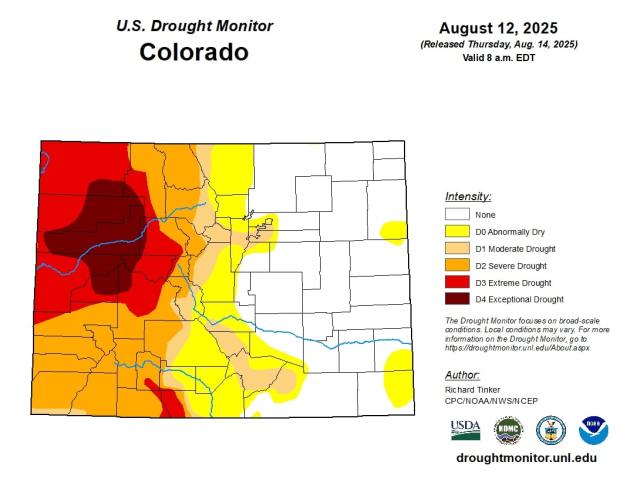
A bit of northwestern Colorado within the final week plunged into distinctive drought — probably the most dire class recorded by the U.S. Drought Monitor. The swath of affected land represents 7% of the state and covers most of Garfield and Rio Blanco counties, in addition to elements of Moffat, Mesa, Delta, Routt and Pitkin counties.
“Northwestern Colorado is the epicenter of drought in the entire nation proper now,” mentioned Russ Schumacher, Colorado’s state climatologist and the director of the Colorado Climate Center. “It’s about as unhealthy because it will get.”
Distinctive drought is predicted to happen as soon as each 50 years, Schumacher mentioned. Up to now this summer season, the afternoon monsoon rains that present reduction have been largely absent from the Western Slope.
The upper-than-normal temperatures and a scarcity of rain have sapped the rivers within the Western half of Colorado. Streamflows statewide are at solely half of the median recorded between 1991 and 2020, according to National Water and Climate Center data.
The shortage of water has restricted fishing and rafting alternatives, decreased agricultural irrigation and threatened river environments.
For the Western Slope’s water managers, low streamflows imply weekly calls and intense coordination to make sure the water that’s accessible is allotted effectively and with most profit.
“It’s been a tough yr to coordinate and ensure individuals have the water they want, as a result of there’s actually not sufficient to go round,” mentioned Sam Calahan, a water sources information specialist for the Colorado River District.
Drought throughout the state
Almost half of Colorado is experiencing some stage of drought, based on new data released Thursday by the U.S. Drought Monitor. Greater than 1.4 million individuals reside in that drought-impacted space, which encompasses your entire western half of the state, elements of metro Denver and a few areas of southern Colorado.
Drought reigns regardless of near-normal winter snowpack ranges throughout a lot of the state earlier this yr. That’s on account of a heat finish to winter, adopted by an unusually dry and heat spring and summer season, Schumacher mentioned.
When afternoon storms have occurred, they’ve largely been dry storms — with lightning however no rain.
“It’s simply been dry, dry, dry,” he mentioned.
The lightning storms have sparked 5 wildfires which are burning on the Western Slope, consuming a whole bunch of sq. miles and destroying 5 houses.
Information from the Nationwide Oceanic and Atmospheric Administration compiled by Climate Central present that common summer season temperatures in Colorado have risen between 2 and 4 levels since 1970. The Western Slope has seen the best warming, based on the information.
These hotter temperatures — fueled partially by greenhouse gases from human growth — make the air drier, which then pulls extra water from soils, rivers and vegetation, Schumacher mentioned. Drier vegetation make extra flamable gas for wildfires.
“It takes what would’ve been a drought anyway and makes it worse,” he mentioned.
Low, low river flows
This summer season has been one of many driest on file for the state’s important Colorado River basin, much like 2018 and 2021, mentioned Calahan of the Colorado River District. Drought in these years made the Colorado River look extra like a creek than a river and prompted a 120-mile-long fishing ban on its mainstem.
“(This yr) is just not file unhealthy, however it’s fairly shut and fairly dire,” Calahan mentioned.
Streamflow within the basin is worst on its western flank and greatest on its japanese facet close to the headwaters, he mentioned. A lot of the water close to the headwaters, nonetheless, is diverted beneath the Continental Divide to Entrance Vary communities.
The district is talking weekly with irrigators throughout the area to greatest divvy up the water that continues to be. Low flows are being supplemented by releases from reservoirs.
Whereas a lot of the reservoirs utilized by Entrance Vary water suppliers crammed up in the course of the spring runoff, these utilized by the Western Slope have been extra of blended bag, Calahan mentioned.
Green Mountain Reservoir — on the Blue River southeast of Kremmling — didn’t fill, and the river district will now ship water from its upstream Wolford Mountain Reservoir to complement Inexperienced Mountain.
“If now we have one other yr like this subsequent yr, and Wolford will get drawn down farther, then we’re in a precarious spot,” Calahan mentioned.
A scarcity of water within the Eagle River close to Vail prompted native water authorities to warn of a possible coming water scarcity. Flows on the river close to Avon have been about half of regular — and the third-lowest recorded on the stream gauge’s 26-year file, mentioned Siri Roman, the overall supervisor of the Eagle River Water and Sanitation District.
District management urged individuals within the district — which incorporates Vail, Avon and japanese Eagle County — to make use of much less water, particularly outdoor.
“We’d relatively see that water within the river than in your lawns,” Roman mentioned.
13 of the 14 stream gauges with historic information within the Higher San Juan basin have been reporting flows beneath or extraordinarily beneath regular on Wednesday. The Animas River in Durango was flowing at 153 cubic ft per second — a fraction of the median of 499 cfs for the day throughout 113 years of information, and near the historic low for that date of 137 cfs.
“You possibly can take a look at it and simply see how a lot of the streambed is out of the water and see among the gravel bars,” mentioned Steve Wolff, the overall supervisor of the Southwestern Water Conservation District.
A number of stream gauges within the basin have been recording file each day lows, just like the San Juan River in Pagosa Springs and on Vallecito Creek.
“We’re on this lengthy, dry interval, and it has impacted everybody on this neighborhood,” Wolff mentioned.

Yampa River basin struggles, too
On the other facet of the state, the Yampa River basin, too, is struggling. The river above Stagecoach Reservoir was flowing at lower than half of the 36-year median.
Low flows pressured Steamboat Springs officials on Thursday to shut the part of river that flows by city to all recreation indefinitely, together with for business operations, tubing, swimming and fishing. Heat water stresses fish populations, and officers hope to minimize the toll on aquatic life by preserving individuals out of the river.
The shortage of water additionally prompted state water managers in late July to mandate that people with more junior water rights use less water from the river system. The principle stem of the Yampa River beneath Stagecoach Reservoir has been positioned on name solely 4 instances: 2018, 2020, 2021 and this yr.
A scarcity of rain and sizzling temperatures meant every part within the basin occurred a few month early, mentioned Holly Kirkpatrick, the general public data officer for the Upper Yampa Water Conservancy District. Excessive flows from mountain runoff dropped in Could, as a substitute of June, and water temperatures began to spike in June, as a substitute of July.
In dry years, the district releases water from Stagecoach Reservoir to maintain sufficient water within the river for environmental well being. The district started these releases this yr on June 27 — the earliest ever — and will deplete the quantity of water accessible for environmental releases by mid-September.
“For most likely the primary time, we’re taking a look at not having sufficient water to help the well being of the river for the remainder of the season,” Kirkpatrick mentioned.
The outlook for the autumn throughout Colorado is far of the identical — drier and hotter than common, Schumacher mentioned.
There’s a sliver of hope, nonetheless, for the return of monsoon situations on the finish of August — or at the very least some cloud cowl.
“It gained’t be a drought-busting rainstorm, however at the very least some extra humidity and a few clouds,” he mentioned.
Get more Colorado news by signing up for our Mile High Roundup email newsletter.