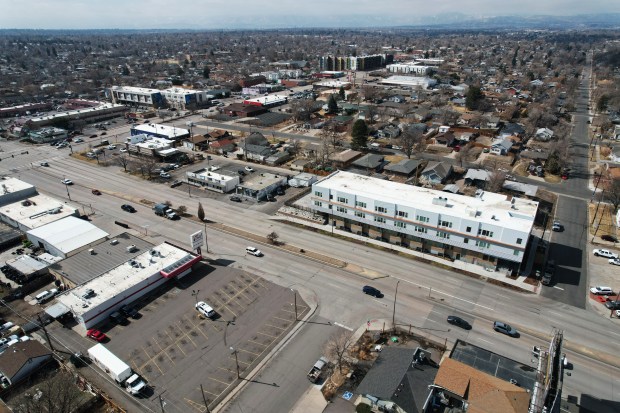
Federal Boulevard was built for cars. It carries up to 46,000 vehicles a day, sometimes crawling in traffic jams, often speeding.
It’s one of Colorado’s deadliest roads, where state records show an average of nearly 20 crashes per week. In the last month, a white Toyota Corolla plowed into a juvenile pedestrian in a crosswalk, causing “serious injuries,” Denver Police said, and a silver sedan struck and killed a woman on foot just before midnight on New Year’s Eve — both hit-and-runs.
But a $318 million, three-year overhaul scheduled to start next year will bring “transformative change,” Colorado Department of Transportation Director Shoshana Lew said.
CDOT contractors will “take this very busy, fast, too dangerous roadway and bring it more holistically into our community,” Lew said. The route will be remade “in a way that improves the safety of intersections, makes it easier to be a pedestrian, makes it an easier place to run or use a business, and just helps it function like more of an urban roadway.”
The construction follows CDOT’s $280 million overhaul in progress along Colfax Avenue east of downtown. On Colfax, construction has diverted traffic into surrounding neighborhoods and disrupted commerce. More than 90 businesses along Colfax scrambled to receive $1.18 million in city financial grants to help them survive.
A similar overhaul of Colorado Boulevard is scheduled for completion by 2030.
Once rebuilt, Federal will incorporate Bus Rapid Transit, which features “stations” rather than stops and reduces delays, typically by installing bus-only lanes and giving buses priority at traffic signals. But Denver transit advocates and neighborhood groups contend that current plans for buses to share lanes with vehicles along parts of Federal don’t go far enough. They want bus-only lanes throughout the 18-mile corridor.
“Is it really going to incentivize people to leave their cars at home if some of the lanes are shared and the buses cannot compete with how fast you can travel by car?” asked Alejandra Castañeda, who lives 1.5 blocks off Federal in north Denver.
Curbside bus lanes
CDOT’s partially completed plans show curbside bus-only lanes will run along both sides of Federal through 75% of the corridor between Dartmouth Avenue in Englewood and 120th Avenue in Westminster. Buses would share lanes with vehicles along stretches through north and south Denver. Those shared lanes run between Dartmouth and Evans, between 20th and 50th avenues, and under Federal’s intersection with Interstate 76.
The 18-foot buses operated by the Regional Transportation District would arrive every 7.5 minutes at 74 raised, covered stations spaced an average of a half mile apart. CDOT plans also show new curbs with wider sidewalks. State and city officials have promised raised medians and landscaping with native trees, shrubs, and flowers.
Yet CDOT’s modeling projects that, even with BRT, the volume of traffic on Federal will increase to more than 60,000 vehicles a day before 2045. The planned reconstruction accommodates increased vehicle traffic, preserving two vehicle lanes in each direction throughout the corridor, requiring widening in some areas to create space for bus-only lanes.
“We want signal headers (the assemblies that hold red, yellow, or green lights) over each lane. That gives greater visibility,” CDOT deputy director for traffic and safety Angie Drumm said.
Protected left turn lanes, where a green arrow on a traffic signal gives drivers exclusive right-of-way to turn left, and sharper turn lanes into the cloverleaf interchange at West Colfax Avenue will help slow traffic, Drumm said. “If you tighten up the lanes, generally, people tend to slow down their driving,” Drumm said.
Instead of a Federal Boulevard speedway, she said, “our goal is to make it more of an amenity.”
Buses vs. cars
Neighborhood groups, seeking reduced traffic, fewer crashes, and an improved quality of life, have been urging CDOT planners to make a bolder shift toward buses.
“Anything that can slow down traffic, make us feel like we are living in a city, not surrounded by highways, would be an improvement,” said James Warren, a board member of the Villa Park Neighborhood Association.
Whether to accommodate increased vehicles “is the big issue,” Warren said. “They should not be widening. The point is to provide access and speed for buses.”
Allen Cowgill, a Sloan’s Lake resident and member of the Denver Bicycle Lobby who serves as co-chairman of Denver’s Department of Transportation and Infrastructure Advisory Board, wants speeds along Federal lowered from 35 mph to 30 mph to help protect the people who depend on transit.
“They are the people being killed,” said Cowgill, who also sees dedicated bus lanes throughout the corridor as essential.
“Part of the reason people don’t take RTD buses is that the buses get stuck in traffic. If RTD buses had their own dedicated lanes, people would be more likely to take RTD. For a lot of people, transit is not realistic because it doesn’t run reliably and frequently enough.”
CDOT officials said they’re designing the new boulevard for slower speeds with limits posted at 30 mph through Denver.

More cars coming
Colorado’s Bus Rapid Transit program manager Ryan Noles said eliminating vehicle lanes to provide bus-only lanes on what would be shared-lane south and north stretches would cause traffic jams and divert vehicles into neighborhoods. The alternative of widening Federal between 20th and 50th avenues to add space for bus-only lanes would require “taking out beautiful planted medians or taking out front yards — pretty hard impacts,” Noles said.
Bus travel times from Dartmouth to north Denver (50th Avenue) will decrease from 40 minutes to around 30 minutes under current plans — “competitive with driving,” he said.
The state’s modeling estimates RTD bus ridership along Federal will increase from 6,000 a day now to 8,500 in 2030, then to 13,000.
“Thousands of people use Federal Boulevard every day to access jobs, restaurants, businesses, and social services,” Denver spokeswoman Nancy Kuhn said. “Many of them use cars. Our goal with BRT is to provide a viable alternative to driving, but we don’t expect that everyone will have the ability every day to switch from driving to using transit,” she said.
To help address crashes and persistent pedestrian fatalities on Federal Boulevard and Alameda Avenue, city safety officials have installed additional speed limit signs. Automated speed enforcement and red-light cameras are slated for introduction on Federal this year.

Historical roots
A century ago, Federal Boulevard emerged as a tree-studded lifeline for neighborhoods that workers could afford. It earned a reputation simply as “the boulevard,” with parks created along it, according to a historical survey commissioned by CDOT and Denver. Part of the appeal was the natural terrain on the west side of the South Platte River. Trolleys linked west-side neighborhoods to downtown.
That pattern broke down, starting in the 1940s, as state officials expanded Federal to give easier access to the Denver Ordnance Plant ammunition factory at the site of the Federal Center. Denver’s post-World War II boom through the 1950s and 1960s brought increasing vehicle traffic as more homes were built. State authorities designated Federal Boulevard a state highway, linking the 6th Avenue Freeway with highways to the north.
CDOT records show at least 33 traffic fatalities along Federal since January 2021. CDOT has documented 5,102 crashes on Federal since then. That’s an average of 1,020 per year. Federal consistently has ranked among Denver’s deadliest streets, with fatality rates up to 20 times the average for Colorado urban streets.

The reconstruction will determine whether new residents, such as Peter Hufford, stay in adjacent neighborhoods. Hufford attended one of the CDOT sessions in a westside school gym, concerned that federal funding cuts might scuttle or delay the overhaul.
He and his wife envision gardening at the house with a half-acre yard that they bought four years ago, just east of Federal on South Decatur Street. They haven’t ruled out raising children there, said Hufford, who designs electronic components for satellites.
Public transit must be viable, he said. “I’d like the bus to be a nice environment. I don’t like driving. I find it stressful. I’d much rather sit and read a book – and still be able to get where I want to go.”
The reconstruction ideally will address multiple problems, including noise, light, and air pollution, Hufford said.
“Those are all issues for me. Noise? I can hear cars drag-racing all night. I like to walk to restaurants on Federal, but walking on Federal now is unpleasant,” he said. “I don’t think I’ll ever be able to see many stars in Denver.” Reasonable control over commercial lighting would help. “The lights are too bright. I wish they would dim the light.”

Business owners brace for disruption
State officials said plans will soon be finalized.
Full funding hasn’t been secured beyond the design and review phase. The projected funding for construction includes CDOT money, a Federal Transportation Administration grant of up to $150 million, and support from local agencies and the Denver Regional Council of Governments.
Meanwhile, business owners along Federal are bracing for the disruption. CDOT officials say they’ll work proactively to include owners in the planning, ensuring access for their parking and deliveries, and maintaining lanes down the middle of Federal during construction.
“The construction is going to hurt business. A lot of them may close. This is not good for business,” My Dodge said behind her counter at Celestial Bakery Deli and BBQ in the Far East Center, 333 S. Federal Blvd., an enterprise she’s built over 31 years.
“One day is enough. But oh my god. More than a year? How are we going to make money?” she said.
“I’m going to cry. Everybody’s going to cry.”
Get more Colorado news by signing up for our Mile High Roundup email newsletter.