In the months leading up to 2026, cross-border travel has been taking on a more cautious tone as both governments are changing the rules.
For travelers, the shift is less about alarm and more about preparation—understanding what may be different on the ground, factoring in added pressure on public services, and taking simple steps that can reduce avoidable disruptions.
Against a backdrop of ongoing U.S.–Canada friction and an increasingly busy international travel calendar, even routine trips are starting to come with a longer checklist.
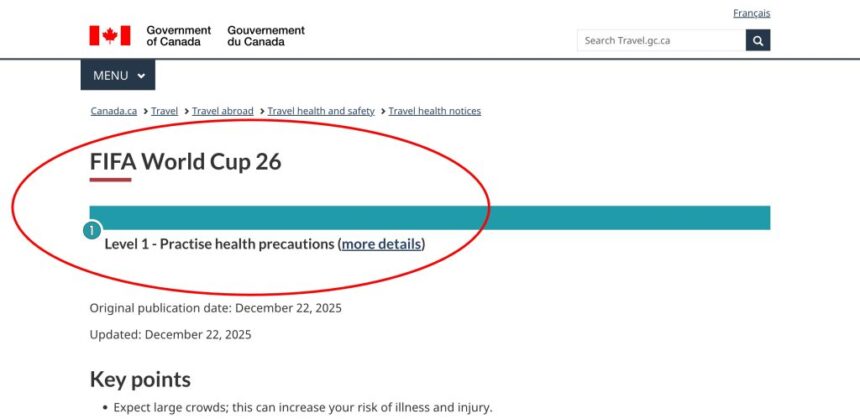
On December 22, Canada updated its U.S. travel guidance with a new, event-specific health notice aimed at Canadians planning to attend the 2026 FIFA World Cup, a tournament expected to draw unprecedented crowds across North America.
Global Affairs Canada’s U.S. destination page now lists a health update noting a travel health notice for the FIFA World Cup 2026.
The added notice does not raise the overall security risk level for travel to the United States.
Instead, it flags the practical reality that mass gatherings can amplify routine health hazards—respiratory illness transmission, dehydration, heat exposure, and crowd-related injuries—especially when fans are moving through airports, public transit, and high-density fan zones in multiple cities over several weeks.
Here at Traveling Lifestyle, we’ve looked closer into this health warning and also the ongoing US-Canada tension and tourism problems.
What Canada’s New Notice Actually Says
The Government of Canada’s dedicated travel health notice for the World Cup emphasizes that large crowds increase the risk of illness and injury and advises travelers to take straightforward preventive steps. In the government’s words: “Expect large crowds; this can increase your risk of illness and injury.”
The notice also stresses basics that become more important at scale: hand hygiene, avoiding close contact with sick people, food and water safety, and planning ahead for access to care. For anyone who becomes ill while traveling—or after returning—it recommends measures that reduce onward transmission, including masking and sharing travel history with clinicians.

The “Before You Leave” Checklist: Six Weeks Is the Key Planning Window
Alongside the notice, Canada’s broader guidance around the tournament encourages travelers to build a medical plan early—ideally six weeks before departure—to confirm routine immunizations, consider destination- and activity-specific vaccines, and review how to carry prescription medications across borders.
This timing matters because adult boosters, travel vaccines, and medication adjustments often require multiple appointments, and the tournament calendar (June 11 to July 19, 2026) coincides with peak travel demand that can strain appointment availability and last-minute pharmacy logistics. FIFA+1
A Health Notice Arrives as Cross-Border Friction Shapes Travel Behavior
While the World Cup advisory is framed as a health precaution, it lands in a period when U.S.–Canada tensions have already changed how many Canadians think about U.S. trips.
Trade politics remain a live issue heading into the 2026 review of the USMCA, with formal talks expected to start in mid-January and leaders on both sides pointing to unresolved tariff and market-access disputes.
At the border, Canada has also warned travelers to expect heightened scrutiny at U.S. ports of entry, including possible inspection of electronic devices. In a statement quoted by Investopedia, a U.S. Customs and Border Protection official defended the practice: “These searches are conducted to detect digital contraband… [and] play a critical role in national security.”
Those dynamics appear to be influencing demand. Earlier in 2025, major travel-industry reporting documented a marked drop in Canadian travel to the U.S., linked to political tension, tariffs, and uncertainty about entry experiences.
Practical Implications for 2026 Travelers
For Canadians heading to U.S. host cities in 2026, the combined message is straightforward: plan earlier than you normally would and treat health, documentation, and contingencies as part of the same travel system.
On the health side, that means building a simple risk-reduction routine that is realistic in stadium and fan-zone environments: hydrate aggressively, use sun/heat protection, eat and drink safely, and know in advance where to get medical help if needed. Security and crowd-safety analysts routinely note that mass gatherings concentrate risk—most events pass without incident, but density increases exposure to problems like disorder and injury.
On the entry side, travelers should assume a more formal border process: carry complete documentation, allow extra time, and treat devices as potentially inspectable—minimizing sensitive data on travel hardware where feasible and ensuring essential contacts and insurance details are accessible offline.
The bottom line: Canada’s new U.S. travel health notice is not a “don’t go” message. It is a large-event operational warning—issued well in advance—to push travelers toward better preparation for a tournament that will test transportation networks, public-health resilience, and border-processing capacity across the continent.