Any links to online stores should be assumed to be affiliates. The company or PR agency provides all or most review samples. They have no control over my content, and I provide my honest opinion.
A few days ago, I reviewed the superb Plaud NotePin S, and I have also recently reviewed the Plaud Note Pro and the original Plaud Note.
I was sceptical of these new voice recorders with AI transcription due to the transcription features you get built into Android with most modern phones now. It seemed excessive to buy another device and then potentially pay for a subscription.
However, I grew to love my Plaud devices and use them regularly for meetings, product briefings and any situation where I need to remember information. I have ADHD, so it has been hugely helpful with keeping track of things I need to remember for meetings.
Since Plaud launched, there has been a growing number of competing products. Many are like-for-like clones from random brands you find on Amazon, but a growing number of big brands are jumping on this bandwagon, including Anker Soundcore with their coin-sized AI Voice Recorder.
Boya is another company entering this market. I was not familiar with them before this review, and initially, the Boya Notra AI Note Taker appears to be a clone of the Plaud Note, but it does offer some additional functionality and a lower price point that might make it a more appealing alternative to the Plaud Note.
Related Reviews
Specification
| Specification | Details |
|---|---|
| Recording Mode | Ambient / Phone Call / Bluetooth |
| Supported AI Models | ChatGPT, Claude, Gemini, Grok |
| Storage | 64 GB local + unlimited cloud |
| File Transfer | Bluetooth, Wi-Fi, USB-C |
| Microphones | 2 × MEMS + 1 × VPU |
| Pickup Range | Up to 10 m |
| Noise Cancellation | Yes, AI-powered (up to -30 dB) |
| App and Web Access | Yes |
| Text Editing | Yes |
| Audio Import | Yes |
| Magnetic Attachment | Yes (MagSafe-compatible) |
| Export File Formats | MP3, WAV, TXT, DOCX, PDF, Markdown, JPEG |
| Battery Life | Up to 24 hours recording<br>Up to 365 days standby |
| Charging | USB-C (full charge in approx. 2 hours) |
| Dimensions | 63 × 63 × 6.8 mm |
| Weight | 45 g |
On paper, the Boya Notra matches and occasionally exceeds the Plaud Note’s specifications. The 10-metre pickup range is particularly impressive, more than double the original Plaud Note’s 3-metre range and double the Plaud Note Pro’s 5-metre range. The three recording modes represent a genuine advantage over Plaud, which only offers ambient and phone call recording.
The weight is slightly higher than Plaud’s 30g, but at 45g, it is still light enough that you will not notice it attached to your phone. The square form factor at 63 × 63mm is more compact than Plaud’s credit card shape (85.6 × 54.1mm), though I found Plaud’s slimmer profile at 2.99mm versus Boya’s 6.8mm feels more premium.
Boya Notra AI Subscription vs Plaud
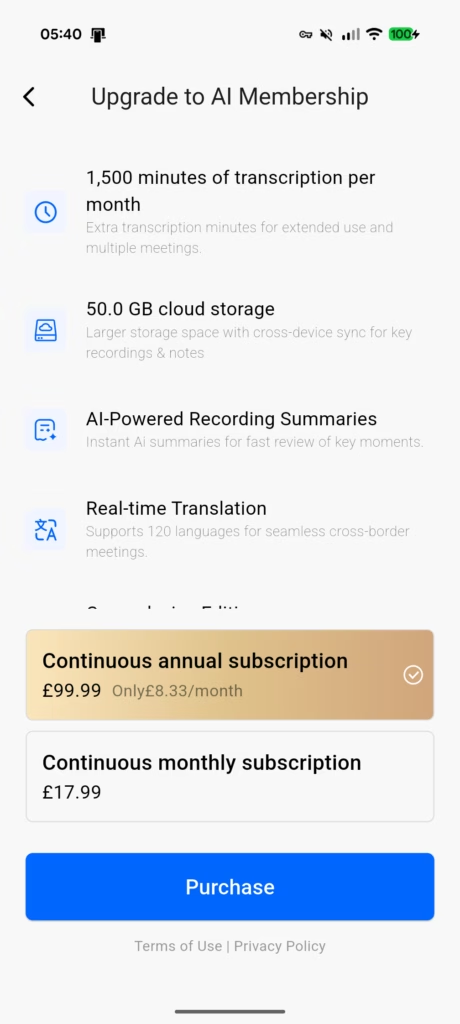
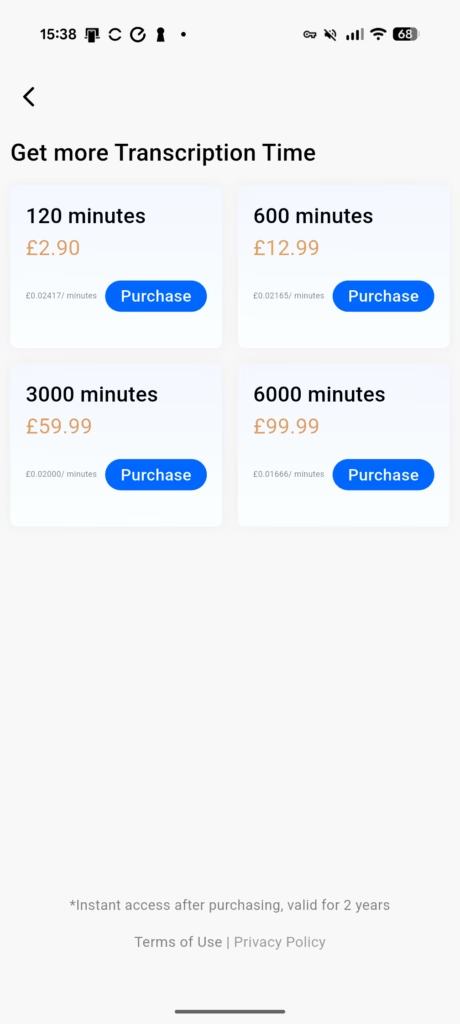
Just like Plaud, Boya uses AI models such as ChatGPT and Claude for its different features. You get 300 minutes per month free, but if you want more, then you need to pay for a subscription.
Boya charges £17.99 per month or £99.00 (£8.33 per month) per year for 1500 minutes, 50GB of online storage, AI-powered recording summaries and real-time translation.
Plaud charges £8.40 per month if billed annually, or £17.99 monthly for 1200 minutes or £18.80 per month billed annually, or £28.49 monthly for the unlimited plan.
Plaud now also benefits from a desktop app, which allows you to record online meetings without intrusive meeting bots.
The subscription comparison is interesting. Boya’s annual plan at £99 works out slightly cheaper than Plaud’s £101 annual basic plan, while offering 300 more minutes per month (1500 vs 1200). However, Plaud’s ecosystem is more mature, with better template options and the invaluable desktop app for recording online meetings. If you attend lots of virtual meetings, Plaud’s desktop app alone makes it worth the extra cost.
The free tier on both devices offers 300 minutes monthly, which I found adequate for my needs when I wasn’t attending excessive meetings. However, working in IT with multiple briefings, product launches, and team meetings, I regularly exceeded this limit. The annual subscription quickly becomes worthwhile if you are recording more than a couple of hours each week.
One area where Boya falls short is the template selection. On the free plan, you only get access to one template – “meeting”. Plaud offers six templates on the free tier, which gives you much more flexibility in how your recordings are summarised. You can upgrade to access Boya’s full library of 60 templates, but this limitation on the free tier is annoying.
Design
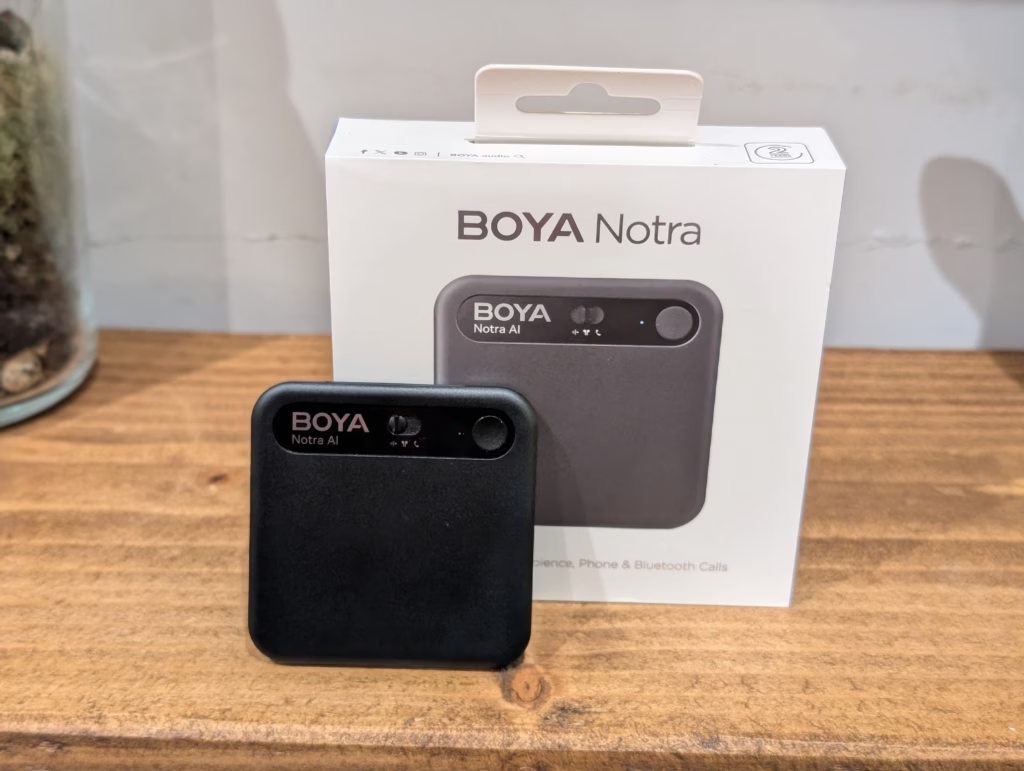
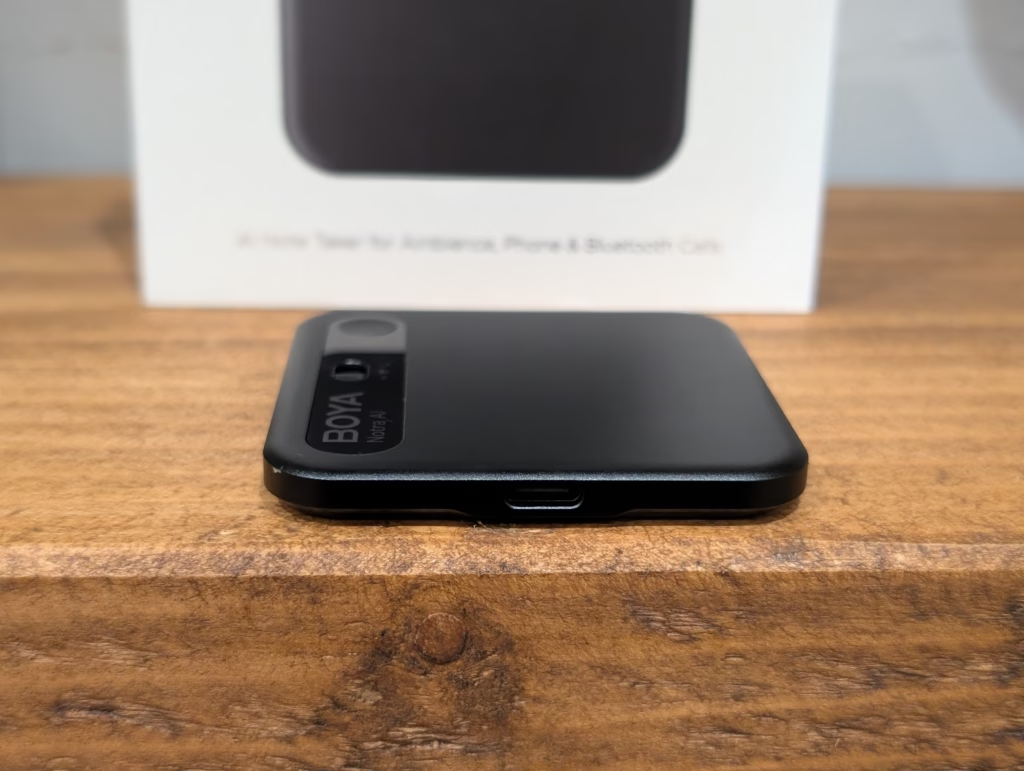
The Boya Notra adopts a square design with rounded corners, measuring 63 × 63 × 6.8mm. It is noticeably chunkier than the Plaud Note at 6.8mm thick compared to Plaud’s impressively slim 2.99mm profile. This extra thickness is immediately noticeable when you have the device attached to your phone. Where the Plaud Note Pro feels like a natural extension of your phone, the Boya Notra creates a more pronounced bump.
The device is available in four colours: black, silver, orange, and purple. The black model I tested has a refined microblasted aluminium alloy finish that looks professional, though it is not quite as sophisticated as the Plaud Note Pro’s rippled texture with its Corning Gorilla Glass AMOLED display.
A rubberised section on the bottom prevents the device from sliding around when placed on a desk. This is a thoughtful touch that the Plaud Note lacks, and I found it genuinely useful during meetings where I placed the recorder in the centre of the table. The rubber grip kept it firmly in place rather than gradually sliding across the surface as people moved papers or bumped the table.
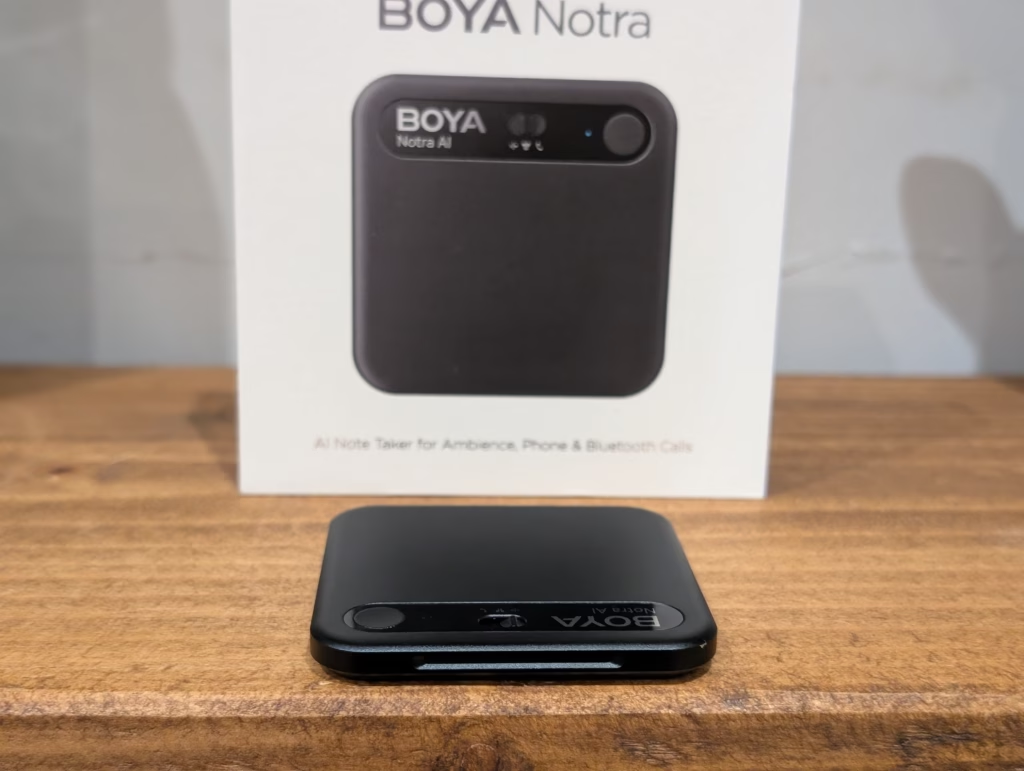
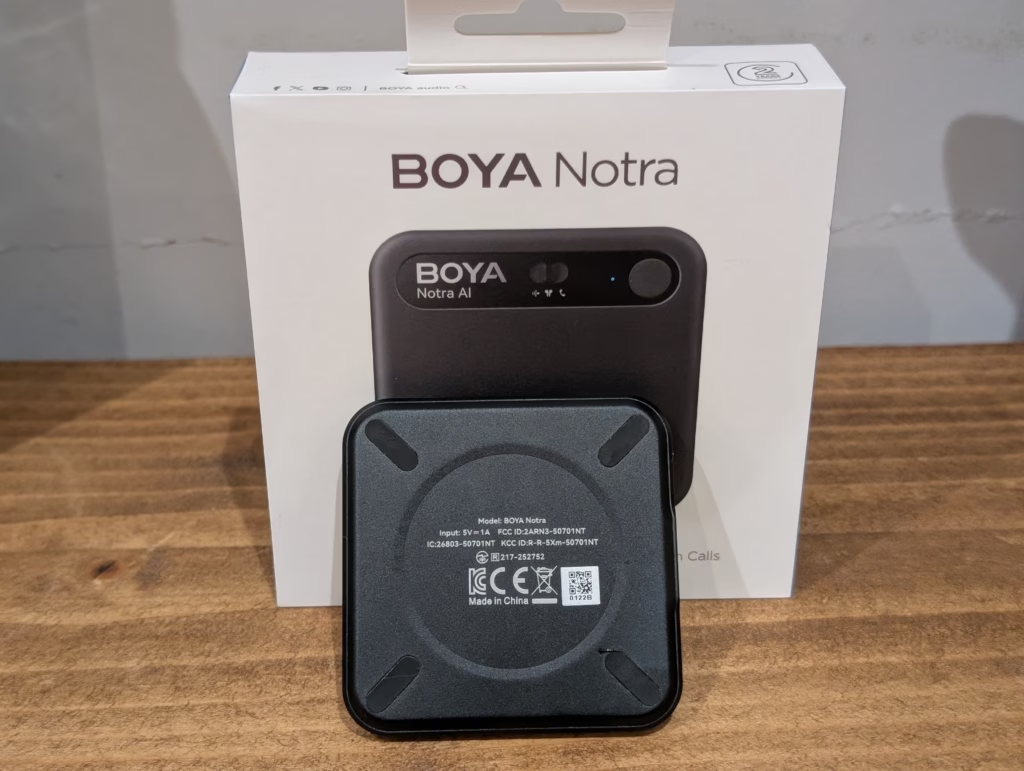
The magnetic attachment system works with MagSafe-compatible phones (iPhone 12 and later) or via the included magnetic ring for other devices. The magnets are strong – I shook my phone vigorously and the Notra stayed firmly attached. This is comparable to Plaud’s magnetic system, which also holds securely.
However, I much prefer the USB-C charging on the Boya Notra compared to Plaud’s proprietary magnetic charging cable. Being able to use any USB-C cable means you are never caught out if you forget the dedicated charger. When travelling, this is a significant advantage – I can charge the Notra using my phone charger, laptop charger, or even my portable battery pack. With the Plaud Note, forgetting the magnetic charging cable means you cannot charge the device at all.
The lack of a display on the Notra is a step backwards from the Plaud Note Pro. The Pro’s 0.95-inch AMOLED display is small but incredibly useful for confirming recording status, checking battery level, and seeing transfer modes. On the Notra, you rely on a red LED indicator to show recording status, which is functional but not as informative. Several times I found myself unsure if a recording had started properly, something the Plaud Pro’s display eliminates.
Boya App & Set Up
The Boya Notra companion app is straightforward to use. Initial setup involves downloading the app, creating an account, and pairing the device via Bluetooth. The process took about five minutes and was reasonably intuitive, though the app could benefit from clearer onboarding instructions for first-time users.
The app interface is clean but lacks the polish of Plaud’s more mature ecosystem. Navigation works well enough, but I found myself missing some of Plaud’s refinements, such as the ability to type notes during recording that get time-synced with the audio. This feature in the Plaud app is brilliant for marking important moments during long meetings.
One area where Boya excels is AI model selection. You can choose between ChatGPT, Claude, Gemini, and Grok for transcription and summarisation. Plaud uses OpenAI’s Whisper and GPT models exclusively. Having the option to switch between different AI models is useful, though in practice, I found the differences in transcription quality to be minimal for English conversations in good acoustic conditions.
The app offers web access as well, which is useful if you want to review recordings on a larger screen. However, there does not appear to be a way to redo transcriptions with a different model once processed. With Plaud, you have more control over reprocessing recordings. Though you could export the audio from Boya and re-import it to try a different model, which is a bit of a workaround.
Meeting / Ambience Recording

The Boya Notra’s ambient recording mode is designed for face-to-face conversations, meetings, lectures, and any situation where you need to capture audio from the surrounding environment. Set the physical switch on the side to the far left position, press and hold the button, and the red LED indicates recording is in progress.
The claimed 10-metre pickup range is ambitious. In my testing at a team meeting, I placed the Notra in the centre of the table and could clearly capture voices from about 5-6 metres away. Beyond that, audio quality degraded noticeably, though voices were still intelligible up to about 8 metres in a quiet room. In noisier environments, the effective range drops to perhaps 4-5 metres.
Compared to the Plaud Note’s 3-metre range, this is a genuine advantage. In larger meeting rooms or when recording lectures, the extended range means you can place the recorder further from speakers and still capture clear audio. However, it does not quite match the Plaud Note Pro’s performance with its four-MEMS microphone array and AI-Beamforming technology.
The two MEMS microphones combined with AI noise cancellation (up to -30dB) do a reasonable job of isolating voices from background noise. In a typical office environment with air conditioning hum and distant conversations, the Notra captured the primary conversation clearly. However, in more challenging acoustic environments – echoey rooms, multiple concurrent conversations, or outdoor settings with wind noise – the Plaud Note Pro’s more sophisticated microphone array produced noticeably better results.
The Notra can also pair with earphones, allowing you to monitor what is being recorded in real-time. The microphone on the earphones captures your voice and records it to the device. This is handy for ensuring audio quality is acceptable before committing to a long recording session.
Call Recording
Recording phone calls is one of the standout features of the Boya Notra. Attach the device magnetically to the back of your phone, set the physical switch to the right position (marked with a phone icon), and make or receive a call. The built-in bone-conduction sensor (VPU) captures the conversation clearly without any alerts or notifications for the other party.
Before discussing performance, it is worth noting the legal implications. In the UK, it is legal to record a call without informing the other party when the recording is for personal use. You cannot share the call recording with third parties without the other party’s consent. Germany requires two-party consent, though private citizens may be allowed to record in cases of self-defence. In the USA, many states including California, Delaware, and Florida are two-party consent jurisdictions. Always verify the law in your specific jurisdiction before recording calls.
Call recording quality was good. Both sides of the conversation came through clearly, with reasonable balance between the person holding the phone and the caller.
Compared to the Plaud Note, call recording performance was similar. Both devices produce clear, usable recordings of phone conversations. The Plaud Note Pro edges ahead slightly with its more sophisticated microphone array, but for most use cases, the Notra is perfectly adequate.
The magnetic attachment is secure enough that I never worried about the device falling off during calls. The 45g weight is light enough that it does not make the phone feel unbalanced or cumbersome during extended conversations.
Bluetooth Recording
This is where the Boya Notra distinguishes itself from Plaud. The middle position on the physical switch enables Bluetooth recording mode, allowing you to record audio from Bluetooth earbuds or headphones. This is genuinely useful for recording private conversations, virtual meetings through earbuds, or online classes without having your phone on speakerphone.
To use Bluetooth mode, switch to the middle position (marked with an earphone icon), connect the Notra to your chosen earbuds via the app, and press and hold the recording button. The app confirms that recording is in progress. The Notra captures audio from the earbuds’ microphone and processes it for transcription.
I tested this feature during several virtual meetings on my phone. Using my usual Bluetooth earbuds, I could participate in the call naturally while the Notra recorded everything. Audio quality was comparable to recording in ambient mode – clear enough for accurate transcription, though not studio quality.
This is a genuine differentiator from Plaud. While Plaud has the NotePin designed for wearable recording, the basic Plaud Note does not offer Bluetooth recording. If you frequently take calls via Bluetooth earbuds or participate in online meetings on your phone, this feature alone might justify choosing the Boya Notra over the Plaud Note.
The only limitation I found was battery life. Recording via Bluetooth seems to drain the Notra’s battery faster than ambient or phone call recording. During a two-hour virtual meeting, the battery dropped from 80% to about 45%, whereas ambient recording typically uses about 10-15% per hour.
File Transfer
The Boya Notra offers three methods for transferring recording files: Bluetooth, Wi-Fi, and USB-C. This flexibility is welcome, as different situations call for different transfer methods.
Bluetooth transfer is convenient for sending individual recordings to your phone. Select the recording in the app and it transfers in the background. Transfer speed is reasonable for short recordings (under 10 minutes), but longer recordings can take a while. A 30-minute recording took about 3-4 minutes to transfer via Bluetooth.
Wi-Fi transfer is significantly faster. Connect both the Notra and your phone to the same Wi-Fi network, and recordings transfer much more quickly. The same 30-minute recording transferred in under a minute via Wi-Fi. This is the method I used most often when back at my desk.
USB-C transfer involves connecting the Notra directly to a computer via cable. You can temporarily enable a file access mode that lets you read files directly from the device. This mode automatically disables when you power off the device, which is a sensible security measure if the device is lost or stolen.
Cloud storage is unlimited, which is generous. Recordings automatically sync to the cloud when connected to Wi-Fi, and the cloud service uses Amazon Web Services for enterprise-grade security. This is comparable to Plaud’s approach, though Plaud’s more mature ecosystem offers slightly better organisation and management of cloud recordings.
The variety of export formats is excellent: MP3, WAV, TXT, DOCX, PDF, Markdown, and JPEG. This means you are not locked into the app and can work with your recordings in whichever format suits your workflow. Plaud offers similar export options, so both devices score well here.
AI Transcription, Summarisation & Mind Maps
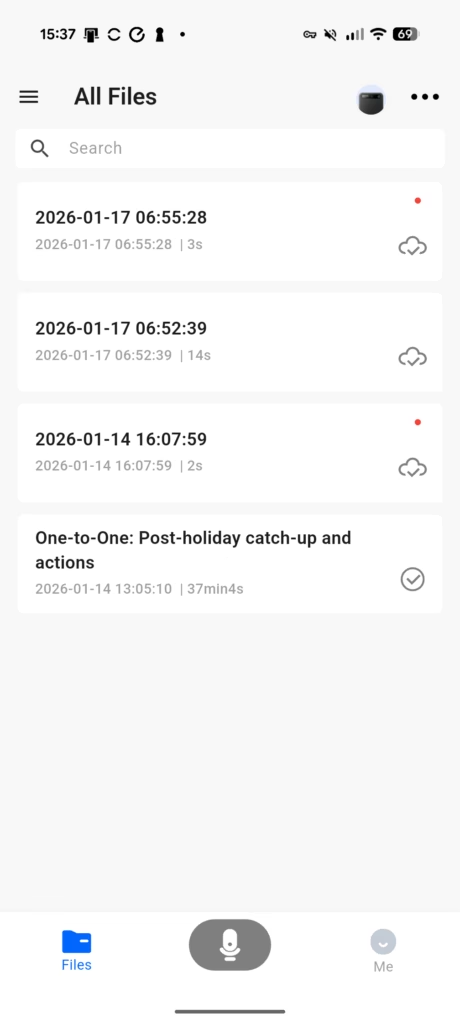
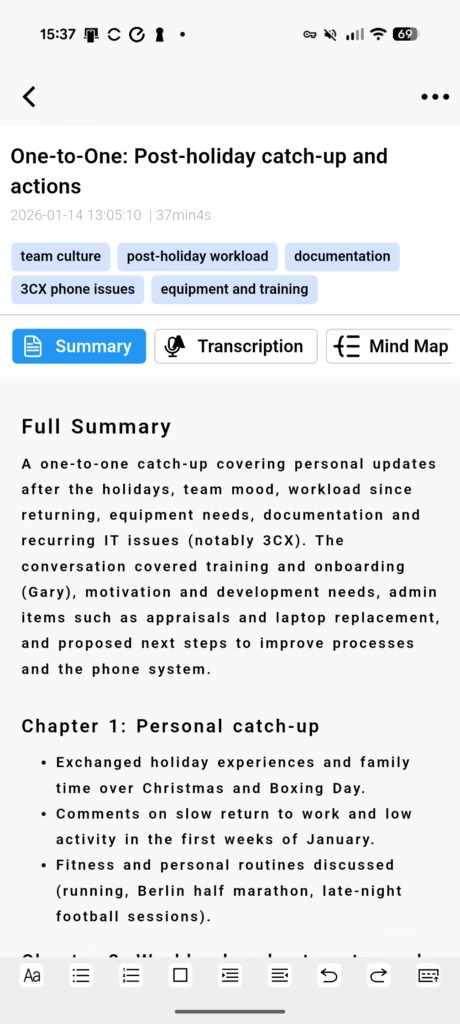
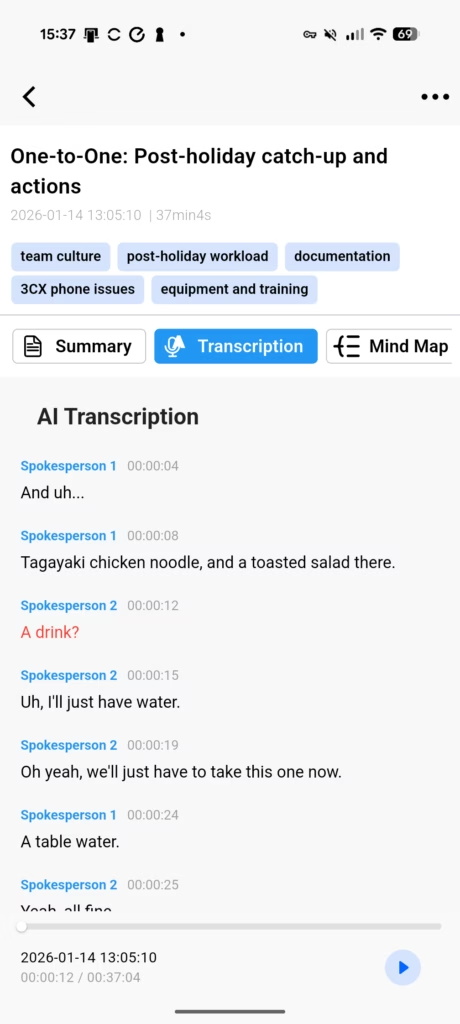
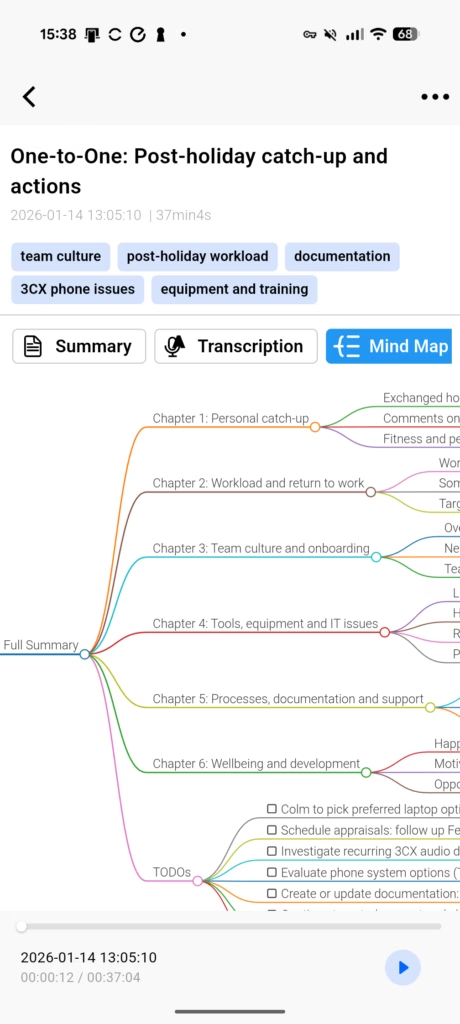
Where Boya falls short in comparison to Plaud is in the underlying AI features. It is still good, just not as good.
The initial issue was that on the free plan, you only get access to one template – “meeting”. Whereas you can use multiple templates per recording with Plaud. This limitation is frustrating because different situations call for different summary styles. A business meeting needs different structure to a lecture or interview.
You can select which model you want to transcribe with – ChatGPT, Claude, Gemini, or Grok. However, there does not appear to be a way to redo the transcription with a different model once processed. With Plaud, while you are limited to their Whisper/GPT ecosystem, the processing tends to be more reliable and consistent.
Transcription accuracy is good for English in good acoustic conditions. I found it comparable to Plaud’s accuracy, with both systems achieving roughly 95% accuracy in clean recordings. Technical terms and acronyms occasionally trip up both systems, though this is a limitation of AI transcription in general rather than a specific Boya weakness.
The transcription text is segmented at regular intervals, making it easy to read and navigate. You can tap on any section to play back that specific part of the recording, which is useful when reviewing content. This matches Plaud’s implementation.
Speaker labelling works reasonably well. The system can distinguish between different voices and assign them labels (Speaker 1, Speaker 2, etc.). You can manually rename these labels in the app afterwards. In meetings with 3-4 regular participants, I found the AI correctly identified who was speaking about 70-75% of the time. This is slightly worse than the Plaud Note Pro, which managed about 80% accuracy in my testing.
AI summaries are where template limitations become apparent. The “meeting” template produces a reasonable summary with key points and action items, but it is quite generic. Plaud’s range of templates – meeting notes, action items, key decisions, speaker-specific summaries – allows you to generate different summary types from the same recording. This flexibility is valuable when you need to extract different insights from the same conversation.
That said, once you upgrade to the Pro plan, Boya offers access to 60+ templates, which actually exceeds Plaud’s offering. The templates cover various use cases including seminars, interviews, lectures, and business meetings. The quality of these summaries is decent, though I found Plaud’s summaries to be slightly more coherent and better structured.
Mind maps are generated automatically to give you a visual overview of the content. These work reasonably well for straightforward conversations with clear topics. For complex discussions with multiple threads, the mind maps can look chaotic and are not particularly useful. This is a limitation I also found with Plaud’s mind maps – they are a nice feature but not something I relied on heavily.
The processing speed is impressive. The app managed to transcribe and summarise an eight-and-a-half-minute recording in around one to two minutes. This is comparable to Plaud’s processing speed.
One feature I particularly liked was the ability to generate titles automatically. The AI accurately reflected the content of my recordings, making it much easier to find specific recordings later. Plaud also does this, so both systems score well for organisation.
Battery Life
Battery life is excellent. The 500mAh battery delivers on its promise of up to 24 hours of continuous recording, or up to 50 hours if you enable some sort of endurance mode (though this was not clearly explained in the documentation I received).
In practical use, recording 2-3 hours daily, I charged the device about once every 5-6 days. This is comparable to the Plaud Note Pro, which I charged roughly weekly with similar usage patterns.
Standby time is particularly impressive at up to 365 days. I left the device unused for two weeks and it still had about 85% battery remaining. This means you can leave the Notra in your bag and know it will be ready whenever you need it.
The USB-C charging is a genuine advantage over Plaud’s proprietary magnetic cable. Full charge takes approximately 2 hours, which is reasonable. Being able to use any USB-C cable means you are never caught out without the right charger.
Charging at 2W is relatively slow by modern standards, but adequate given the small battery capacity. During testing, the device charged from empty to full in just under 2 hours, matching the claimed charging time.
Price and Alternative Options
The Boya Notra has an RRP of £114, and they offered an early bird discount, taking it down to just £90.
In comparison, the Plaud RRP is:
- Plaud NotePin S: £159
- Plaud NotePin: £149
- Plaud Note: £149
- Plaud Note Pro: £169
The price difference is significant. At £90, the Boya Notra costs £59 less than the standard Plaud Note and £79 less than the Plaud Note Pro. Even at the full RRP of £114, it is £35 cheaper than the Plaud Note.
For someone deciding between these devices, the Boya Notra at £90 offers excellent value. You are getting most of the functionality of the Plaud Note at nearly 40% lower cost. The Bluetooth recording mode and USB-C charging are genuine advantages, while the main compromises are slightly less refined AI features and the lack of a display.
If you are considering the Plaud Note Pro at £169, the decision becomes more nuanced. The Pro’s superior microphone array, AMOLED display, and more polished software ecosystem justify the extra cost if you use the device extensively. For heavy users who record multiple hours weekly, the Pro’s better audio quality and more sophisticated AI features are worth paying for.
For occasional users or those on a budget, the Boya Notra at £90 is hard to argue against. It delivers the core functionality – recording, transcription, summarisation – at a much more accessible price point.
Other alternatives in this market include various generic clones on Amazon for £70-85, but these typically lack proper app support and reliable AI transcription. The Boya Notra’s proper ecosystem and support from an established audio brand make it a safer choice than unknown Amazon brands.
Overall
The Boya Notra is a decent AI note taking device. At the reduced price of £90, I would say it is well worth considering over Plaud. It is not quite as refined, but it is close enough, and the price difference compensates for slightly inferior performance.
The Boya Notra does beat Plaud in certain areas. It has the Bluetooth recording feature, which is genuinely useful if you take calls or attend meetings via Bluetooth earbuds. I much prefer the USB-C charging over Plaud’s proprietary magnetic cable – the convenience of being able to use any standard cable cannot be overstated.
The 10-metre pickup range (realistically 5-6 metres in practice) is better than the original Plaud Note’s 3-metre range, making it more suitable for larger rooms or lecture halls. The rubberised bottom grip is a thoughtful detail that prevents the device sliding around on tables.
However, the Plaud ecosystem is more mature and refined. The AI transcription and summarisation are slightly more accurate and coherent. The template options on the free tier are better. The Plaud Note Pro’s four-MEMS microphone array and AI-Beamforming produce noticeably better audio quality in challenging acoustic environments.
The lack of a display on the Notra is a step backwards from the Plaud Note Pro. While the LED indicator is functional, having an AMOLED display to confirm recording status, check battery level, and see transfer modes is genuinely useful. Several times with the Notra, I was unsure if a recording had started properly.
If you are a heavy user who records multiple hours weekly and needs the best possible audio quality and AI features, the Plaud Note Pro at £169 is worth the investment. The superior microphone array, display, and more polished software justify the extra cost.
If you are a casual to moderate user, or if budget is a primary concern, the Boya Notra at £90 delivers excellent value. You are getting most of the functionality of much more expensive devices at nearly 40% lower cost. The Bluetooth recording mode is a genuine advantage over the basic Plaud Note.
The Plaud Note at £149 sits in an awkward middle ground. It is significantly more expensive than the Boya Notra but lacks the hardware improvements of the Note Pro. Unless you specifically value Plaud’s more mature ecosystem and established brand, the Boya Notra’s £59 lower price makes it the better choice for most buyers.
One area where both Plaud and Boya score well is privacy and security. Both use enterprise-grade encryption and comply with GDPR, SOC II, and HIPAA standards. You maintain control over what gets uploaded and when. The 64GB local storage on both devices means you can record extensively without immediately uploading to the cloud.
For anyone who attends regular meetings, conducts interviews, or needs to remember detailed information from conversations, an AI voice recorder like the Boya Notra or Plaud Note can be genuinely transformative. The time saved from not having to manually transcribe recordings, combined with the AI-generated summaries and action items, quickly justifies the investment.
However, if you only occasionally need to record conversations, your phone’s built-in recording and transcription features (which are increasingly capable on modern Android and iOS devices) will likely suffice without the additional expense.
The Boya Notra earns a recommendation for anyone seeking an AI voice recorder on a budget. It delivers the core functionality at an accessible price point, with a few genuine advantages over more expensive alternatives. It is not perfect – the AI features are not quite as refined as Plaud, and the lack of a display is a compromise – but at £90, it is an excellent value proposition that is hard to argue against.

I am James, a UK-based tech enthusiast and the Editor and Owner of Mighty Gadget, which I’ve proudly run since 2007. Passionate about all things technology, my expertise spans from computers and networking to mobile, wearables, and smart home devices.
As a fitness fanatic who loves running and cycling, I also have a keen interest in fitness-related technology, and I take every opportunity to cover this niche on my blog. My diverse interests allow me to bring a unique perspective to tech blogging, merging lifestyle, fitness, and the latest tech trends.
I’m proud to share that Vuelio has consistently ranked Mighty Gadget as one of the top technology blogs in the UK. With my dedication to technology and drive to share my insights, I aim to continue providing my readers with engaging and informative content.