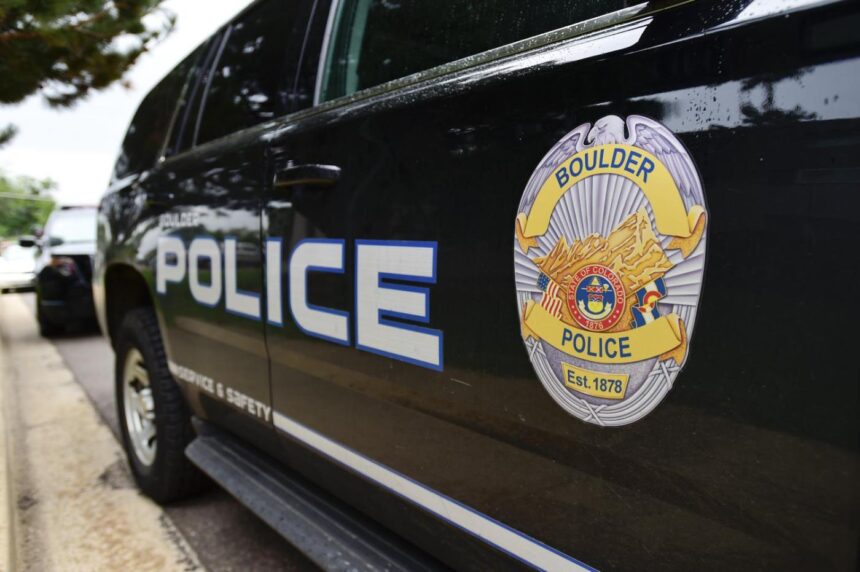
Boulder’s police radios will now not be accessible for curious minds and ears beginning Tuesday.
Up till now, anybody concerned with what the Boulder Police Division was doing might go to a police scanner web site, equivalent to Broadcastify, and eavesdrop on conversations between officers and dispatchers. That poses safety issues and is much less environment friendly for giant operations, in line with BPD spokesperson Dionne Waugh.
That’s why a brand new radio system the division is switching to Tuesday won’t be accessible for the general public to hear in with ease anymore.
The brand new radio system already is utilized by lots of the police division’s fellow companies in Boulder County, so communication with these companies will probably be quicker, in line with Waugh. The system is also encrypted.
“Essentially the most evident, on a regular basis profit, is definitely how rapidly we are able to now talk and share info with associate companies, from the Boulder County Sheriff’s Workplace to Boulder Valley College District safety,” Waugh mentioned in an announcement. “As we transfer towards internet hosting the worldwide Sundance Movie Competition and proceed helping with many particular occasions that commonly draw massive crowds from throughout the nation, we have now to herald lots of exterior companions and the prior radio system was not ample sufficient to deal with these massive operations.”
The affect on native information protection
The Day by day Digital camera may also now not have the ability to tune in to the division’s radio, which it commonly makes use of to hear for police actions as they occur. Day by day, Digital camera reporters hear police speak about an energetic crime scene, automotive crash or different police exercise on the radio. When it sounds severe, necessary or in any other case newsworthy, reporters take what they heard and ask the related authorities concerning the incident.
Many Boulder police tales within the Digital camera originate from preliminary info a reporter or editor heard on the radio scanner.
The division provided an encrypted radio to the Digital camera, requiring that editorial workers signal a 10-page contract that might have meant reporters and editors should comply with the division’s guidelines, or lose entry fully.
The contract stipulated that any signatory information group wouldn’t pay for a radio scanner. It additionally said that information organizations wouldn’t disclose what it heard “in any method, previous to the conclusion of regulation enforcement operational actions on the scene(s),” and mentioned the Digital camera couldn’t in any method share tactical info which may result in an officer’s hurt.
If the Digital camera signed the contract, it might even be held responsible for any damages that would have arisen from utilizing the radio.
Prairie Mountain Media Regional Editor and Day by day Digital camera Editor John Vahlenkamp mentioned the Digital camera has used radio entry safely and pretty. Digital camera protection utilizing the radio system has not put an officer at risk in his recollection, he added.
“I respect the Boulder Police Division’s supply of a radio, however our firm’s follow has been to not signal any contract with the intention to entry unencrypted police radio visitors, and this choice is in line with that follow,” Vahlenkamp mentioned. “I perceive the issues that the division has concerning officer security. We’ve that very same concern. For the a long time we’ve had entry to first responder scanner visitors, we’ve saved security on the prime of our minds.”
Although the dearth of entry to the police radio scanner will affect the Digital camera’s Boulder protection, it won’t stop the newspaper from persevering with to tell the neighborhood, Vahlenkamp mentioned.
“We’ll proceed to maintain an ear and a watch on public security issues within the communities we serve, and we’ll maintain our readers knowledgeable.”
Reporters, apart from utilizing the radio scanner, monitor social media, speak to related officers and use press releases to kickstart police protection. That can nonetheless occur. Nevertheless, the lack of entry to the police scanner cuts off one avenue reporters use to find out about what police are doing in Boulder.
Boulder police didn’t share any plans to alter their method to sharing info with the general public about crimes and police actions underneath the brand new encrypted system.
When requested if Boulder police would decide to proactively sharing the small print of particular varieties of ongoing crimes or police actions equivalent to shootings, police shootings or deadly crashes, Waugh didn’t decide to any such information-sharing.
“We are going to proceed to prioritize info that’s associated to retaining our neighborhood secure,” Waugh wrote. “The discharge of knowledge may also proceed to be evaluated in keeping with greatest practices in regulation enforcement public info sharing.”
Waugh did, in an earlier assertion, say the division would notify the neighborhood when they’re being requested to shelter in place, evacuate or take one other protecting motion — a normal that’s already in place.
Waugh additionally didn’t reply a query about whether or not or how Boulder police might enhance its practices for sharing info with the general public.
The Day by day Digital camera reviewed the previous three months of posts on the division’s social media account on X and located the division has been usually fast to put up about main automotive crashes or highway closures. Info in traffic incidents tends to be updated in the moment, because the scene unfolds. That can be true of information being released during the Fairview High School lockdown.
Nevertheless, different varieties of instances, equivalent to when a mountain lion killed a pair’s canine in Boulder in July, weren’t made available to the public until three days later. On Oct. 16, the division posted a couple of man carrying a machete round a neighborhood in Boulder. Information about that was posted two days later.
On one other event, a person drove a car on the bike path in North Boulder in September, and the division didn’t proactively notify the general public. The Digital camera discovered about that from a post by an anonymous user on Reddit.
Improved regional regulation enforcement
Boulder’s new encrypted system permits town to connect with the State of Colorado Digital Trunked Radio System, which permits simpler communication with close by companies, Waugh mentioned.
The town has been attempting to get this method on-line since a minimum of November 2024, when it contracted with Motorola to construct out radio infrastructure for the brand new system. In keeping with Waugh, Boulder has been behind a lot of Colorado in shifting over to encrypted radio.
In 2019, the Denver Police Division went encrypted and provided the same settlement to information shops: purchase a radio for $4,000 and signal a contract holding reporters to the division’s requirements. JS declined to signal the contract and doesn’t have entry to DPD’s radio anymore.
That very same 12 months, Longmont Public Safety went full-time with encrypted radios after a six-month trial interval. After initially asking the Longmont Instances-Name to signal a contract stipulating what the paper might use the radio for, the division gave the Instances-Name a radio scanner freed from cost and and not using a contract. That handshake settlement is ongoing, and Longmont police radio visitors performs near-constantly within the Instances-Name’s newsroom.
The specter of leaving radios public
Encryption, Waugh mentioned, will defend regulation enforcement from individuals who may use the scanner to study the place officers are.
“We all know anecdotally that people all through the years have listened to public radio channels to observe police response. Encryption protects each the neighborhood in addition to police, fireplace and paramedics, who’ve typically been targets themselves when responding to assist others,” Waugh mentioned.
Encryption additionally ensures a sufferer’s info stays personal, Waugh mentioned.
When requested for particular examples of safety breaches or victims’ info being unduly shared due to public entry to the scanner, Waugh wouldn’t share any such situations. She mentioned that the specter of such a breach grows each day, and ready for such an incidence could be irresponsible.
Waugh mentioned encrypting police radios permits regulation enforcement to talk with each other with out the worry that somebody may hear tactical info.
“The communication with and between officers, firefighters and paramedics is paramount to the security of all individuals in Boulder, and by encrypting that info, we’re capable of have that further second to reply with out somebody alerting a nasty actor about our response,” Waugh mentioned.
Methods to keep knowledgeable going ahead
Boulder police, town and Boulder County supply methods to remain knowledgeable about police actions within the space. Whether or not that’s BoCo Alert, Wi-fi Emergency Alerts, Everbridge alerts, or utilizing social media and studying conventional information, the general public will nonetheless be notified of the identical emergencies they at all times have, Waugh mentioned.
“The Boulder Police Division is likely one of the main companies within the state and the nation concerning its sharing of public info by way of each conventional and social media shops and this has not modified,” Waugh mentioned. “We are going to proceed to overview and assess all technique of communication with our neighborhood and adapt in accordance with metropolis worker bandwidth and greatest practices in public info.”
The Boulder Hearth-Rescue Division shouldn’t be becoming a member of the identical encrypted system, and its radios will nonetheless be accessible on-line, in line with spokesperson Jamie Barker. The Boulder County Sheriff’s Workplace radio scanner can be nonetheless accessible to the general public on-line on websites like OpenMHz.