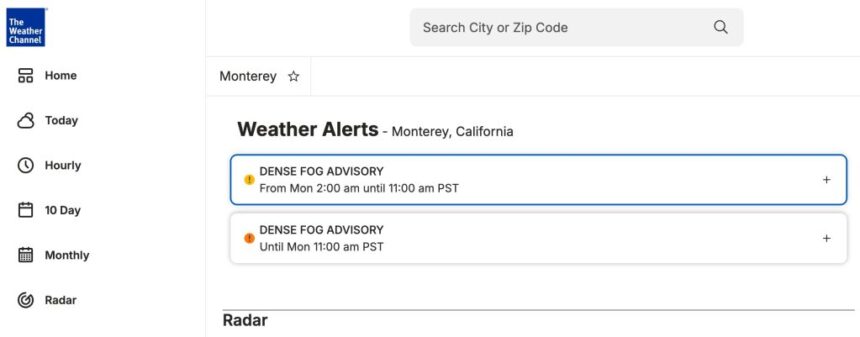
A Dense Fog Advisory in effect this morning from the Big Sur Coast to the San Francisco Bay shoreline is sharply reducing visibility and complicating travel along some of California’s most heavily used coastal corridors.
The National Weather Service (NWS) warns that drivers in the Salinas and Carmel Valleys, the Hollister area, Monterey Bay, and the San Francisco Bay shoreline should expect visibility of “one quarter mile or less in dense fog” through late morning.
The advisory, issued by the NWS San Francisco Bay Area office, runs until 11 a.m. PST and stresses that “low visibility could make driving conditions hazardous.”
Local coverage from Central Coast outlets has echoed that concern, highlighting widespread fog impacting the Monday commute and early tourist traffic.
The core risk is not just the fog itself but how quickly conditions change. Along Highway 1 and U.S. 101, drivers can move from relatively clear stretches into near-whiteout pockets within seconds.
This is particularly dangerous on two-lane segments near Big Sur, where sharp curves, cliffs, and a lack of lighting leave little room for error. National guidance from the NWS on fog safety underscores that motorists should slow down, allow extra time, and make their vehicles more visible by using low-beam headlights rather than high beams.

Transportation and safety agencies across California have repeatedly emphasized a similar message. Caltrans and the California Highway Patrol (CHP) advise motorists to reduce speed, use low-beam headlights, keep a safe following distance, and avoid sudden lane changes when driving in dense fog.
According to Caltrans-linked safety campaigns, speeding remains a leading factor in fog-related crashes, which tend to have a higher fatality rate than many other weather-related collisions. ABC30 Fresno+1

Meteorologically, today’s event is a textbook early-winter Central Coast pattern: cool, stable air trapped near the surface overnight after recent moisture, with light winds allowing fog to thicken in low-lying basins and along the marine layer. NWS zone forecasts for the Northern Salinas, Hollister, and Carmel Valleys, as well as for the Southern Monterey Bay and Big Sur Coast, all include the same advisory language and note that cloud cover is expected to break later in the day.
For commuters in the Bay Area, the advisory reaches into the San Francisco Bay shoreline, Santa Clara Valley, and interior North and East Bay valleys, meaning clogged visibility at multiple freeway choke points.
Transportation officials urge drivers to build in additional travel time, especially on approaches to major bridges and interchanges where sudden braking in fog can trigger multi-vehicle collisions.
Tourists and leisure travelers face a different but related set of challenges. Visitors heading to Monterey, Carmel, or Big Sur for sunrise views often discover that the coastline is completely obscured until late morning. Weather alert bulletins for Monterey explicitly instruct drivers: “If driving, slow down, use your headlights, and leave plenty of distance ahead of you.”
This advice is particularly important on scenic pullouts and narrow park access roads, where pedestrians, cyclists, and parked vehicles can appear abruptly from the fog.
Key takeaways for travelers today include:
- Expect very limited visibility along Highway 1, U.S. 101, and connecting valley roads during the morning hours.
- Delay nonessential trips until late morning where possible; NWS forecasts suggest gradual improvement toward midday.
- When driving, avoid high beams, which can reflect off fog droplets and further reduce visibility, and rely on low beams and fog lights instead.
As December progresses, additional dense-fog episodes are likely along the Central Coast and Bay Area, particularly following incoming storm systems later this week.
With holiday traffic ramping up, safety agencies stress that caution, lower speeds, and proper lighting are the most effective defenses against California’s fog-driven crash risks.